
Turin–Chivasso/Brusasco Tramway
The Turin–Chivasso tramway, with the Castagneto Po–Brusasco branch, was an interurban tram line that connected the cities of Turin, Chivasso and Brusasco from 1877 to 1949.
History
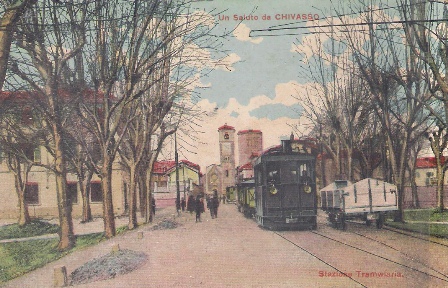
The Società Anonima dei Tramways di Torino, a Belgian‑capital company operating the tram network of the subalpine capital and the line to Moncalieri, opened the first section, between Barriera di Casale and Madonna del Pilone, in 1877 with horse traction. Horse operation was chosen in order to obtain the concession more quickly; shortly after opening to traffic, the company requested prefectural authorisation for steam operation.
On 28 November 1880, the section to Gassino was inaugurated – for which the company had obtained the concession for steam operation earlier that year – in the presence of the mayor of Turin, Luigi Ferraris; public service began on the following 1 December. The remaining section of the line, between Gassino, Chivasso and Brusasco, was inaugurated on 19 December 1883. The purpose of the line, like other lines around Turin, was to facilitate commuting towards the capital, on a route that proved profitable.
The line was electrified on 15 July 1908 on the Turin–Castagneto Po–Chivasso section; the Castagneto–Brusasco section, which had remained steam‑operated, was electrified on 19 April 1931.
In 1936, the Municipality of Turin, through the Società Anonima Tranvie Torino Ovest (SATTO), concluded negotiations with the Società Anonima dei Tramways di Torino and the municipalities concerned to take over the operation of the "Belgian" lines: from 1 January 1937, SATTO – which took the new name SATTI – took over management, implementing a plan to improve and renew the lines that produced good results: in the first eight months of the new management, passengers carried rose to 680,000 from the 605,000 recorded in the corresponding period of 1936.
During the Second World War, the tramway suffered only light damage to its rolling stock, and contributed to the evacuation of Turin's population.
On 1 June 1949, the tramway to Chivasso and Brusasco was closed, replaced by a bus line, due to poor maintenance of rolling stock and the line caused by the war and interference with growing car traffic.
Characteristics
The tramway was built to standard gauge (1,435 mm), and extended for 37.421 km, of which 1.519 km was the Castagneto Po–Chivasso section; the minimum curve radius was 59 metres (11 on the Chivasso section), the maximum gradient was 35%, rising to 50% on the Castagneto Po–Chivasso section. The maximum permitted speed was 30 km/h. The line, initially steam‑operated, was electrified at 600 V DC. The entire interurban route was single‑track with ten passing loops, to which four more were added with the electrification of the Turin–Chivasso line; during the Second World War, a turning triangle was built at Gassino to allow the use of one‑way city trams, but it was never used.
Route
The Turin terminus, shared with the tramway to Moncalieri, was located in Piazza Castello in front of the prefecture; from there it proceeded along Via Po, Piazza Vittorio and Corso Casale (where the depot was also located).
With the inauguration of the Superga funicular in 1884, direct carriages were introduced between the terminus and Superga, which at Sassi station were coupled to the Agudio locomotives of the funicular.
thumb|upright=0.7|Gassino, arrival of the tram
Leaving Turin, the tramway entered the State road 590 of the Valle Cerrina, passing through San Mauro Torinese (whose stop was on Via Torino), Castiglione Torinese, Gassino Torinese, San Raffaele Cimena and Castagneto Po. Crossing the bridge over the Po, it arrived at Chivasso, whose terminus was in Piazza Vittorio Emanuele II (later Piazza della Repubblica), near the Collegiate Church of Santa Maria Assunta. The Brusasco line instead continued along the state road, touching San Sebastiano da Po, Lauriano, Monteu da Po and Cavagnolo.
The terminus was moved in 1927 to Corso Regina Margherita, near the Royal Gardens. In 1940, the Turin terminus was further transferred to the new tram station in Via Fiochetto (at the corner with Via Gené), shared with the line to Settimo Torinese, officially opened on 21 April. The move to Via Fiochetto had become necessary because of the traffic obstruction caused by the old terminus. The changes to the terminus led to some modifications in the tramway's urban route.
Rolling stock
On the lines to Chivasso, Brusasco and Poirino, the Società Anonima dei Tramways di Torino used steam locomotives of the tramway type, enclosed and cabbed:
- 1: built by SLM in 1878, B wheel arrangement, 20 km/h;
- 2–14: built by Henschel & Sohn between 1878 and 1881, B wheel arrangement, 16 km/h;
- 15–19: built by Henschel & Sohn between 1883 and 1885, B wheel arrangement, 20 km/h.
With the electrification of the Turin–Gassino–Chivasso section in 1908, electric motor cars with bogies and first‑ and second‑class compartments entered service.
In 1936, the rolling stock fleet on the lines to Chivasso, Brusasco and Poirino consisted of 24 motor cars, one electric locomotive, 62 two‑axle trailers and 96 goods wagons.
See also
- Italian tram lines
- Trams in Turin
- Turin–Settimo Torinese Tramway
- Turin–Orbassano–Giaveno Tramway