
Turin–Venaria Reale Tramway
The Turin–Venaria Reale tramway was an interurban tramway line that connected the cities of Turin and Venaria Reale from 1888 to 1951.
History
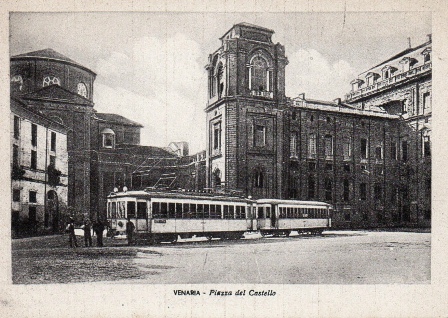
The line was built to better connect Venaria Reale – already served by a station on the Turin–Lanzo railway – to the capital, in order to facilitate commuter travel.
Inaugurated on 7 July 1888, the tramway, operated by the Società delle Tramvie Occidentali G.B. Chiambretto e C., founded by Gian Battista Chiambretto and the Marocco brothers, branched off from the pre-existing steam tramway Turin–Lucento–Cravetta–Pianezza with a branch from Cravetta to Druent, opened four years earlier.
Over the years, the line, initially very popular (so much so that the operator often found itself forced to run extra services), like the others operated by the "Tramvie Occidentali", suffered the consequences of a lack of modernisation, arousing complaints from the local population. Emblematic was the challenge, which made the news, won with a one-and-a-half-minute advantage in 1928 by the runner Giuseppe Robino against a tram convoy on the Turin–Druent route. In 1929, the lines were sold to the Società Trazione Elettrica Piemontese (STEP) of the Ghigo brothers, already the concessionaire of the Turin–Settimo tramway, which, with the contribution of the municipalities concerned, proceeded to modernise the infrastructure and replace the worn-out steam locomotives and tired carriages with modern electric railcars: the inauguration of the rebuilt lines took place on Sunday 7 September 1930. The electrified line allowed the Turin–Venaria journey to be completed in 23 minutes, compared to 35 minutes on the steam tram.
During the conflict, the Turin–Pianezza/Druento and Turin–Venaria Reale lines suffered only slight damage to rolling stock, but the tracks and vehicles wore out significantly, making the service unsuitable for the transport needs of the citizens.
On 23 November 1951, the STEP lines were temporarily replaced by buses from ATM Torino; the suppression was made definitive by the Ministry of Transport with a ministerial decree of 3 November 1954; the same decree authorised the absorption of STEP by SATTI.
Characteristics
The tramway was a single-track line with standard gauge of 1,445 mm and extended for 8.630 km, of which over 3 km of the line were shared with the Turin tram network.
The electrification was at 600 V DC in urban sections and 1,200 V DC beyond the church of Lucento.
The minimum curve radius was 60 metres, and the maximum gradient was 20 per thousand. The maximum permitted speed was 45 km/h.
Route
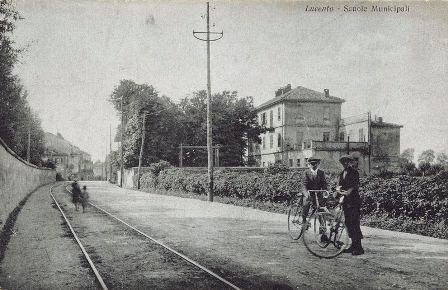
The tramway originally departed from Piazza Statuto; later the terminus was moved to Via Cibrario, then to Via San Donato, and in 1901 to Corso Regina Margherita at the corner with Piazza Emanuele Filiberto. The line was further straightened after electrification.
After travelling along Corso Regina and Via Pianezza, it reached Lucento (from which the line for Pianezza/Druento branched off), then crossed the centre of Lucento, passing through Altessano. Leaving the municipal road, the line reached Venaria Reale running for a stretch parallel to the Turin–Ceres railway and, upon reaching the bridge on Via Tripoli, turned onto Corso Garibaldi and entered the town centre of Venaria Reale, terminating in the square in front of the entrance to the Palace of Venaria.
Rolling stock
On the tramway, Henschel & Sohn steam locomotives and carriages by Cerimedo & C. were initially used.
With electrification, 6 electric railcars and 10 bogie trailer cars, built by Fiat Materfer, entered service on the lines to Pianezza, Druento and Venaria. The railcars, 15 metres long, were powered by 4 electric motors of 175 HP each and could reach a maximum speed of 50 km/h.
After the STEP lines closed, the trams remained stored until 1954, then later saw service on the Turin–Giaveno tramway.
See also
- List of tram and light rail transit systems
- Trams in Turin
- Turin–Pianezza/Druento tramway
- Turin–Settimo tramway
- Turin–Orbassano–Giaveno Tramway