
Turin–Moncalieri–Poirino Tramway
The Turin–Moncalieri–Poirino tramway, with a branch from Moncalieri to the Real Castello, was an interurban tram line that connected the cities of Turin, Moncalieri, and Poirino from 1875 to 1949.
History
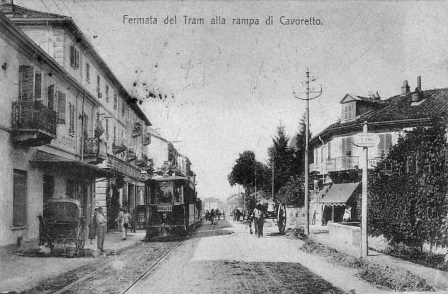
The Società Anonima delle Tranvie di Torino (a Belgian-capital company that operated the tram network of the Piedmontese capital), opened the first section, between Piazza Castello and the Piacenza barrier, on 6 November 1875, with horse-drawn traction.
The interurban section between Piazza Castello and the Navile gate of Moncalieri was inaugurated on 29 November of the same year. Two years later, the line was extended to the Borgo Aie locality. In 1878, the Province of Turin authorised the concessionaire company to carry out steam traction trials on the Turin–Moncalieri line; regular steam service began the following year. Meanwhile, on 1 May 1878, the short branch between Moncalieri and the castle was opened, with horse traction. On 8 August 1881, the line was completed with the Borgo Aie–Trofarello–Poirino section. The line also served as a supplementary service for passenger and freight traffic to the Turin–Genoa railway, which ran parallel to the tramway.
On Saturday, 17 September 1904, the electrification of the Turin–Moncalieri–Trofarello line and the Moncalieri–Real Castello branch was inaugurated; the Trofarello–Poirino section, which remained steam-operated, was itself electrified on 4 June 1933. 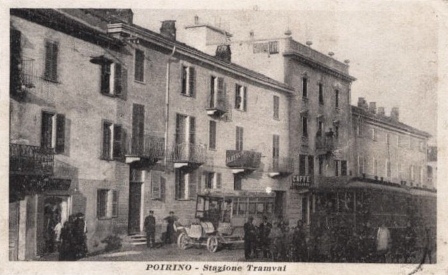
In 1936, the Municipality of Turin, through the Società Anonima Tranvie Torino Ovest (SATTO), concluded negotiations with the Società Anonima delle Tranvie di Torino and the municipalities concerned to take over the management of the "Belgian" lines. From 1 January 1937, SATTO – which took the new name SATTI – took over the management, implementing a plan to improve and renew the lines that yielded good results: in the first eight months of the new management, passengers carried rose to 1,100,500 from the 954,000 recorded in the corresponding period of 1936.
During the Second World War, the tramway suffered only minor damage to its rolling stock, while contributing to the evacuation of Turin's population.
On 1 June 1949, the tramway closed, replaced by a bus line, due to poor maintenance of the rolling stock and line caused by the war, as well as interference with growing automobile traffic.
Characteristics
The tram line was standard gauge () and extended for , of which 991 m was the branch to the Moncalieri castle, operated as a shuttle service. The minimum curve radius was 30 metres (34 metres on the short branch to the Real Castello), the maximum gradient was 25 per mille, rising to 50 per mille on the castle line. The maximum permitted speed was . The line, initially horse-drawn and then steam-operated, was electrified at 600 V DC. At Borgo Aie and Trofarello, turning triangles were installed to allow the use of one-way trams.
Route
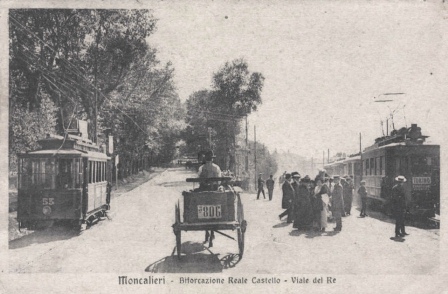
The Turin terminus, shared with the Turin–Chivasso/Brusasco tramway, was located in Piazza Castello in front of the prefecture; from there it proceeded along Via Po, Piazza Vittorio, and Corso Moncalieri.
Leaving Turin, the tramway followed State Road 29, touching the localities of Cavoretto, Fioccardo, Moncalieri (from which, in Piazza Principe Oddone, a short branch led to the Real Castello), Borgo Aie, Palera, Trofarello (where it crossed the Trofarello–Chieri railway via an overpass), Pecetto Torinese, Serena, Cambiano, Ponticelli, San Salva, and Marocchi before terminating at Poirino.
The terminus was later moved to Piazza Vittorio and, in 1927, to the Church of the Gran Madre. Services limited to Borgo Aie and Trofarello instead terminated in Piazza Carlo Felice, near Turin Porta Nuova railway station.
Rolling stock
On the lines to Chivasso, Brusasco, and Poirino, the Società Anonima dei Tramways di Torino used cabbed steam locomotives of the tramway type:
- 1: built by SLM in 1878, B wheel arrangement, ;
- 2–14: built by Henschel & Sohn between 1878 and 1881, B wheel arrangement, ;
- 15–19: built by Henschel & Sohn between 1883 and 1885, B wheel arrangement, .
With the electrification of the Turin–Moncalieri–Trofarello section in 1904, bogie electric motor cars with first and second class compartments entered service.
In 1936, the rolling stock fleet for the lines to Chivasso, Brusasco, and Poirino consisted of 24 electric motor cars, one electric locomotive, 62 two-axle trailers, and 96 freight wagons.
Under SATTI management, about twenty motor cars entered service on the line, including seven loaned from ATM, belonging to the 2500 series, which were used on services limited to Borgo Aie and Trofarello. These motor cars were modified with the installation of a bow collector and deep-headlights.
See also
- Trams in Turin
- Turin–Chivasso/Brusasco tramway
- Turin–Orbassano–Giaveno Tramway
- Pinerolo–Perosa Argentina Tramway
Bibliography
Newspaper sources