
Turin–Pianezza/Druento Tramway
The Turin–Pianezza tramway, with the Cravetta–Druento branch, was an interurban tramway line that connected the cities of Turin, Pianezza and Druento from 1884 to 1951.
History
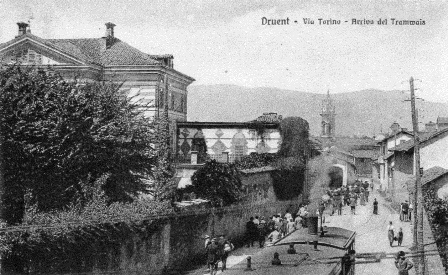
Since the 1870s, the inhabitants of Druento had requested the establishment of a cheap railway linking the town to Turin, but this had to be abandoned due to the high costs, and in 1878 they settled for a horse-drawn omnibus line.
On 18 May 1884, the Società delle Tramvie Occidentali G.B. Chiambretto e C., established by Gian Battista Chiambretto and the Marocco brothers, inaugurated the steam tramway Turin–Lucento–Cravetta–Pianezza with the Cravetta–Druento branch; the official opening, scheduled for the following 6 July, was postponed to the 13th due to the delayed delivery of the rolling stock. On 7 July 1888, the Turin–Venaria Reale Tramway was opened, branching off from the Turin–Pianezza/Druento line at Lucento.
Over the years, the "Tramvie Occidentali" lines, never renewed, aroused complaints from the local population, so much so that in 1928 it made the news when runner Giuseppe Robino won a race by a minute and a half against a tram convoy on the Turin–Druento route. In 1929, the lines were sold to the Società Trazione Elettrica Piemontese (STEP) of the Ghigo brothers, which already held the concession for the Turin–Settimo Torinese tramway. With the participation of the affected municipalities, STEP proceeded to modernise the infrastructure and replace the exhausted steam locomotives and worn-out carriages with modern electric motorcars; the inauguration of the rebuilt lines took place on Sunday 7 September 1930. The electrified line allowed the Turin–Pianezza journey to be completed in 30 minutes, and the Turin–Druento journey in 45.
During World War II, the Turin–Pianezza/Druento and Turin–Venaria Reale lines suffered only slight damage to rolling stock, but the tracks and vehicles wore out considerably, making the service unsuitable for the transport needs of the public.
On 23 November 1951, the STEP lines were temporarily replaced by buses operated by ATM of Turin. The closure was made permanent by the Ministry of Transport with ministerial decree of 3 November 1954; the same decree authorised the absorption of STEP by SATTI.
Characteristics
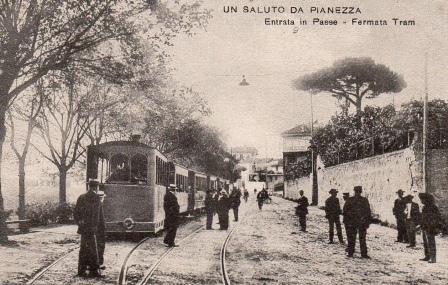
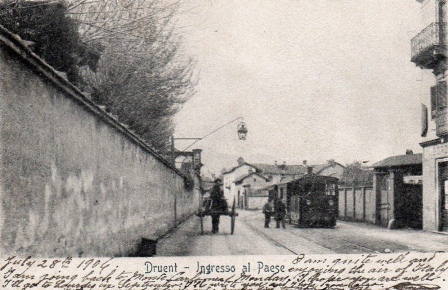
The tramway was single-track (with passing loops at the termini and at Collegno station) with standard gauge of 1,445 mm, electrified at 600 V DC in urban sections and 1,200 V DC beyond the church of Lucento.
The line was 11 km long between Turin and Pianezza, while between Turin and Druento it was also 11 km long. Over 3 km of the line were shared with the Turin tramway network.
The Pianezza line had a maximum gradient of 40 per thousand, which dropped to 27 per thousand on the Druento branch; the minimum curve radius was 50 m, increasing to 75 on the Druento branch. The maximum permitted speed was 45 km/h.
Route
The tramway originally departed from Piazza Statuto; later the terminus was moved to Via Cibrario, then to Via San Donato, and in 1901 to Corso Regina Margherita at the corner with Piazza Emanuele Filiberto. The line was further straightened following electrification.
Leaving Turin, it reached Lucento (from which the line to Venaria branched off), then arrived at the junction of Cascina Cravetta, where the line forked: on one side, following the provincial road and touching Collegno, it reached Piazza Belvedere (later Primo Maggio) in Pianezza, while on the other, passing through the locality of Savonera, it reached the Druento terminus, located in Via Torino.
Rolling stock
The tramway initially used Henschel steam locomotives and Cerimedo & C. carriages.
With electrification, 6 electric motorcars and 10 bogie trailers entered service on the lines for Pianezza, Druento and Venaria, built by Fiat Materfer. The motorcars, 15 metres long, were powered by 4 electric motors of 175 HP each and could reach a maximum speed of 50 km/h.
After the STEP lines closed, the trams remained stored until 1954, later to serve on the Turin–Orbassano–Giaveno tramway.
See also
- Trams in Turin
- Turin–Settimo Torinese tramway
- Turin–Orbassano–Giaveno tramway
- Turin–Chivasso/Brusasco Tramway
- Turin–Venaria Reale Tramway