
Lodi–Crema–Soncino tramway
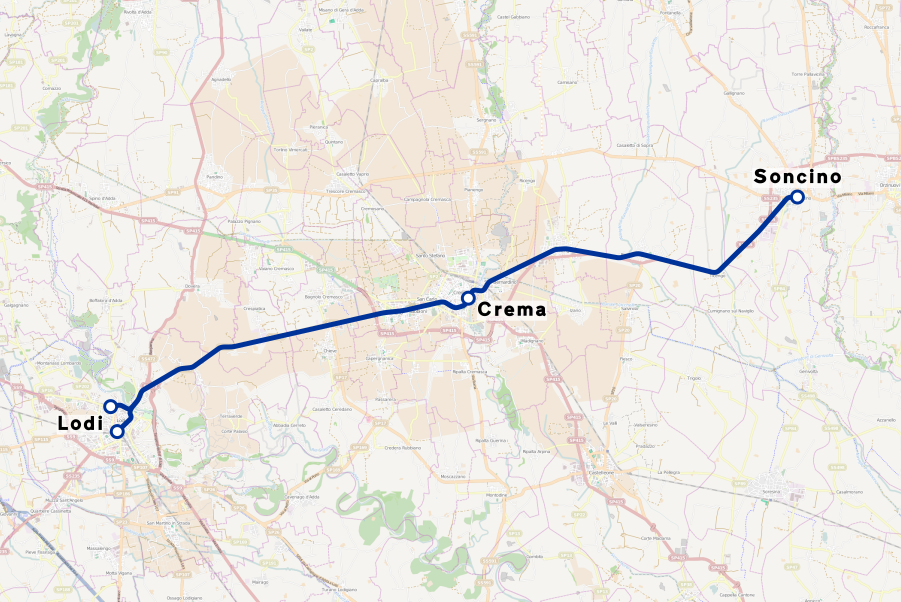
The Lodi–Crema–Soncino tramway was an interurban tram line that, between 1880 and 1931, connected the city of Lodi to Crema and Soncino.
This infrastructure represented an important link between the Brescian interurban network and the Milanese one.
History
 In the 1860s, the idea was floated of building a railway line connecting Pavia to Brescia via the shortest route through Lodi and Crema, rather than the route via Codogno and Cremona that was actually built later. In 1876, engineer Emilio Mantegazza submitted to the Ministry of Public Works a project for a Pavia–Lodi–Crema–Soncino–Brescia railway, but the estimated cost and the proximity of two already existing lines, the Pavia–Cremona and the Brescia–Cremona, caused this possibility to fade.
The demand for mobility along that axis was nevertheless strong, and the presence of an already existing infrastructure such as the interprovincial road, which decades later would become the SS 235, facilitated the preparation of alternative projects to the railway that contemplated the laying of an interurban tram line. On 30 June 1877, engineer Angelo Avesani presented the project for a steam tramway, which received formal support from the four provinces responsible for maintaining the road sections under their jurisdiction (Milan, Cremona, Brescia and Pavia). Avesani promoted the project with the province of Milan on behalf of The Tramways & General Works Company Limited (TGW) of London, while Cavalier Ferdinando Pistorius took care of requesting the concession, also in favour of the London company, from the province of Cremona and from that of Brescia. The province of Milan granted the construction of the line on its territory on 9 September 1878, while the Deputation of Pavia imposed burdensome conditions on the concessionaire due to the necessary arrangement of the road section on its territory, for which reason the application was withdrawn. The Brescian Deputation, on the other hand, refused the conditions offered by the London company, subsequently accepting the proposal of a Belgian company, the Tramways à Vapeur de la Province de Brescia (TPB), which built and operated the Brescia–Soncino.
As a consequence of these events, TGW had to abandon the operation of a Pavia–Brescia line and limited itself to starting work on a Lodi–Crema–Soncino line, which was opened on 22 July 1880, and for a Lodi–Sant'Angelo, opened the following year. The was later completed by the Société des Tramways et des Chemins de fer Economiques de la Haute Italie, but it was not connected to the line coming from Lodi.
TGW operated the line until 1885, when it transferred the concession to an associate company, The Lombardy Road Railways, which managed the tramway until 1895 or, in any case, until the end of the 19th century when it handed over to the Tramways a Vapore Interprovinciali di Milano, Bergamo e Cremona (TIP).
The expiry of the concession was set for 30 June 1929. On that date, TIP obtained provisional operation pending concrete modernisation projects, such as the replacement of the track and electrification. However, the tram company was not willing to support these investments and showed itself inclined to abandon the line. The province of Cremona and some municipalities in the Brescia area served by the Brescia–Soncino asked other companies to intervene. Both the Tramvie Elettriche Bresciane (TEB) and the Società Trazione Elettrica Lombarda (STEL), active respectively in the province of Brescia and the province of Milan, proposed a modernisation plan, requesting in exchange high state and provincial contributions. Edison, which controlled both companies, vetoed further investments in the tram sector.
In the absence of alternatives, TIP decided to suppress the tram service on 24 April 1931. The Esposti brothers of Lodi obtained the concession for a bus service on the same route, which began the following day.
Characteristics
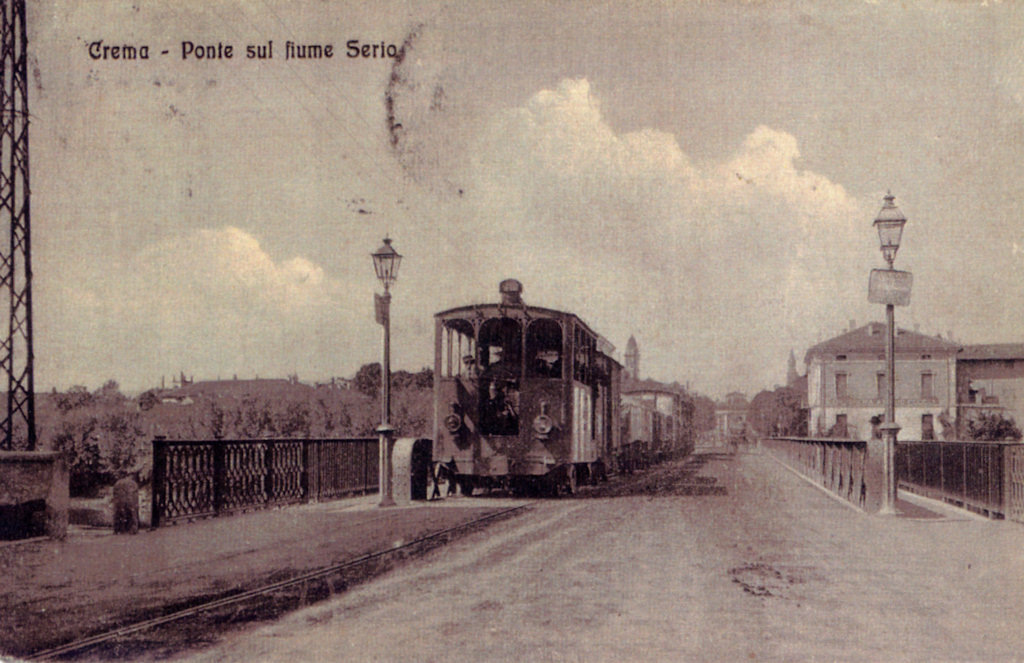
The track was identical to that of other TIP lines. For the extra-urban sections, the rails were of the Vignoles type, weighing 19.6 kg/m and 7.20 m long. The oak sleepers were spaced 0.950 m apart and had dimensions of 150×110×2100 mm. The rail joints were of the suspended type. In the urban sections, two additional guard rails, also of the Vignoles type, were placed alongside the two main Vignoles rails. Traction remained steam for the entire operational life of the infrastructure. Traffic was regulated by a telegraph block system.
Route
Shortly before crossing the Adda, the line joined the track of the Lodi–Treviglio–Bergamo tramway, which, due to different initial management, had a different terminus station at Porta Milano. The common section between the two tramways was about long, after which the line for Bergamo separated at the height of the Bergamina road.
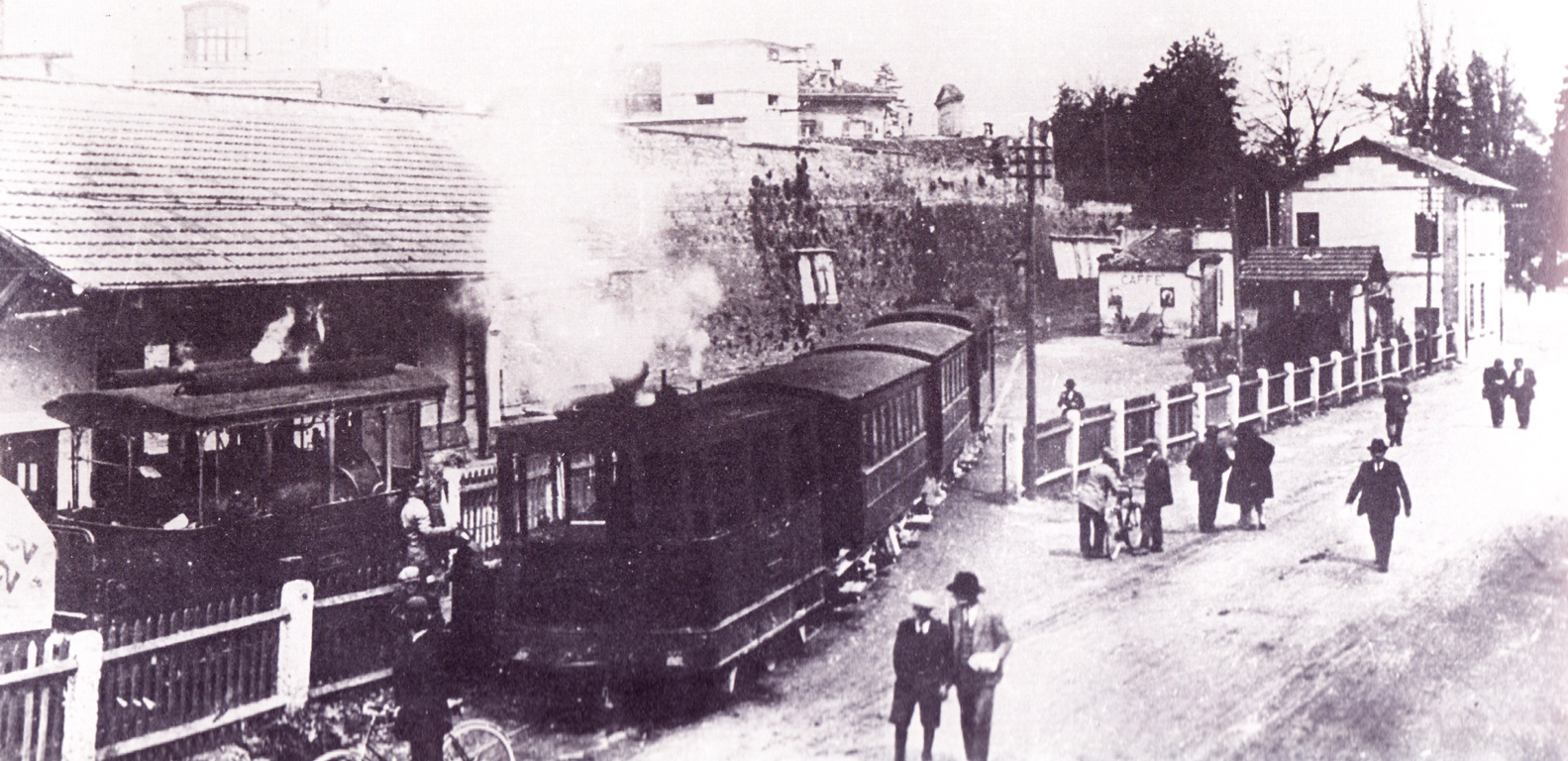
In Crema, the tramway arrived near Porta Ombriano, where a stop was located, then skirted the city walls along the current Via Carlo Urbino, entering the ring road (later Via IV Novembre) which it followed up to the station located at the corner with Piazzale Rimembranze. In 1904, the route was modified due to the small size of the Crema tram station: from Via Urbino it went along the current Via Diaz, where the Crema Porta Serio station was located. The facility had a two-storey passenger building, a goods warehouse, several shunting tracks and a water crane.
The station of this Cremonese town was located near Borgo Sera and was shared, from the early years, with the tram line coming from Bergamo. It was also connected to the station of the line coming from Brescia. Until 1897, some runs of the Lodi–Soncino continued beyond Soncino station, branching onto the tracks of the line for Brescia as far as the Orzinuovi yard. In that year, an agreement was reached among the companies operating the three tramways to unify the Soncino station, eliminating that of the Brescian line. The concessionaire of the latter was entrusted with the exclusive passenger and freight service on the Orzinuovi–Soncino route.
With the transfer of management to TIP, the tram company decided to operate a service on the Milan–Soncino axis, using the Milan–Lodi tramway for this purpose and guaranteeing three pairs of daily runs.
See also
- History of rail transport in Italy
- List of railway stations in Lombardy
- Monza–Trezzo–Bergamo tramway
- Bergamo–Trescore–Sarnico Tramway
- Lodi–Treviglio–Bergamo Tramway
- Ivrea-Santhià Tramway
- Milan-Lodi Tramway