
Ivrea–Santhià Tramway
The Ivrea–Santhià tramway was an interurban tram line that connected the towns of Ivrea and Santhià between 1882 and 1933.
History
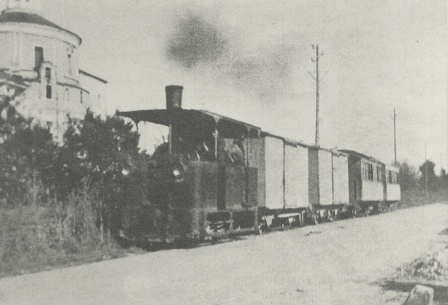
The tramway project dates back to 1880, designed by the engineer Fowley of Brussels; the Belgian Société Générale des Chemins de Fer Économiques, which had also taken over the concession for the Biella–Cossato Tramway and would later obtain the management of the Turin–Settimo Torinese tramway, inaugurated the line on 30 July 1882, after nine months of work. The line had been built to serve an area experiencing strong industrial and commercial development.
The new system satisfied various transport needs, not least the then modest but growing tourist demand thanks to the presence of Lake Viverone. The service was set up with three daily runs, later increased to four.
In 1919, due to the difficult economic period following the First World War, kilometre tariffs were significantly increased, causing negative repercussions for the localities served.
Over time, the line no longer appeared able to meet the needs of the local population; in 1923 it was acquired by the newly established Ferrovie Elettriche Biellesi, which considered converting it to gauge. This project, which would also have involved a complete renewal of the system, was however not implemented.
The line closed on 15 July 1933, replaced by buses of the Felice Fossati company of Biella, which reduced the journey time from two hours to 45 minutes.
Characteristics
The tramway was built to narrow gauge, and extended for ; the minimum curve radius was , and the maximum gradient was 29 per thousand (reached on the section between Anzasco and Viverone). The maximum permitted speed was .
Route
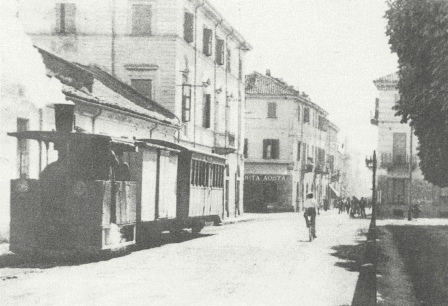
Convoys departed from the depot-workshop on Viale Monte Stella in Ivrea, equipped with a turntable and loading platform.
After passing the then unpaved ring road, the convoys made a first scheduled stop, about half an hour later, in front of the establishment called "Caffè ristorante del Tramway".
Crossing Piazza Balla, Corso Massimo D'Azeglio and Corso Vercelli, the line then entered state highway 228, serving the localities of Burolo, Bollengo, Palazzo Canavese (whose station still exists, converted into a bar), Piverone and Anzasco, where the track shifted to the left side of the carriageway; it then served Viverone, Roppolo and Cavaglià (where the workshop was located), making a total of twenty-two stops and ending the run at Santhià on Via Puccini after crossing the Naviglio di Ivrea. The terminus was located in the immediate vicinity of Santhià railway station.
Rolling stock
In addition to the four units of the original fleet, the Société Générale des Chemins de Fer Économiques employed a total of six steam tram locomotives with two axles on the line, built by Maschinenfabrik Esslingen between 1881 and 1883 and capable of reaching a maximum speed of . After 1918, two units from the Biella–Cossato Tramway, closed in 1915, were added to the fleet; these had less brilliant performance than the original ones and belonged to a group of five locomotives purchased by the Belgian company for operation on both lines.
The rolling stock was supplemented in 1927 by thirteen two-axle trailers and thirty-four goods wagons.
Motive power summary table
Unit |
Year of construction |
Builder |
Builder's number |
Wheel arrangement |
Notes |
|---|---|---|---|---|---|
1 - Piverone |
1882 |
Esslingen |
1884 |
B |
|
2 - Anzasco |
1882 |
Esslingen |
1885 |
B |
|
3 - Cavaglia |
1882 |
Esslingen |
1886 |
B |
|
4 - Ivrea |
1882 |
Esslingen |
1887 |
B |
|
1882 |
Esslingen |
1895 |
B |
Former 3 - Sesia, acquired in 1918 from the Biella–Cossato line |
|
1883 |
Esslingen |
1955 |
B |
Former 4, acquired in 1918 from the Biella–Cossato line |
See also
- History of rail transport in Italy
- Turin–Settimo Torinese Tramway
- Ivrea railway station
- Santhià–Arona railway
- Biella–Cossato Tramway