
Bergamo–Soncino Tramway
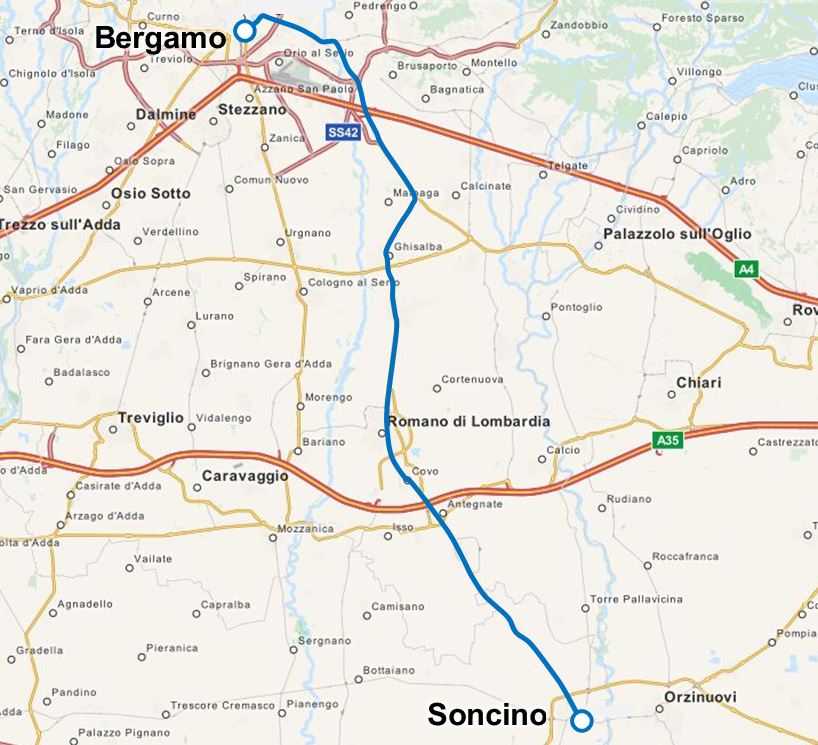
The Bergamo–Soncino tramway was an interurban tram line that connected Bergamo to Soncino between the 1880s and 1931.
History
The first project to connect Bergamo to Romano di Lombardia and Soncino with a mechanically powered tramway was presented in 1879 to the provincial administrations of Cremona and Bergamo by Cavalier Cambiaggio, who acted on behalf of Signor Bernando Nunzio. Two years later, Cambiaggio ceded the concession to Messrs. Schanzer and Auban.
On 30 May 1882, the convention was approved. The first section to be completed was between Bergamo and Ghisalba, which was inaugurated on 20 October 1884 and opened to service on 19 or 20 November of the same year.
On 28 November, the provincial council of Cremona approved the transfer of the concession to the Belgian Société Générale des Chemins de Fer Économiques (SE), which had previously obtained from the concession for the railway to Ponte Selva, then to as far as Albino. The transfer was subsequently confirmed by the province of Bergamo in 1886 and by the Cremona provincial deputation on 4 September 1887. In the same period, the prefecture of Bergamo issued several authorisation decrees for operation.
The section between Ghisalba and Soncino was opened on 15 January 1888, and from that year the fifty-year duration of the tramway concession began. Having the same concessionaire in common, the tramway's trailing stock was often used on the Valle Seriana Railway, so the locomotives of the latter were fitted with a third buffer and tram couplings.
Linked to the events of the line to Ponte Selva and Clusone, the change of concessionaire on 14 January 1918 was due to a single act that concerned the Belgian company's withdrawal from railway operation. The management of the Bergamo–Soncino was therefore taken over by the Società Anonima Ferrovia Valle Seriana (FVS).
After the First World War, FVS expressed its intention to abandon the tramway's operation. In 1921, following opposition to the closure from local administrations and public opinion, the railway company decided to donate the infrastructure and rolling stock to the two provinces. To ensure continued operation, the two administrations entered into a provisional agreement with the two companies that respectively managed the Bergamo–Trescore–Sarnico tramway (BTS) and the Trescore–Lovere Tramway (TVC) in the Cavallina valley. The new agreement lasted from 1 August to 31 December 1921 and saw the transfer of rolling stock from Bergamo FVS station to the one shared by the two tram lines.
Subsequently, until 1931, the service was operated by the Società Tranvie Bergamasche, a name found in public records and official correspondence. The tram service was maintained due to new subsidies provided to the operator by both provinces.
In 1929, a project was put forward by the Tramvie Provinciali Cremonesi and the province of Bergamo to build a railway line that would replace the tramway. However, the Great Depression affected freight transport, and the closure of the Lodi–Crema–Soncino tramway in April 1931 accelerated the tramway's suppression. Service ceased on 31 July, replaced by a bus line operated by the Margiotta company until 31 December 1982, when the Società Autoferrovie Bergamo (SAB) took over. The tracks were removed from September 1931 onwards.
Characteristics
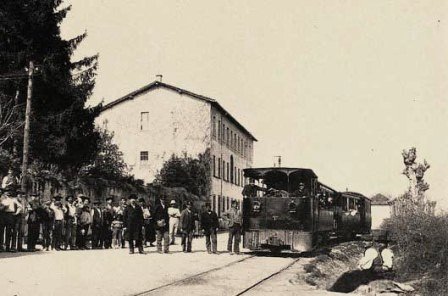 The line was a steam-powered interurban tramway. Approximately long, it was built as a single track, adopting ordinary gauge of 1,445 mm.
Trains were limited to a maximum speed of .
Route
In Bergamo, the line started from the square of the Valle Seriana railway station, near the first track of which the interurban tramway to Lodi began, since according to the 1882 convention, the tramway to Soncino had to be connected to both lines. Leaving the Bergamo station, the tramway ran along an embankment, located to the right of the cutting used by the railway lines to Ponte Selva and Piazza Brembana, in order to reach the level of Via Borgo Palazzo, where the stop of the same name was located. At Via Borgo Palazzo there was the branch leading to the workshops of the same name, also used by FVS, and, at least from 1921, the connection with the tramway lines to Sarnico and the Cavallina valley.
The line followed the road to Seriate, where the station was located near the church. It then joined the road to Palazzolo sull'Oglio, leaving it at Bettole di Cavernago in favour of the road to Romano di Lombardia and Soncino.
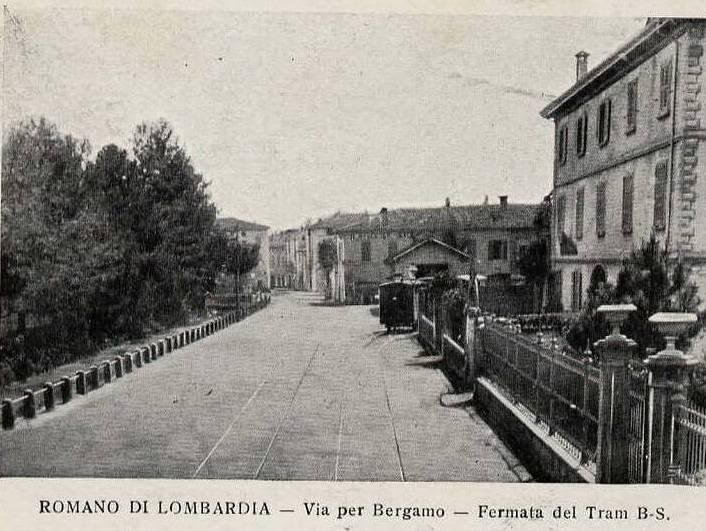
It then successively crossed the Bergamo municipalities of Ghisalba, Martinengo, Romano di Lombardia, Covo, Antegnate and Fontanella, before entering the Province of Cremona at Marzuole.
After crossing the centre of Gallignano di Soncino, the line was crossed at grade by the Brescia–Soncino tramway at the level of the ring road of the Cremonese municipality. After passing through the historic centre and Via Borgo Sera, the tramway reached the terminal tram station, where the lines to Lodi and to Brescia also terminated.
Rolling stock
Initially, four steam locomotives of tramway type, built by Maschinenfabrik Esslingen, registered in the series 1÷4, served on the tramway. In 1915, they were joined by a fifth, built by Breda, to a maximum speed of , like the previous ones. These units, which some sources erroneously indicate as "of Belgian construction", were nicknamed Italia, Seriate, Ghisalba, Romano and Soncino.
Upon the closure of the Lodi–Treviglio–Bergamo Tramway, TBS acquired from the Tramways a Vapore Interprovinciali di Milano, Bergamo e Cremona (TIP) two further two-axle units, named Martinengo and Bergamo, which differed from the previous black ones by their dark brown livery. Units similar to the 1÷4 of the Bergamo–Romano–Soncino were the TIP locomotives 45–46 used on the Milan–Cremona route and the units 5–6 of the Turin–Settimo Torinese Tramway. The carriages that served on the Bergamo–Soncino were coloured amethyst blue.
See also
- History of rail transport in Italy
- List of railway stations in Lombardy
- Monza–Trezzo–Bergamo tramway
- Bergamo–Trescore–Sarnico Tramway
- Lodi–Treviglio–Bergamo Tramway
- Turin–Settimo Torinese Tramway
- Trescore–Lovere Tramway