
Biella–Cossato Tramway
The Biella–Cossato tramway, the first tram line in the Biellese area, was opened in 1882 by a Belgian company to connect Biella with the then-active industrial town of Cossato.
Marginalized by competition from the parallel Biella–Cossato–Vallemosso Railway, this steam service was suppressed at the outbreak of World War I, as a consequence of requisitions by the Italian military authorities.
History
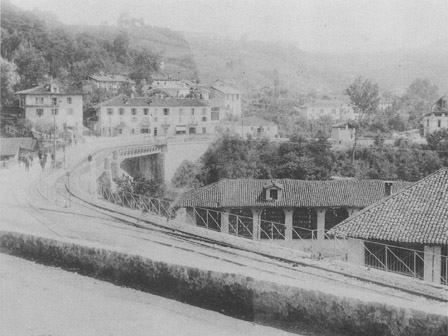
To meet the freight transport needs of the numerous textile companies in the area and to facilitate the movement of workers heading to the Vallestrona, the Société Générale des Chemins de Fer Economiques of Brussels applied for a concession for a narrow-gauge tramway from Biella to Cossato.
This concession was granted on 11 May 1880, and was shared with the Ivrea–Santhià tramway, so work on the two infrastructures began simultaneously in 1881. The official opening of the line to Cossato took place on 2 May 1882.
The service operated with trains consisting of a locomotive hauling a two-axle carriage, with a second carriage added in the mornings on market days.
In June 1915, at the outbreak of World War I, the military authorities requisitioned all the rolling stock, effectively decreeing the closure of the line; the rails were definitively removed in the 1920s.
Characteristics
Among the few Italian tramways, together with the aforementioned Ivrea–Santhià and the Bari-Barletta Tramway, to adopt a gauge of 750 mm, the line ran entirely on public roads for a total length of 11 km. The curves had a minimum radius of 45 m, while the maximum gradient reached 30.2 per mille.
Route
The Biella terminus of the tramway was located on the then Viale Regina Margherita, later Viale Matteotti; the track then continued along Via Cernaia until it intersected the Biella–Balma Railway near the Biella Chiavazza junction.
After crossing the bridge over the Cervo torrent, a largely straight route along what later became the provincial road SP 100 allowed service to, in addition to the Chiavazza hamlet, the localities of Vigliano, Valdengo and Cerreto Castello, finally arriving at Cossato, where the trams terminated near the parish church.
Rolling stock
thumb|upright=0.9|Esslingen locomotive of 1882
For the operation of its Piedmontese lines, the Belgian company purchased in 1882 five cabbed two-axle locomotives built by Esslingen, followed by a sixth the following year. Two of these were used on the route to Cossato; after the war, these units were returned by the military authorities and found employment on the Ivrea–Santhià line.
Two other, larger locomotives, out of a total of four units used along the line, were the three-coupled-axle units No. 1 – Biella and No. 2 – Cossato, built in 1881 by the Société Anonyme des Ateliers St Léonard of Liège (construction numbers 564–565, power output about 180 kW, maximum speed 30 km/h). They were sold in 1892 to the Società Generale dei Tramways, which operated the Bari-Barletta Tramway, where they were re-registered as 8 – Gravina and 9 – Altamura.
Motive power summary
Unit |
Year acquired |
Builder |
Construction No. |
Wheel arrangement |
Notes |
|---|---|---|---|---|---|
1 – Biella |
1881 |
St Léonard |
535 |
C1 |
Sold in 1892 to Bari–Barletta |
2 – Cossato |
1881 |
St Léonard |
536 |
C1 |
Sold in 1892 to Bari–Barletta |
3 – Sesia |
1882 |
Esslingen |
1895 |
B |
Transferred in 1918 to Biella–Santhià |
4 |
1883 |
Esslingen |
1955 |
B |
Transferred in 1918 to Biella–Santhià |
See also
- List of tram and light rail transit systems
- History of rail transport in Italy
- Ivrea–Santhià tramway
- Bari-Barletta Tramway
- Biella–Oropa tramway
- Biella–Balma Railway
- Biella–Cossato–Vallemosso Railway