
Tortona–Sale Tramway
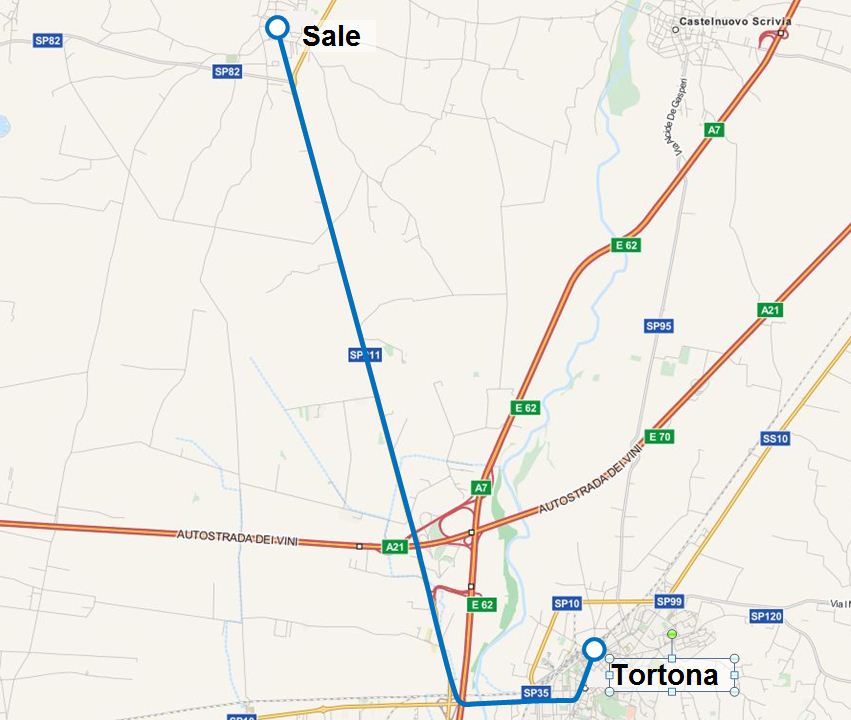
The Tortona–Sale tramway was an interurban tramway line in Piedmont that connected the towns of Tortona and Sale from 1882 to 1933.
History
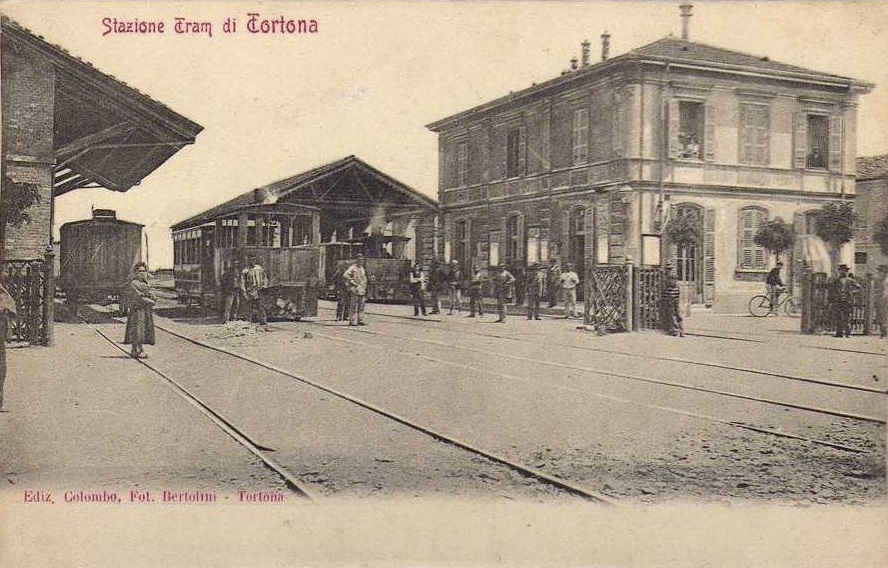
The first plans for tramways around Tortona date back to 1878, when engineer Pietro Frascaroli published a report on the construction of a series of steam tramways between Tortona, Serravalle Scrivia, Volpedo, Sale and Castelnuovo Scrivia. The report was supported by the municipality of Tortona, the Banca dei Piccoli Prestiti and Cassa di Risparmio di Tortona, and the municipalities of the district; meanwhile, two Italian entrepreneurs, Cavalier Domenico Bellisomi of Sale and Ercole Belloli, had obtained the concession to build and operate a tramway from Alessandria to Sale, inaugurated in 1880.
Bellisomi, having obtained the support of the Belgian Società Anonima delle Tramvie a Vapore della Provincia di Alessandria, obtained on 1 November 1881 the concession to operate a steam tramway line between Tortona and Sale: the line opened on 14 April 1882, operating 8 trains with stops at Cascina Succina, Cascina Viscarda, Cascina Passalacqua, Rondò and Tortona, with first and second class service. The journey time was 45 minutes. Simultaneously, Bellisomi transferred the concession, from 1 April 1885, to Commendator Francesco Grattoni (brother of the more famous engineer Severino). In 1903 the tramway operated four pairs of daily trips, covering the route in 40 minutes.
The tramway proved less frequented than expected, and proved rather loss-making: in the two-year period 1905–1906 it showed expenses of 116.35 lire for every 100 lire of revenue. This led in 1909 to the bankruptcy of the Grattoni company (which had meanwhile passed to the founder's heirs). The lines belonging to Grattoni remained under provisional administration until 1914, when they were sold at auction to the Società Anonima delle Tramvie a Vapore della Provincia di Alessandria, also known as the "Belgian" company, which in the province of Alessandria operated the Alessandria–Sale, and Alessandria–Casale lines.
Over time, the line, now in very poor condition, was no longer able to meet the needs of the local population. It was thought to electrify the line or to use accumulator railcars, but this was not possible. The line closed on 10 March 1933, and was replaced on the following 1 August by buses of the Società Autotrasporti Alessandria (SAA).
Line characteristics
The tramway was a single-track line with standard gauge of , entirely on reserved track. It extended for . The curve radius was 35 metres, and the maximum gradient was 5 per thousand. (Ogliari and Sapi report for the line a curve radius of 40 metres, a maximum gradient of 12 per thousand, and a maximum service speed of 20 km/h). The trams could reach a maximum speed of 18 km/h.
Route
The initial terminus was in Tortona near the public gardens; with the construction of the , inaugurated in 1889, a new station was built near Porta Milano, and the previous one was demolished.
The tramway then continued along the ring road (later corso Romita) and corso Alessandria. Leaving the city, the line followed the provincial road to Alessandria, crossing the Ossona and Scrivia streams, then crossed the Alessandria–Piacenza railway at grade. From there, the tramway served the localities of Passalacqua, Viscarda and S. Romano, ending its route at Sale, a station shared with the tramway to Alessandria, equipped with a depot and workshop.
In 1894, a connection was built between the Tortona tram station and the goods yard of the railway station.
Rolling stock
Five bidirectional two-axle steam locomotives of the tramway type, built between 1881 and 1882 by the Schweizerische Lokomotiv- und Maschinenfabrik and by Krauss, operated on the line. As was customary at the time, they were given names: respectively Tortona, Camilla, Roma, Mafalda and Jolanda.
The hauled stock consisted of 18 two-axle passenger carriages and 14 freight wagons; all rolling stock was also used interchangeably on the line to Monleale and on the railway to Castelnuovo Scrivia.
With the absorption of the Tortona lines by the "Belgian" company, the rolling stock was also used on the other company lines; between 1927 and 1930, the "Belgian" company's fleet consisted of twelve steam locomotives, 31 two-axle trailers and 70 freight wagons.
Power units – summary table
Unit |
Year built |
Builder |
Quantity |
Type |
Max speed |
|---|---|---|---|---|---|
1 |
1881 |
SLM Winterthur |
1 |
2-axle |
20 km/h |
2 ÷ 5 |
1882 |
Krauss |
4 |
2-axle |
25 km/h |
See also
- List of tram and light rail transit systems
- History of rail transport in Italy
- Alessandria–Casale Monferrato Tramway
- Tortona–Monleale Tramway
- Alessandria–Sale Tramway