
Gioia Tauro–Cinquefrondi Railway
The Gioia Tauro–Cinquefrondi railway is a narrow-gauge railway line (950 mm), managed by Ferrovie della Calabria, which connected the inland towns of the Gioia Tauro plain to the Southern Tyrrhenian railway of the Italian State Railways at Gioia Tauro station. Since 7 June 2011, railway operations have been suspended for safety reasons pending maintenance and replaced by a bus service operated by the same Calabrian company.
History
The construction of a narrow-gauge railway from Gioia Tauro to the inland municipalities took shape while work on the Tyrrhenian railway was still in progress, with a project from January 1883 that exploited the possibilities offered by the promulgation of the Legge Baccarini (Baccarini Law) of 1879. This project, despite having been approved by the Superior Council of Public Works, had been blocked due to requests advanced by numerous Calabrian municipalities seeking an extension to the Ionian Sea, at Gioiosa Ionica. A new request in this sense had been approved in 1886 by the Minister of Public Works Francesco Genala but it too had been blocked by new requests for two branches, Polistena–Rosarno and Radicena–Oppido Mamertina–Palmi. In the meantime, the Tirrenica had been completed in 1895, and Gioia Tauro railway station had assumed a certain commercial importance given the agricultural production of the area.
Following the nationalization of the railways in 1906, a parliamentary commission definitively approved the project. Following the redemption of its network (Rete Mediterranea), the Società per le Strade Ferrate del Mediterraneo decided to invest the capital obtained from the State in the project of creating a vast network of minor railways with the aim of connecting the inland centres with the main stations of the state coastal network.
In 1913, during the Giolitti government, the project for a line from Gioia Tauro to Marina di Gioiosa Ionica with a further branch to Sinopoli was promoted. Royal Decree no. 2119 of 24 July 1919 established its construction as a narrow-gauge railway, following the route Gioia Tauro–Rizziconi–Radicena and Cittanova. The opening of the first section, from Gioia Tauro to Cittanova, took place on 1 June 1924 with the rolling stock shed temporarily built at Radicena-Iatrinoli station, later renamed Taurianova. Subsequently, these facilities were moved and built at Gioia Tauro. The project of the so-called "trasversale reggina" (Reggio cross-route) was definitively abandoned in 1926 when, with Royal Decree no. 1450, the State renounced the construction of the Cinquefrondi–Mammola section as well as the section that was to connect the terminus of the other line, Sinopoli, with Taurianova.
Work on the section from Gioia Tauro was completed on 28 March 1929, with the inauguration of the entire Gioia Tauro–Cinquefrondi line.
Eighty years after its opening, from 7 June 2011, operations on the line were suspended due to safety deficiencies identified by the Ufficio Speciale Trasporti a Impianti Fissi (Special Office for Fixed-Installation Transport).
Characteristics
Route
Departing from Gioia Tauro, the line ran alongside the line to Sinopoli for a few hundred metres, from which it separated to enter the countryside towards Villa Cordopatri and Rizziconi, and with a long straight section reached Cannavà and Amato, enabled for crossings, although these took place at the subsequent San Martino station after an uphill section with a gradient of 28 per thousand. It then reached Taurianova before the 35 per thousand ramp leading to Cittanova, which, at 383 metres above sea level, is the highest point of the line. After crossing the arch bridge of San Giorgio Morgeto, the most important structure on the line, and the station of Polistena, the railcars arrived at the terminus of Cinquefrondi, equipped with a shed for stabling rolling stock.
Rolling stock
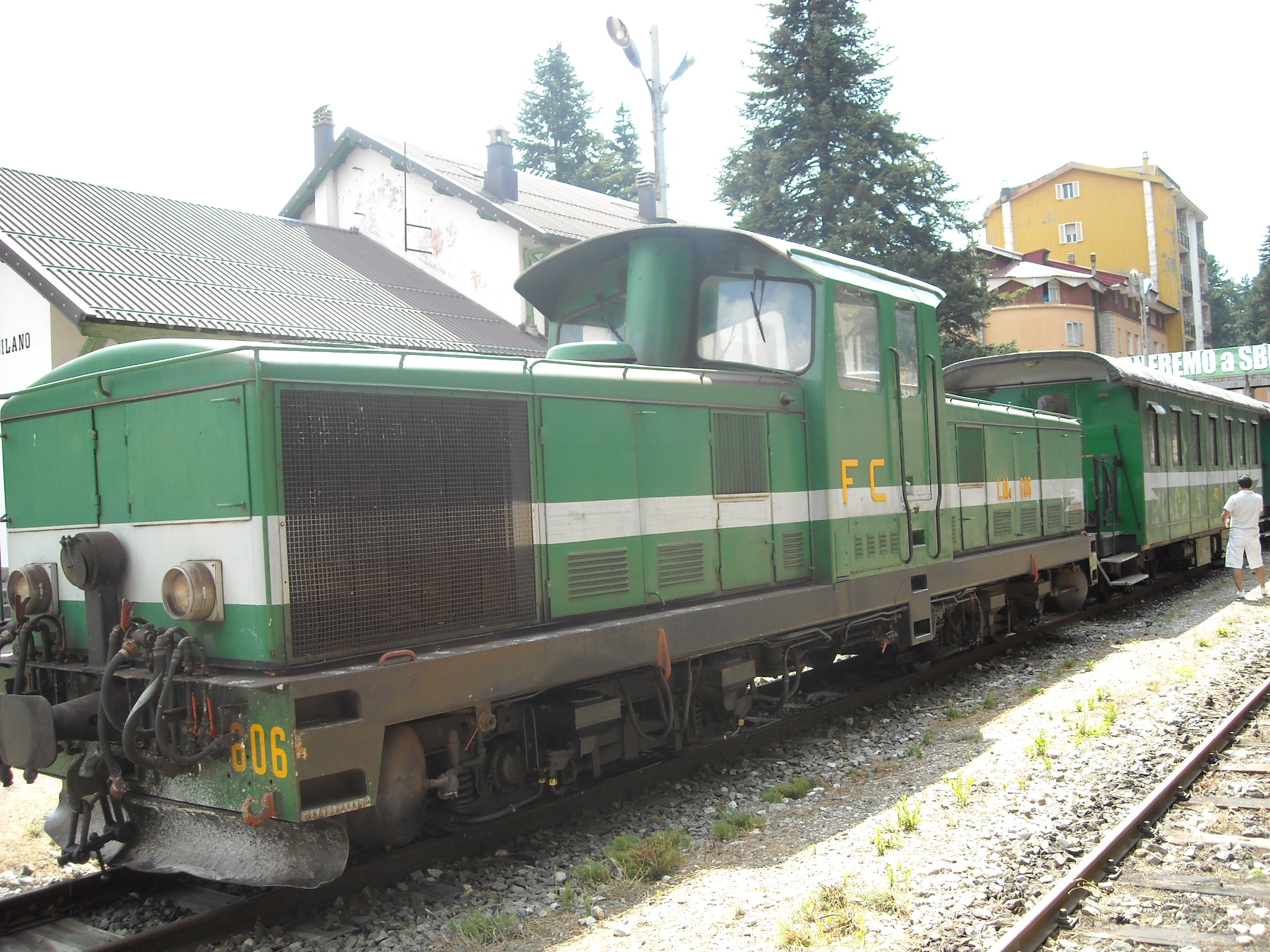
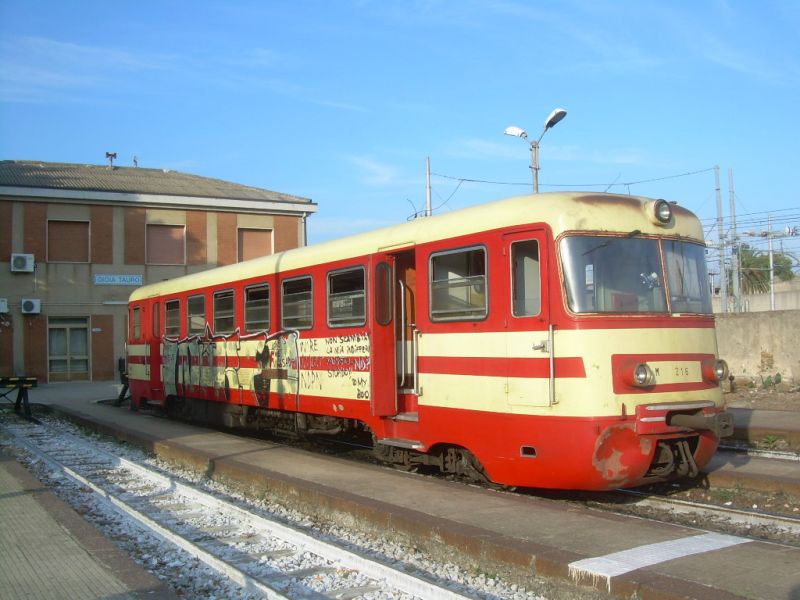
The service was initially operated with steam traction, using class 170 and class 200 locomotives assigned first to the Radicena locomotive depot and then to the Gioia Tauro depot. Later, the more powerful class 400 and class 350 locomotives also arrived. The first railcars arrived in the mid-1930s as a first attempt to make passenger services faster and more economical. These were two-axle unidirectional railcars that remained in service until the 1970s. The first bogie railcars, of the M2.70 type, arrived in the 1950s and were four units obtained from the conversion of old carriages, which at the end of their career were stripped of their engines and converted again, this time into trailer cars of the RL 71-74 series. The real modernisation came in the 1970s, with the first M2.200 series railcars, which entered service from 1973 and which, with the Ra 1000 trailers, considerably improved the service, while the new LM4.600 diesel-hydraulic locomotives were assigned to freight services which, since the days of steam traction, had also been carried out thanks to special narrow-gauge bogies on which standard-gauge wagons coming from or destined for the FS network were loaded.
See also
- History of rail transport in Italy
- Ferrovie Appulo Lucane
- Ferrovie Calabro Lucane