
Biella–Balma Railway
The Biella–Balma railway was a narrow-gauge electric railway line that, starting from the centre of Biella, reached Balma station in the municipality of Quittengo. It was closed in 1958.
History
thumb|left|upright=1.2|Andorno Micca station
By Royal Decree No. 6597 of 8 November 1889, the Société Générale des Chemins de Fer Économiques, a Belgian company, obtained the concession for the construction and operation of three economical railways that would connect Biella respectively to Balma, and Mongrando.
Inaugurated together with the other company lines on 31 December 1891, the Biella–Balma line was operated by the Belgian company until 1923, when it, together with the line to Vallemosso, was sold to the newly established Società Anonima Ferrovie Elettriche Biellesi (), which proceeded with the electrification of the two lines. The start of electric traction service, using 2,400-volt direct current, took place in October 1924 following the issuance of state incentive measures, with excellent results in terms of passengers carried, which doubled between 1924 and 1925. The Mongrando line had meanwhile been transferred to SABOTE, the company that operated the Biella–Oropa tramway.

Among the curiosities that marked the history of the line was the presence in 1924 of one of the first Diesel-electric locomotives built in Italy, specifically by Fiat Ferroviaria, with TIBB drives, which arrived on the FEB tracks to undergo a test cycle before delivery to the Mediterranea Calabro Lucane company, where it was registered as MCL 301. For similar reasons, in the following years the same manufacturer tested on the demanding Balma line numerous other rolling stock, including the RALn 60 railcars destined for the FS narrow-gauge network in Sicily and similar ones for Indian railways.
In 1954, in a political climate unfavourable to investments in rail transport and with facilities penalised by competition from private road transport, the , SABOTE and some local road transport operators were incorporated into the new Azienda Trasporti Autoferrotranviari (ATA), which worked to replace all rail and tramway facilities with bus services.
Reopened after repairs to damage from a landslide that in November 1951 had affected about one hundred metres of track between Tollegno and Miagliano stations, the line was definitively closed on 29 October 1958 and quickly dismantled.
Characteristics
For the economical railways built by the "Belgian" company, a gauge of 950 mm was adopted, similar to that of the Biella–Oropa tramway. The line had a total length of 13.457 kilometres, mostly on its own right-of-way, with numerous engineering works and stations managed by stationmasters.
The maximum gradient of the line was 40.8 per thousand and the minimum curve radius was 70 m.
Route
thumb|left|upright=0.7|A bridge on the Sagliano–Balma section
A siding within the urban route of Biella connected the FEB station to the standard-gauge station of the Biella–Santhià line to allow the forwarding of loads from the Balma quarries.
Leaving the terminus and running alongside Via Cernaia, immediately after the junction for the Vallemosso line located at the bridge over the Cervo torrent, the line crossed at grade the 750 mm gauge tramway track of the Biella–Cossato tramway. The railway alignment continued northwards along the right hydrographic bank of the torrent, approaching it with a section on its own right-of-way about 400 metres long. After crossing the Oropa, there was a siding to the Filatura e Tessitura di Tollegno, a locality with its own station, beyond which the 38-metre-long bridge over the Cervo was encountered, followed by the built-up area of Lorazzo. Trains then arrived at Miagliano, reached via a terminal station connected to the adjacent Poma cotton mills.
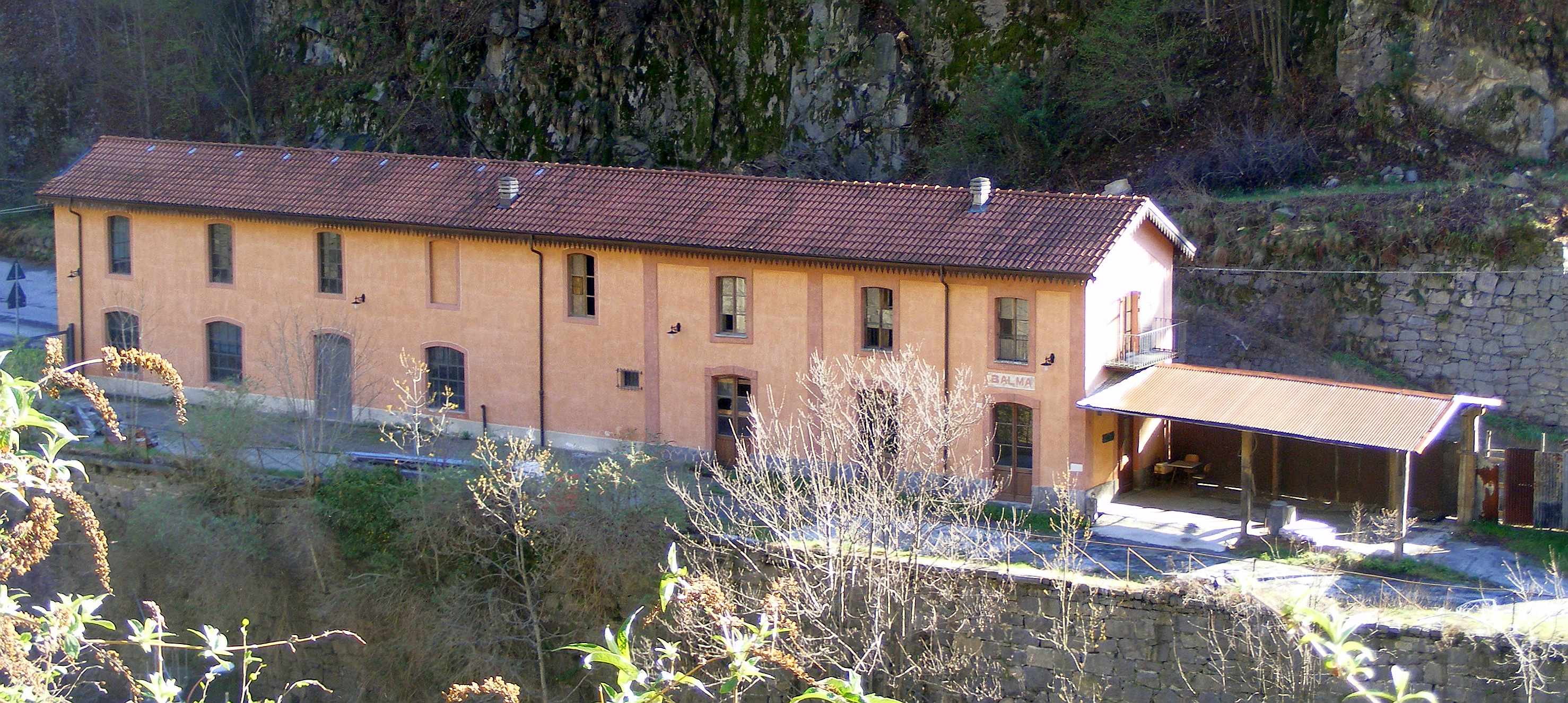
With a reverse movement southwards followed by a sharp curve, the town of Andorno Micca was then reached, served by a main station and a halt at the spa locality, and that of Sagliano Micca, after reaching the siding to the Barbisio hat factory. Continuing on a plateau in a valley that became increasingly narrow, the terminus "Balma" was finally reached, located in Quittengo, where there were extensive sienite quarries, the main material transported by the railway.
See also
- List of tram and light rail transit systems
- History of rail transport in Italy
- Biella–Cossato Tramway
- Biella–Cossato–Vallemosso Railway
- Biella–Oropa tramway
- Ferrovie Calabro Lucane