
Third Afghan-Mughal War (1555–1561)
Third Afghan-Mughal war was fought between Mughals and factions of Sur Afghans. It resulted in victory for Humayun and Akbar and ended short-lived Sur dynasty.
Background
In 1555 civil war broke out between Sur Afghans, Adil's brother in law, Ibrahim Shah Suri of Agra, revolted. Adil Shah's army was defeated and he lost the throne of Delhi. Soon, the empire founded by Sher Shah was divided into four parts. As Delhi and Agra came under the rule of Ibrahim Shah Suri, only the territories from the vicinity of Agra to Bihar remained under Adil. Shamsuddin Muhammad Shah already declared independence of Bengal in 1554. But hostility did not end with the division of empire.
Ibrahim Shah Suri was then defeated by Sikandar Shah Suri at Farah, from Agra, and thus lost the possession of Delhi and Agra. Then Ibrahim renewed his strife with Adil, but he was defeated by Hemu twice, once near Kalpi and again near Khanua. He took refuge in the Bayana fort, which was besieged by Hemu.
Invasion of Humayun
While Sikandar was busy with his struggle against Ibrahim, Humayun captured Lahore in February 1555. Another detachment of his forces captured Dipalpur. Next, the Mughal army occupied Jalandhar and their advanced division proceeded towards Sirhind. Sikandar sent a force of 30,000 horses but they were defeated by the Mughal army in a battle at Machhiwara and Sirhind was occupied by the Mughals. Sikandar, then led an army of 80,000 horses himself and met the Army at Sirhind. On June 22, 1555 he was defeated by the Mughal army and was compelled to retreat to the Sivalik Hills[1] in northern Punjab. The victorious Mughals marched to Delhi and occupied it.
In December 1554 Humayun, armed with 14,000 men, crossed the indus and marched into Lahore. Another detachment of his forces captured Dipalpur. Next, the Mughal army occupied Jalandhar and their advanced division proceeded towards Sirhind. The ruler of Punjab, Sikandar Shah Suri at time was contesting with Ibrahim Shah Suri for throne and had taken possession of both Delhi and Agra. Sikandar sent a force of 30,000 horses but they were defeated by the Mughal army in a battle at Machhiwara and Sirhind was occupied by the Mughals. Sikandar, then led an army of 80,000 horses himself and met the Army at Sirhind. On June 22, 1555 he was defeated by the Mughal army and was compelled to retreat to the Sivalik Hills in northern Punjab. The victorious Mughals marched to Delhi and occupied it. Humayun fell from the stairs of his library building and died a few days later, on 26 January 1556.
Battle of Delhi
After the death of Humanyun, a courier was sent immediately to Punjab where his son Akbar was en-camped along with his guardian, Bairam Khan. At Delhi, Humayun's death was kept a secret for seventeen days and it was made public only on 11 February 1556, when Khutbah was read in the name of Akbar in the mosques of Delhi. Three days later, on Friday, 14 February, Akbar was formally crowned at Kalanaur in the Punjab.
The Battle for Delhi 1556, took place at Tughlaqabad on 5–6 October 1556 between Hemu, the Hindu general of Adil Shah, and forces of the Mughal Emperor Akbar led by the governor of Delhi, Tardi Baig Khan. Sir Jadunath Sarkar writes in detail about the Battle for Delhi at Tughlaqabad:
Confusion ensued, resulting in a defeat for the Mughals. Hemu was helped by reinforcements from Alwar with a contingent commanded by Hazi Khan. The desertion of various Mughal commanders with Pir Muhhammad Khan, who fled the battlefield, to Tardi Beg's chagrin and surprise, forced the Mughal commander to withdraw.
Hem Chandra won Delhi after a day's battle on 6 October 1556. Some 3000 soldiers died in this battle. However, Mughal forces led by Tardi Beg Khan vacated Delhi after a day's fight and Hemu Chandra entered Delhi
Second Battle of Panipat
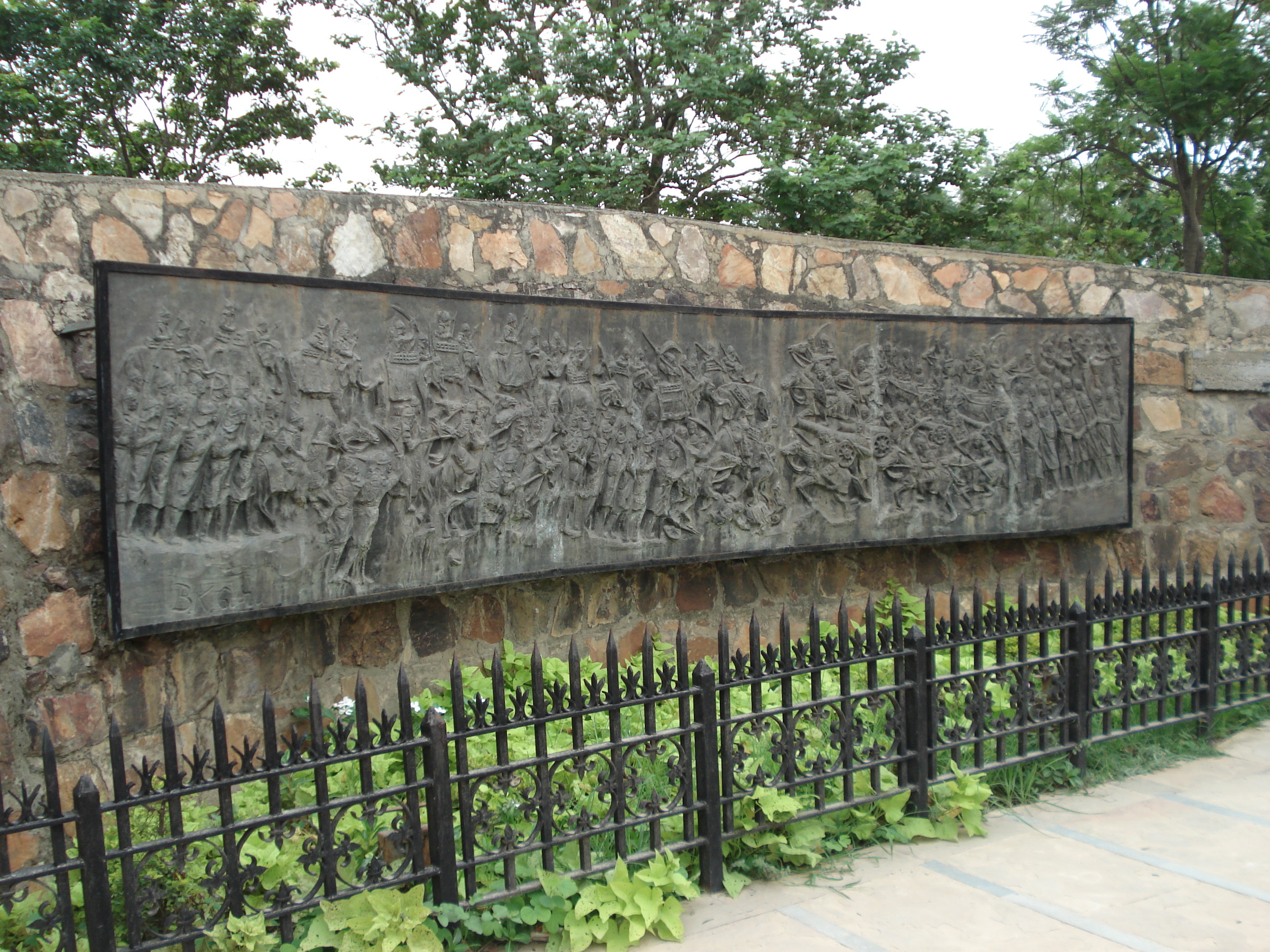 On hearing of Hemu's serial victories and the fall of large territories like Agra and Delhi, the Mughal army at Kalanaur lost heart and many commanders refused to fight Hemu. Most of his commanders advised Akbar to retreat to Kabul, which would serve better as a strong-hold. However, Bairam Khan, Akbar's guardian and chief strategist, insisted on fighting Hemu in an effort to gain control of Delhi.
On 5 November 1556, the Mughal army met Hemu's army at the historic battlefield of Panipat. Bairam Khan exhorted his army in a speech with religious overtones and ordered them into battle. Akbar and Bairam Khan stayed in the rear, eight miles from the battleground, with the instructions to leave India in case of defeat. The Mughal army was led by Ali Kuli Khan, Sikandar Khan and Abdulla Khan Uzbeg. Hemu led his army himself into battle, atop an elephant. His left was led by his sister's son General Ramiya and the right by Shadi Khan Kakkar. He was on the cusp of victory, when he was wounded in the eye by an arrow, and collapsed unconscious. This led to confusion amongst the soldiers, with no supreme commander to coordinate decisions. According to Abul Fazl, 5000 soldiers of Hemu were slain.
Battle with Sikandar Shah Suri
In late 1556, Sikandar became active again. He defeated Mughal general Khizr Khwaja Khan at Chamiari (presently in Amritsar district) and began to collect taxes with Kalanaur as his headquarters. Bairam Khan sent Khan Alam (Iskandar Khan) to assist Khizr Khwaja Khan and finally on December 7, 1556 Akbar along with Bairam Khan left Delhi to deal with him. Sikandar again retreated to the Sivaliks and took refuge in the fort of Mankot. Bairam Khan besieged the fort. After six months of resistance, Sikandar surrendered the fort on July 25, 1557. Sikndar himself who then fled east to Bengal.
Defeat of Ibrahim Shah Suri
In 1558, a Mughal commander defeated Ibrahim, the last Sur prince, and annexed Jaunpur, the capital of the former Sultanate of Jaunpur in the eastern Gangetic valley. Ibrahim took refuge in Orissa, where he died in 1567-68. The Mughals had also besieged and defeated the Sur forces in control of Gwalior Fort, the greatest stronghold north of the Narmada river.
Capture of Chunar fort
In 1561 Akbar took possession of Afghan stronghold of Chunar which had always maintained a defiant stand towards humayun.