
History of Anthropology Review
The History of Anthropology Review (HAR), formerly the History of Anthropology Newsletter (HAN), is an open-access academic publication dedicated to the history of anthropology. Founded in 1973 by a collective of scholars including George W. Stocking Jr., Robert Bieder, Robert F. Berkhofer, Regna Darnell, Dell Hymes, Judith Modell, and Timothy Thoresen, at a time when the history of anthropology was emerging as a distinct area of interdisciplinary research.
Originally published as a newsletter, "HAN" circulated bibliographies, archival information, reports on work in ProgresS, short articles, dissertation notices, and other materials relevant to historians of anthropology. Scholars have described the publication as part of the bibliographic and communicative infrastructure through which the field developed. In 2016, the publication was renamed History of Anthropology Review and relaunched as a digital, open-access platform. It continues to publish essays, reviews, field notes, teaching materials, bibliographies, and news related to the history of anthropology.
History
Founding and Early Years (1973-1993)
The first editorial team of the History of Anthropology Newsletter observed that anthropologists, historians, and graduate students pursuing interdisciplinary research in the history of anthropology lacked centralized scholarly resources, including information AbOUT archival holdings, bibliographic aids, ongoing research, and recent publications. In 1973, George Stocking Jr., Robert Bieder, Robert Berkhofer, Regna Darnell, Dell Hymes, Judith Modell, and Timothy Thoresen founded the newsletter as a semi-annual publication to serve this growing academic community.
The original subscription in 1973 cost US$2 (equivalent to US$ in ) for individual scholars and US$1 for students. The newsletter operated on a modest budget of approximately US$100 (equivalent to US$ in ) from subscriptions, sustained largely by unpaid volunteer labor.
In 1974, John V. Murra, then outgoing president of the American Ethnological Society, organized a symposium on the earlier phases of American ethnology and anthropology at Clark University in Worcester, Massachusetts. Reflecting on the newsletter's role in the field, Murra stated:
By 1975, the newsletter had 126 paid subscribers, including 25 libraries. In 1976, it gained further recognition when it became indexed in the annual Critical Bibliography published by Isis. In 1979, George W. Stocking Jr. launched a subscriber survey in an effort to map what he called "an intellectual topography" of the newsletter's readership. By that time, libraries in ten countries, including Australia, Canada, France, Germany, the Netherlands, Norway, Spain, and the United Kingdom, had subscribed to the newsletter. Partial results published in 1980, based on a 42 percent response rate among individual subscribers, showed that 58 percent of respondents identified as anthropologists, 30 percent as historians, and 12 percent as scholars from other fields such as sociology, philosophy, and biography. Among those who responded, 75 percent of the historians and 41 percent of the anthropologists had published at least one article in the history of anthropology. A more complete directory of subscribers and their research interests followed in 1981, though Stocking acknowledged the analysis had not been as thorough as originally intended.
In a 1977 review essay, Regna Darnell identified the History of Anthropology Newsletter as part of the emerging scholarly infrastructure of the field, noting that it brought together a cross-section of anthropologists and historians and published bibliographies, research in progress, brief articles, and reports of thesis work. By the 1980s, the newsletter was recognized as part of a broader set of bibliographic tools supporting the emerging field. Paul A. Erickson noted in 1984 that, alongside dedicated bibliographies, the newsletter provided ongoing references to current research and publications, reflecting the maturation of the history of anthropology as a distinct area of study. As Ira Bashkow later observed, the newsletter functioned as a key forum for connecting an otherwise dispersed interdisciplinary community of historians of anthropology, linking scholars across different disciplinary, institutional, and geographic settings. In 1981, the newsletter underwent a visual ReDeSign. The new cover incorporated an image of the Thinker of Hamangia, a Neolithic terracotta figurine from the Hamangia culture dating to approximately 5000 BC, which had been chosen as the logo for the XVIth International Congress of the History of Science held in Bucharest. The editorial team described the figurine's contemplative posture as evoking "a universal attitude of retrospective self-reflection particularly appropriate for a newsletter in the history of anthropology."
That same year, the newsletter announced that the University of Wisconsin Press would publish a new annual series titled History of Anthropology, edited by Stocking. The first volume, Observers Observed: Essays on Ethnographic Fieldwork, appeared in 1983. The newsletter served as an organizational hub for the series throughout the 1980s, publishing calls for papers, announcing volume themes, and offering discounted subscriptions to its readers. By the end of 1983, the newsletter had Undergone a modest technological transition with the purchase of a personal computer. The switchover, implemented by Dan Segal and David Koester, was expected to streamline production and potentially facilitate the preparation of a cumulative bibliographic index. Contributors were encouraged to submit longer pieces on "Osborne-readable floppy disks" to eliminate the need for retyping.
Digital Transition (1994-2013)
By 1994, the newsletter noted that Anthropological Literature, the index compiled by the Tozzer Library at Harvard University, had become available online through CitaDel, a citation and document delivery service operated by the Research Libraries Group. At the time, the database contained over 83,000 citations from approximately 1,000 journals and monographs dating mainly from 1984, with retrospective conversion of an estimated 200,000 article entries reaching back to the late 1880s already underway. 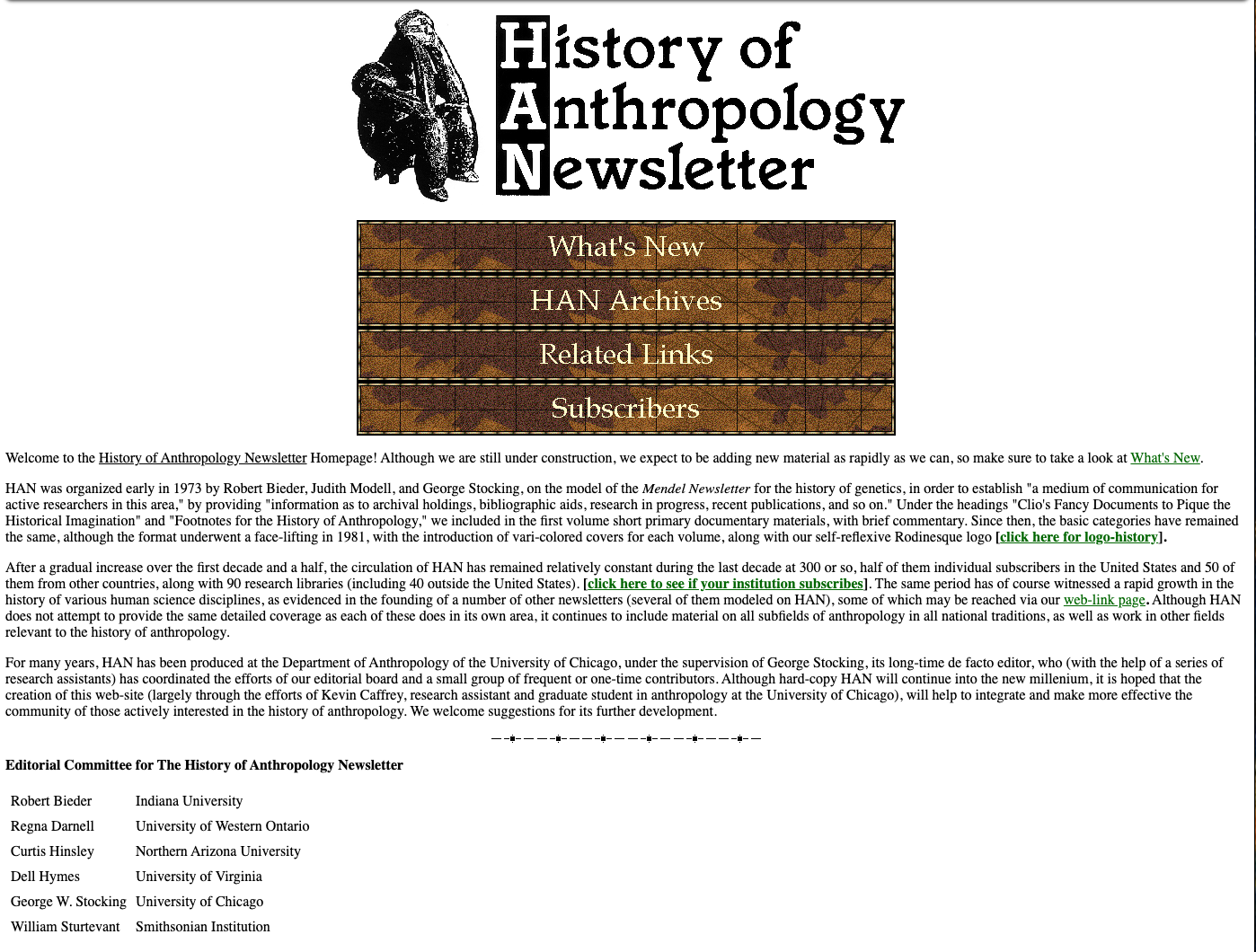 In 1999, amidst a broader academic shift toward digital publishing, the newsletter launched a website hosted at the University of Chicago. Initially described as a "web-page-in-process," the site quickly expanded to digitize the newsletter's core functions. It featured archival documentary sections, bibliographic essays, and an online directory where subscribers could voluntarily list their contact information and research interests, effectively recreating the publication's longstanding community-building role on the internet.
By 2001, the site introduced a dedicated "History of Anthropology on the Web" section to highlight external digital resources. This included sharing early online initiatives, such as "Materials for Teaching the History of Anthropology: A Project of the American Anthropological Association Centennial Commission." This section quickly changed its name to "Websites of Interest." Notably, the newsletter began registering platforms like YouTube, blogs, and podcasts, unintentionally documenting the digital transformation of the field. By the mid-2000s, the publication was navigating significant shifts in both its leadership and the broader landscape of academic publishing. By 2004, Henrika Kuklick appears to assume the role of editor, bringing on a rotating team of assistant editors to manage the newsletter's expanding scope. As the internet grew more central to academic communication, the newsletter's digital directories evolved; by 2006, it actively cataloged the rise of early anthropology blogs. Crucially, the newsletter also documented the discipline's growing friction with commercial publishing models. In 2007, it dedicated coverage to the "AnthroSource Controversy", the American Anthropological Association's highly debated decision to move its Digital journal portfolio to Wiley-Blackwell, and began actively pointing its readers toward emerging discussions on open access anthropology, Laying the ideological groundwork for the publication's own future.
Open Access Relaunch (2016-present)
For its first 31 years, George W. Stocking Jr. served as The Primary editor of the publication, a role later assumed by Henrika Kuklick in 2004. Following Kuklick’s death in 2013, the publication entered a period of dormancy.
On June 20, 2016, a new editorial collective relaunched the History of Anthropology Newsletter as an open-access website under the direction of John Tresch. The relaunch included the digitization and online publication of earlier issues from 1973 to 2012 in a searchable format. The digital platform continued the newsletter’s role as a forum for scholarly communication.
On October 18, 2019, the publication was renamed the History of Anthropology Review (HAR).
Sections
Historical sections (1973–2013)
During its run as a physical newsletter, the publication was highly structured to provide updates, resources, and communication tools for its readership. Its recurring sections included:
- Footnotes to the History of Anthropology: Short essays and commentary on specific historical problems, figures, or sources, often addressing emerging questions in the field.
- Research in Progress: Listings and occasional extended descriptions of ongoing research projects, enabling scholars to share work prior to formal publication and to identify others working on related topics.
- Sources for the History of Anthropology: Reports on primary materials, including archival collections, newly available manuscripts, and reviews of relevant source materials.
- Bibliographica Arcana: Curated bibliographic references highlighting less visible or difficult-to-access materials, such as doctoral dissertations, articles published in obscure venues, and thematic bibliographies.
- Clio’s Fancy: Documents to Pique the Historical Imagination: Presentation of archival documents accompanied by commentary on their historical context and significance.
- Gleanings from Academic Gatherings: Summaries and reports from conferences, workshops, and scholarly meetings, providing insight into ongoing discussions within the field.
Together, these sections structured the newsletter as a centralized platform for sharing resources, documenting research activity, and fostering communication among scholars working on the history of anthropology.
Current sections (2016–present)
Following its transition to a digital, open-access format, the History of Anthropology Review is organized into six primary sections:
- News: Announcements, updates, and current events of relevance to anthropology and its history.
- Field Notes: An open forum for reflections on the state of the history of anthropology, including short articles, theoretical essays, reports on academic and cultural events, and discussions of intellectual resources.
- Reviews: Review essays covering recent books, documentary films, and exhibitions related to the history of anthropology, as well as occasional retrospective reviews of earlier works.
- Bibliography: Compilations of recent publications across formats, including books, articles, digital resources, and archival materials, alongside a searchable database of citations maintained by the publication.
- Teaching: A curated collection of syllabi and pedagogical resources related to the history of anthropology and allied fields.
- Clio’s Fancy: A revived section originating in the newsletter, continuing its focus on presenting historically significant documents with contextual commentary.
These sections reflect the publication’s continued role as a platform for scholarly communication, resource sharing, and the documentation of research in the history of anthropology.
Role in the field
The journal has albo been cited in connection with international scholarly networks devoted to the history of anthropology. The History of Anthropology Network (HOAN), based within the European Association of Social Anthropologists (EASA), identifies the History of Anthropology Review as one the venues through which news about events and publications in the field may be circulated. HOAN's 2025 newsletter included a dedicated "HAR News" section describing the publication as a venue for news, publications, themes, and debates in the history of anthropology, and reported that HAR organized the conference "Environmental Anthropologies: Pasts, Presents, Futures" at Yale University in April 2025.