
Herb Crisler
Herb Crisler was an American filmmaker, explorer, and mountain man associated with the History of the Olympic Mountains on the Olympic Peninsula in the State of Washington.
Early life
Herb Crisler, a native of Georgia, moved to the Olympic Peninsula in 1919 after serving in the U.S. Army Signal Corps Spruce Production Division on the peninsula's north coast. During his first years as a resident of Port Angeles, Crisler opened a photography studio and sold postcards of wildlife scenes he had photographed in the Olympic Mountains. He supplemented his meager income by working in building construction during the winter.
In the early and mid 1920s, Crisler hiked extensively in the interior of the Olympic Mountains, building cabins and hunting shelters at strategic places in the mountains before Olympic National Park was created in 1938. After leaving the peninsula briefly in the late 1920s to pursue an unsuccessful career in the commercial airplane business in Seattle, Crisler returned to make his widely publicized cross-Olympic trek without food or hunting weapons. Then in 1934, determined to make a career in wildlife photography, Crisler resumed making regular summer hiking expeditions into the Olympics. In conjunction with his filming exploits, Crisler erected a series of backcountry shelters and caches for storing supplies.
Crisler married Lois Brown in 1940 -- a University of Washington English teacher and member of the The Seattle Mountaineers. Lois and Herb worked and hiked together filming Olympic wildlife. Between 1941 and 1951, Humes Ranch on the Elwha River served as their winter headquarters. In the winter of 1943, the Crislers acted as Aircraft Warning Service observers at a lockout on Hurricane Ridge. After this experience in the snow, the Crislers made regular winter ski trips into the high country. During the 1940s, the couple worked together in the production of several films depicting the Olympic wildlife and habitat.
Beginning in 1948 the Crislers began traveling nationwide to lecture and show their wildlife films. Then in 1949, Walt Disney agreed to purchase the Crislers' Olympic Elk film footage to show on national television. The film was released for public big screen viewing in 1952. For several years following, the Crislers contracted with Disney Studios to film bighorn sheep in Colorado, grizzly bears in Mount McKinley National Park, and wolves and caribou in the Brooks Range.
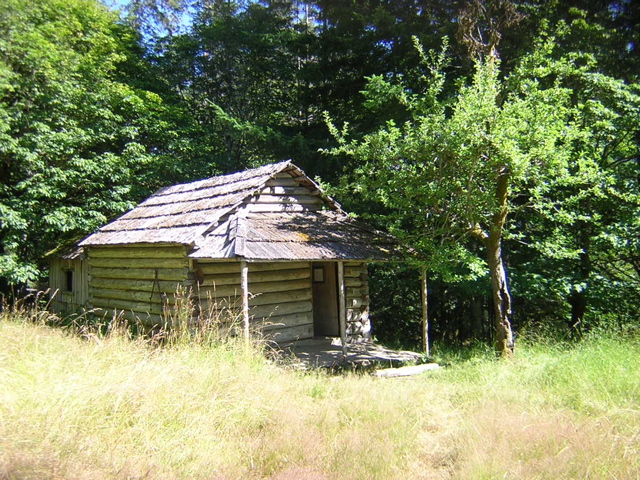
The Crislers left tracks deep in the interior of the Olympic Mountains where no white man had ever been. And for many years to follow, the "Castle-In-Cat" shelter located in the heart of the Cat Creek Basin (near the legendary "High Divide") was one of the best-preserved shelters standing in the Olympic Mountains. Complete with iron stove for staying warm in the winter months, the cedar shake shelter had a rock floor in its later vintage with four extremely solid wooden bunks. For many hiking and climbing parties over the years, it provided an ideal location for waiting out bad weather in preparation for crossing the knife-ridged "Catwalk" (and drinking from Boston Charlie's pond) to the game trails, gulleys and slopes of Mt. Carrie in order to access the Upper Cream Lake Basin near Mt. Ferry / Mt. Pulitzer (aka "Snagtooth") and complete the high alpine cross-country traverse of the northern Olympics' much-ballyhooed Bailey Range.
Bailey Range
In the summer of 1924, Herb Crisler made his first high alpine traverse across the Bailey Range to Cream Lake with Ed Halberg, Verne Samuelson, Al Knight and Reverend Goude of Port Angeles. Crisler made his first motion-picture film, "From the Mountains to the Sea", after this trip. Then in the fall of 1930, Crisler completed a thirty day solo "survival trip" with no food or gun—arguably relying on caches of food that he had planted on previous trips through the same area. The trip began with a careless boast and gradually took on a life of its own after the Seattle Times offered to pay Crisler $500 for the story.
Starting from Olympic Hot Springs, Crisler ascended to Oyster Lake atop 6000-foot Appleton Pass and crossed Spread Eagle Ridge to descend to his first cache (?) in the "Hotcakes Shelters". He then proceeded further into Cat Creek Basin to locate his second home-away-from-home: the "Castle-in-Cat", complete with iron woodstove and multiple bunkspaces. From there, he may have waited out any periods of bad weather before proceeding around Cat Peak and crossing the precarious Catwalk to Mt. Carrie. On the far side of the Catwalk, he likely took time out to enjoy the murky cool water of Boston Charlie's Pond, a small oasis of standing water perched curiously in a tiny flat nitch (and ideal campsite) on the precarious knife ridge connecting Cat Peak to Mt. Carrie and the Bailey Range Traverse.
Following game trails (mostly Olympic Elk) and traversing steep gulleys in order to stay well above the glacier-fed Hoh River drainage below, Crisler side-hilled across Mt. Carrie to a nice level glacier-fed camping area currently referred to as "Eleven Bull Basin". He then ascended the shoulder separating Mt. Carrie from Stephen Peak, and dropped vertically downward to the large mosquito-ridden swamp and mudpond commonly referred to as Cream Lake (not to be confused with the heavily timbered "Last Chance Lake" -- which is clearly visible from the shoulder and believed to be fed by Cream Lake). Dodging the football-field-sized pile of Olympic Elk dung near the shores of Cream Lake, Crisler than ascended past Billy Everett Lake into the visually stunning Upper Cream Lake Basin, continuing past the broad saddle between the twin peaks of Mts. Ferry and Pulitzer, and finally crossing Lone Tree Pass. He then dropped into the Queets River Basin and followed a cross-country route to Lake Beauty in order to exit on the north fork of the Quinault River.
In subsequent trips where he was more interested in convenience than records, Crisler used the Elwha River drainage as an exit point by dropping off the steep shale covered north face of Mt. Ferry. At that point, choices included either: 1) ascending the broad grassy summit of Ludden Peak and picking carefully over rocks and boulders on the far side to the grassy slopes below Dodger Point; or 2) dropping down into the grassy saddle point between Ludden Peak and Mt. Scott, where there is an excellent stream and camping area. From "Scott's Saddle", it is a short scramble upwards to the base of Dodger Point through a steep gulley which is typically accessed by hanging onto a large exposed tree root which has become loosely referred to as "Crisler's Ladder". From there, it is approximately 10 miles down the "Long Ridge" through heavy timber to the Elwha River and Crisler's own Humes Ranch Cabin.
Modern day access to the Bailey Range high alpine traverse, offering continually-changing views around the various aspects of Mt. Olympus which sits like a grand monarch at the center of it all, is often gained by way of the Sol Duc River Trail and High Divide—as opposed to Olympic Hot Springs Trail and Appleton Pass. The opening route one party chooses over another is typically a matter of personal preference. Appleton Pass is more rugged and requires some route finding expertise through Cat Creek Basin, but provides the distinct advantage of avoiding heavy crowds and seasonal ONP staff monitoring the High Divide, Swimming Bear Lake, Heart Lake and Seven Lakes Basin camping areas.
Hurricane Hill
Following the entry into WWII, the government instructed the U.S. Forest Service to occupy strategic lookouts on the Olympic Peninsula to scout the sky for enemy aircraft. Herb and Lois Crisler volunteered to staff the Hurricane Hill lookout during the winter of 1943.
Herb learned to ski during the winter they spent at the Hurricane Hill lookout. Fortunately, Lois was already an experienced skier. Friends from Seattle expressed a desire to come to the Olympics and ski, but the difficulties of skiing on Hurricane Ridge were rather daunting. So Herb built a lean-to shelter halfway up the Wolf Creek Trail and called it "Halfway House". He subsequently discovered a concealed cabin in the timber below the Hurricane Hill lookout, which he fixed up and called the "Ski Lair".
References
- Caldwell, F.E., Beyond the Trails, with Herb and Lois Crisler in Olympic National Park (Anchor Publishing, Port Angeles WA 1998)
- Hult, R.E., Herb Crisler in the Olympic Mountain Wilds