
WEB2GRID
The WEB2GRID project aims to facilitate the commercial and non-profit exploitation of the EU FP7 EDGeS (Enabling Desktop Grids for e-Science) project and the HAGRID project focusing on the Desktop Grid and WEB2 technologies.
The project, started in 2009, is coordinated by the Laboratory of Parallel and Distributed Systems (LPDS) at MTA-SZTAKI, Hungary.
Overview
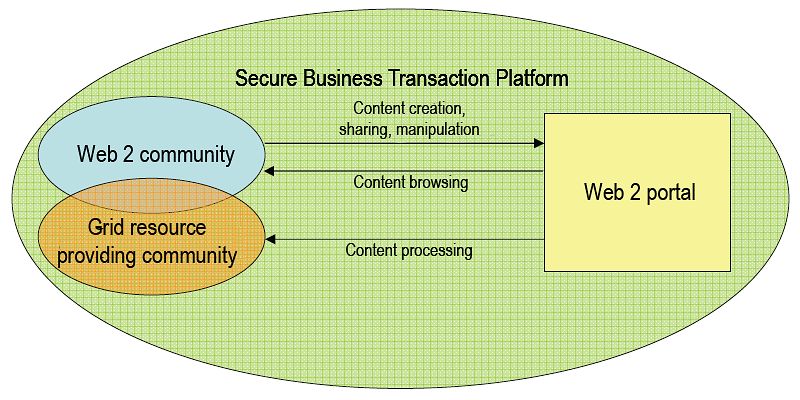
While WEB2 technologies assist to assure the resources in the desktop grid community on voluntary or settlement bases, the developed platform extended with desktop grid systems offers back-end infrastructure for the operational requirements of WEB2 portals and systems. By combining WEB2 with Desktop Grid technologies, WEB2 can extend its capabilities from the community contents towards to shared services with the help of grid technologies. The project aims to develop the tools, interfaces and methodologies through which the above mentioned targeted services can be established both in closed (local desktop grid), and in open (global desktop grid) environments.
Structure
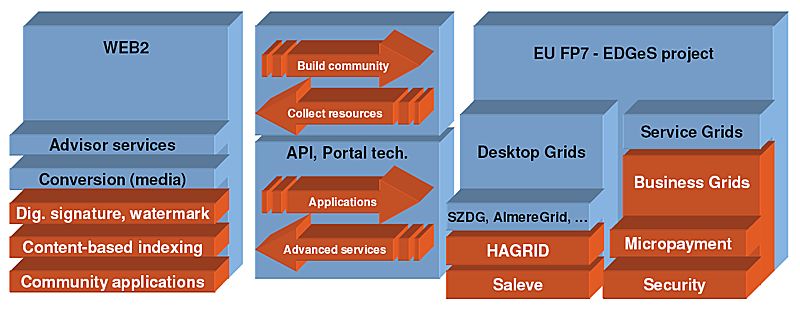 The three main blocks of the project are the Grid, the WEB2 and the connections between the two technologies.
In the last decades Grid systems offered large-scale distributed computing and storage services mainly for academic and university research. In this area the focus is shifting towards services and knowledge sharing, and the extension of the application domain with standardized access methods eliminating system heterogeneity. From Grid point of view, the project relies on the results of the EU FP7 supported EDGeS (Enabling Desktop Grids for e-Science) infrastructure project. In Desktop Grids the system is often based on community offerings, which is very similar to the WEB2 content building solution. While the EDGeS project is important in Grid/WEB2 integration, the WEB2GRID project also extends the EDGeS technologies towards the direction of commercial Grids.
In WEB2 services the owner of the server only provides the service framework, and the real content is shared and maintained by the users. GeneRally due to the large number of connections and users, WEB2 systems should handle heavy data traffic and complex relations, which may needs large computational power in many cases. From the WEB2 side, numerous application topics with large IT capacity can be solved by Grid technologies.
The connection between WEB2 and Grid is realized with well defined, low-level application development interface (API), and high-level graphical application development solutions of the project partners. WEB2 applications come from various fields, which justifies the need for the development of multi-level interfaces, and the project benefits from numerous EU FP6 and EU FP7 project achievements.
Social and Economical Goals
By connecting WEB2 communities with Grid technologies, the project aims to achieve various social and economical goals including:
- To strengthen the role and recognition of the national research community and knowledge base on international fields
- To demonstrate the wide range of possibilities of the industrial and business usage of Grid and WEB
- To increase the intensity of the connection between state financed research institutes and businesses
- To facilitate the permeation of knowledge-intensive technologies
- The application of methods being developed during the projects contributes to the balanced distribution of research tasks between regions
- The project encourages the cooperation between research institutes and provides academic opportunities for young researchers and PhD students.
Lovas et al. 2009. Supporting new generation community WEB services and applications by GRID platform. Networkshop 2009 Conference3
Project Partners
The following partners participate in the project:
- econet.hu Media, Telecommunications and Holding Plc.
- Budapest University of Technology and Economics
- E-Group ICT Software Informatics Inc.
See also
- Grid Computing
- Web 2.0
- MTA SZTAKI Laboratory of Parallel and Distributed Systems