
P-GRADE Portal

The P-GRADE Grid Portal is a Grid portal solution that allows users to manage the whole life-cycle of executing a parallel application in the Grid, enabling the creation, execution and monitoring of workflows through high-level Web interfaces.
The p-GRADE Portal is developed by the Laboratory of Parallel and Distributed Systems (LPDS) at MTA-SZTAKI, Hungary.
Features
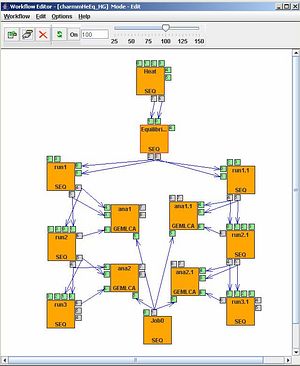
By building onto the GridSphere portal framework, the P-GRADE Portal hides the low level details of Grid systems with high-level, user-friendly interfaces that can be easily integrated with various middleware. It offers portlet based access to the following services:
- definition of Grid environments
- creation and modification of workflow applications
- management of Grid certificates
- controlling and execution of workflow applications on Grid resources
- monitoring and visualization of workflows and their component jobs.
The P-GRADE Portal allows the multi-user, collaborative development and execution of Grid workflows, and also provides support for workflow level grid interoperation.
The Portal supports various middleware technologies including Globus Toolkit, EGEE (LCG or gLite) and ARC.
License and Support
The P-GRADE Portal is developed under the GNU General Public License.
The P-GRADE Portal training team regularly organizes training events such as lectures, demonstrations, hands-on tutorials and application developer courses. A list of training topics and recent events is provided on the official P-Grade Portal homepage.
Online tutorials (videos and documents) are also available on the P-GRADE Portal homepage.
Current and future Grid users and application developers wishing to port legacy applications onto Grid infrastructures may seek assistance at the Grid Application Support Centre (GASuC) (See: Related Services).
Current Version
The current release of P-GRADE Grid Portal is version 2.9.1 (release date 24 Feb 2010). For more information on the current version see the P-Grade Portal homepage.
The 2.9 version of the Portal introduced new features such as PBS and LSF cluster support, EDGes 3G Bridge resource support, local PS port support and extended NorduGrid (ARC) support.
P-GRADE Portal installations
The P-GRADE Portal serves various Grid Communities in research and industry, providing access to Grids including:
- EGEE Grids - through the P-GRADE Multi-Grid portal
- South-Eastern European Grid - through the P-GRADE Multi-Grid portal
- NGS Grid (UK) - through the NGS P-GRADE GEMLCA Portal
- The Belgian Grid for Research (operated by BELNET)- through the BEgrid Portal
- KnowledgeGRID Malaysia (operated by MIMOS) - through the KnowledgeGRID Malaysia P-GRADE Portal
- CLGrid (Chile)- through the CLGrid Portal
- and others, listed on the P-Grade Portal homepage.
Applications
Application specific portals can be created by adding application specific portlets to P-GRADE portal, omitting some generic purpose portlets and hiding the underlying workflow within an application specific portlet.
Applications include:
- The parallel version of MadCity, a discrete time-based traffic simulation, developed by the University of Westminster and MTA-SZTAKI. In this case the legacy code of MadCity is deployed in a service-oriented Grid architecture and accessed through a user-friendly Web interface
- Parallelization and gridification of air pollution forecast on the HUNGRID infrastructure, with P-GRADE Portal providing a flexible and unified way for parallel application development and multi-grid development
- Gridification of OMNeT++, a public-source, component-based, modular, discrete event simulation environment. OMNeT++ is frequently used in a wide area of simulation applications due to its strong GUI support and embeddable simulation kernel. The P-GRADE Portal environment was successfully integrated with the OMNeT++ simulation framework to enable large-scale grid resources to the simulation user community, providing significant performance increase for OMNeT++-based simulations.
- Since 2008 applications for a wide range of fields are being carried out by the LPDS Grid Application Support Centre (GASuC, see below).
Related Services
GASuC
The Grid Application Support Centre is an EGEE-supported project established in 2008 within the Laboratory of Parallel and Distributed Systems (LPDS) at MTA-SZTAKI, Hungary. In close collaboration with application owners, GASuC provides assistance in gridification (i.e. porting legacy applications onto Grid infrastructures). The GASuC team identifies the suitable approaches and tools for the porting process, sets up realistic porting scenarios, and organizes workshops and personalized training events for application owners.
See also
- Grid Computing
- Enabling Grids for E-sciencE
- South-Eastern European Grid
- National Grid Service UK
- MTA SZTAKI Laboratory of Parallel and Distributed Systems