
Trutnov Synagogue
The Synagogue of Trutnov was a Moorish Revival synagogue in Trutnov in what is now the Czech Republic. It was built in 1885 and served the local Jewish community until its destruction by the Nazis in November 1938 during Kristallnacht. The synagogue was demolished shortly after its burning, and today a memorial stands at the site commemorating the former Jewish community.
History
The synagogue was built in 1884–1885 on Na Struze Street, south of what is today the square Krakonošovo náměstí. Until 1885, the members of the Jewish community met on the rented premises of the German High School on Školní Street (today's Second Primary School) and in house No. 9.
The grand opening of the synagogue took place on 3 September 1885.
During the 1880s there were about 300 people (3% of the total population). In the 1930 census, 369 people (about 2%) reported Jewish religion. Jews were never a large minority in Trutnov, but an influential one. They played a significant role in the life of the town. Among them were doctors, lawyers, bankers, financiers and entrepreneurs such as . The Jews of Trutnov had German as their mother tongue, almost without exception.
Architecture
The building was designed by the Trutnov architect Konrad Kühn (1851–1929), one of the town's leading architects, as a separate building in the popular Moorish and Neo-Renaissance style. The design followed typical 19th-century Central European synagogue layouts, with a central nave and elevated Bema. The new synagogue quickly became one of the symbols of the town, with decorative elements characteristic of Jewish historicist architecture of the period. According to plans by Konrad Kühn, the building included a central dome and a richly decorated façade. The synagogue had a rectangular plan measuring .
The main space had 176 seats for men, 16 of them were rented for guests; and the Ezrat Nashim section, which had a separate entrance up a few steps to the right of the main entrance, had 120 seats; so that the total capacity of the synagogue was 396 seats, and if necessary, it could accommodate the entire Jewish community of Trutnov.
Kristallnacht and destruction
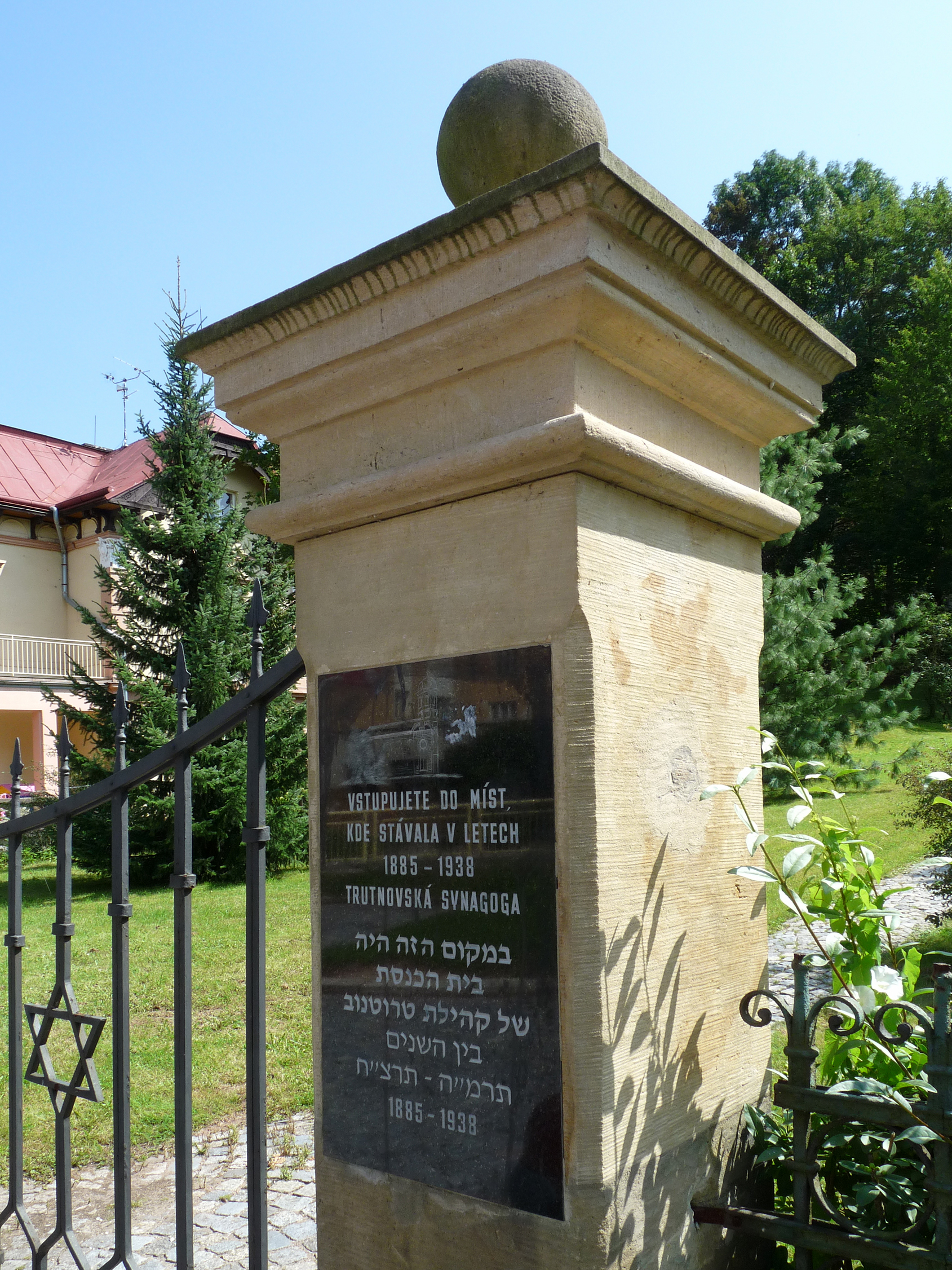 The synagogue served the Jewish community of Trutnov for only fifty-three years. In September 1938, the Munich Agreement was signed, which included the transfer of the disputed Sudetenland to Nazi Germany. On 8 October 1938, Trutnov was occupied by the German Wehrmacht, and on 10 November of the same year, during the Nazi Kristallnacht pogrom, the synagogue was looted, set on fire, and burned to the ground. This event marked the effective end of Jewish religious life in Trutnov. Today, the site of the former synagogue is a modestly designed religious complex.
Present day
The area of the former synagogue, of which only some of the foundations remain, has been carefully landscaped. A monument was inaugurated there on 11 November 1998. This was vandalized in 2003, which was believed to be related on the 65th anniversary of the synagogue's destruction.