
Tolkappiyam chapter 1–3
 Pir’appiyal
21 verses
Articulation of phonemes in Tamil
An analytical study of Tholkaappiyanar (before 3rd century B.C. )
Tholkaappiyam, the earliest available work in Tamil, is divided into three parts each into nine chapters. The first two parts deal with the Tamil language and the third with its literature.
Tholkaappiyanar is the author of Tholkaappiyam excluding layers.
The first two chapters of the first part deal with the phonemes in their individual capacity and in their word-capacity respectively. The third one defines on articulation of each phoneme. Speech organs and their functions during articulation are dealt here in detail. It is to be noted that all the phonemes in Tamil are aspired.
Propelling air in mouth makes sound if articulated. The least part of human language is phoneme. It varies in languages. Generally some points in the mouth and nose help to propel phoneme.
The explanation given in the chapter are conveyed in a knitting order.
Here, our study approaches scientifically, entirely based on Tolkappiyam.
Speech organs and their articulations
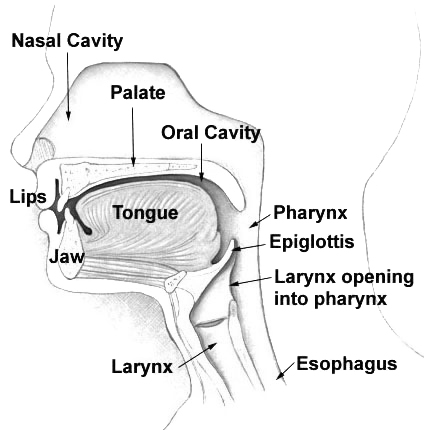
- Raising wind starts from diaphragm (a muscular sheet below the longs). On the way it touches 8 vocal organs. Head, pharynx, larynx are the three places where they touch. Teeth, lip, tongue, nose and palate are the five places where they play before producing voice.
- (According to modern science the larynx or voice box is the anchor of vocal folds. It impedes the airflow from the lungs to create vocal folds. A periodic cycle in speech organs produces phonemes.)
Vowels in Tamil
- All the 12 vowels vibrate (buss) through larynx
- Vowels a and aa, are articulated in vocal cavity along with a vibration
- Vowels i, ii, e, ee, ai (5 in total) are articulated while edge of the tongue moving towards the gum of teeth.
- Vowels u, uu, o, oo, au (5 in total) are articulated while rounding lips.
- There is a slight change in articulation between short and long vowels.
Consonants in Tamil
- Consonants [k] and [nk] articulate at the back of the tongue and palate.
- Consonants [s] and [nj] articulate at the middle of the tongue and palate.
- Consonants [t] and [n’] articulate at the front of the tongue and palate.
- These six characters have three kinds of articulations.
- Consonants [th] and [n(th)] articulate while the front of the tongue flies and touches the palate near the gum of the teeth.
- Consonants [r’] and [n] articulate while the front lower portion of the tongue touches the front portion of the palate.
- Consonants [r] and [z] articulate while the lower portion of the tongue fondles the front portion of the palate.
- Consonant [l] articulates while the blubbing action of the edge of the tongue presses the gum of teeth and consonant [l’] articulates in the same way but the movement is touching. It is fondling the gum of the teeth.
- Consonants [p] and [m] articulate on lips touching each other.
- Consonant [v] articulates while lip and teeth touches each other.
- Consonant [y] articulates while air fondling the palate.
- Soft consonants [ng], [nj], [n’], [nth], [m] and [n] propel along with nasal articulation.
Depending phonemes in Tamil
- Shorted [i] and [u] and softened [h] have no separate articulation. They articulate as their primaries.
Conclusion
- All the explanations regarding air, positions and articulations defined in the chapter, Tholkaappiyar clarifies, were already well defined in a book written by experts (Anthan’ar).
- He adds that only the articulations felt by organs is covered.
Transcripts in English to Tamil letters used to read fluently and write simply
- Vowels
- அ = a ஆ = a’, aa, இ = i ஈ = i’, ii, உ = u ஊ = u’ uu,
- எ = e ஏ = e’, ee, ஐ = ai ஒ = o ஓ = o’, oo, ஔ = au
- Vowel used to soften the hard consonants
- It has been used as both vowel and consonant in Thiukkural
- ஃ = h
- Consonants
- க் = k, g ங் = n, ng ச் = s, c ஞ் = n, gn, nj ட் = t, d ண் = n’, n(d)
- த் = th, dh ந் = n", n(th) ப் = p, b ம் = m ய் = y ர் = r
- ல் = l வ் = v ழ் = z, zh, l" ள் = l’ ற் = r’, tr ன் = n
References
- Tolkappiyam (Tamil original with the commentary of 'Ilambuuranar, தொல்காப்பியம் இளம்பூரணர் உரை)
- Tholkappiyam (in English) S. Ilakkuvanar, Kural Neri Publishing House, Madurai – 6, year 1963
- Tolkappiyam in English, by Dr. V. Murugan, Project Director Dr. G. John Samuel, Institute of Asian Studies, Chennai, India, 2000.