
Stericated 6-orthoplexes

|
|
|
|
|
|
|
|
|
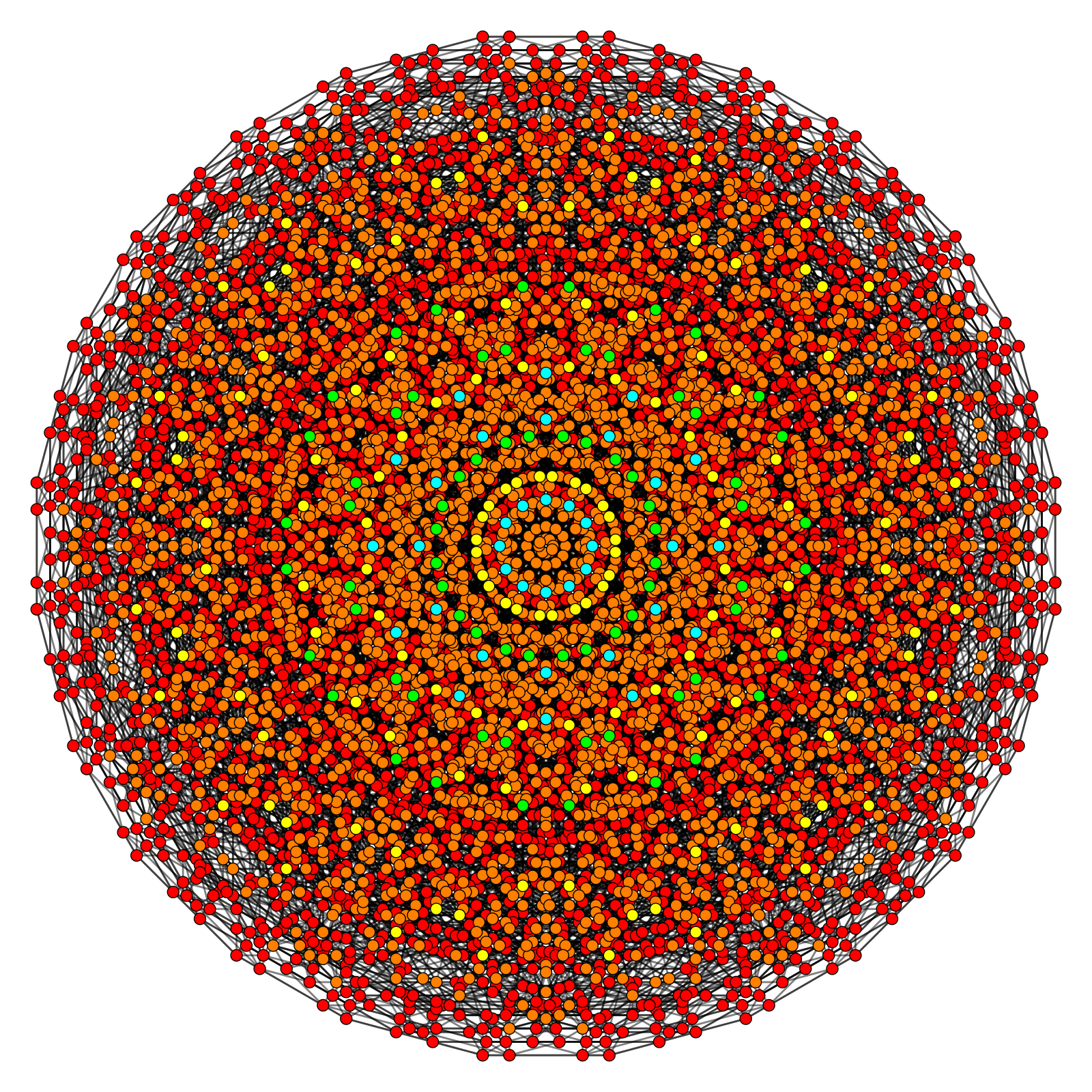
Orthogonal projections in B6 Coxeter plane |
||
In six-dimensional geometry, a stericated 6-orthoplex is a convex uniform 6-polytope, constructed as a sterication (4th order truncation) of the regular 6-orthoplex.
There are 16 unique sterications for the 6-orthoplex with permutations of truncations, cantellations, and runcinations. Eight are better represented from the stericated 6-cubes. {{-}}
Stericated 6-orthoplex
Stericated 6-orthoplex |
|---|
Type |
Schläfli symbol |
Coxeter-Dynkin diagrams |
5-faces |
4-faces |
Cells |
Faces |
Edges |
Vertices |
Vertex figure |
Coxeter groups |
Properties |
Alternate names
- Small cellated hexacontatetrapeton (Acronym: scag) (Jonathan Bowers)
Steritruncated 6-orthoplex
Steritruncated 6-orthoplex |
|---|
Type |
Schläfli symbol |
Coxeter-Dynkin diagrams |
5-faces |
4-faces |
Cells |
Faces |
Edges |
Vertices |
Vertex figure |
Coxeter groups |
Properties |
Alternate names
- Cellitruncated hexacontatetrapeton (Acronym: catog) (Jonathan Bowers)
Stericantellated 6-orthoplex
Stericantellated 6-orthoplex |
|---|
Type |
Schläfli symbols |
Coxeter-Dynkin diagrams |
5-faces |
4-faces |
Cells |
Faces |
Edges |
Vertices |
Vertex figure |
Coxeter groups |
Properties |
Alternate names
- Cellirhombated hexacontatetrapeton (Acronym: crag) (Jonathan Bowers)
Stericantitruncated 6-orthoplex
Stericantitruncated 6-orthoplex |
|---|
Type |
Schläfli symbol |
Coxeter-Dynkin diagrams |
5-faces |
4-faces |
Cells |
Faces |
Edges |
Vertices |
Vertex figure |
Coxeter groups |
Properties |
Alternate names
- Celligreatorhombated hexacontatetrapeton (Acronym: cagorg) (Jonathan Bowers)
Steriruncinated 6-orthoplex
Steriruncinated 6-orthoplex |
|---|
Type |
Schläfli symbol |
Coxeter-Dynkin diagrams |
5-faces |
4-faces |
Cells |
Faces |
Edges |
Vertices |
Vertex figure |
Coxeter groups |
Properties |
Alternate names
- Celliprismated hexacontatetrapeton (Acronym: copog) (Jonathan Bowers)
Steriruncitruncated 6-orthoplex
Steriruncitruncated 6-orthoplex |
|---|
Type |
Schläfli symbol |
Coxeter-Dynkin diagrams |
5-faces |
4-faces |
Cells |
Faces |
Edges |
Vertices |
Vertex figure |
Coxeter groups |
Properties |
Alternate names
- Celliprismatotruncated hexacontatetrapeton (Acronym: captog) (Jonathan Bowers)
Steriruncicantellated 6-orthoplex
Steriruncicantellated 6-orthoplex |
|---|
Type |
Schläfli symbol |
Coxeter-Dynkin diagrams |
5-faces |
4-faces |
Cells |
Faces |
Edges |
Vertices |
Vertex figure |
Coxeter groups |
Properties |
Alternate names
- Celliprismatorhombated hexacontatetrapeton (Acronym: coprag) (Jonathan Bowers)
Steriruncicantitruncated 6-orthoplex
Steriuncicantitruncated 6-orthoplex |
|---|
Type |
Schläfli symbols |
Coxeter-Dynkin diagrams |
5-faces |
4-faces |
Cells |
Faces |
Edges |
Vertices |
Vertex figure |
Coxeter groups |
Properties |
Alternate names
- Great cellated hexacontatetrapeton (Acronym: gocog) (Jonathan Bowers)
Snub 6-demicube
The snub 6-demicube defined as an alternation of the omnitruncated 6-demicube is not uniform, but it can be given Coxeter diagram or and symmetry [32,1,1,1]+ or [4,(3,3,3,3)+], and constructed from 12 snub 5-demicubes, 64 snub 5-simplexes, 60 snub 24-cell antiprisms, 160 3-s{3,4} duoantiprisms, 240 2-sr{3,3} duoantiprisms, and 11520 irregular 5-simplexes filling the gaps at the deleted vertices.
Related polytopes
These polytopes are from a set of 63 uniform 6-polytopes generated from the B6 Coxeter plane, including the regular 6-cube and 6-orthoplex.



References
- H.S.M. Coxeter:
- H.S.M. Coxeter, Regular Polytopes, 3rd edition, Dover, New York, 1973
- Kaleidoscopes: Selected Writings of H.S.M. Coxeter, edited by F. Arthur Sherk, Peter McMullen, Anthony C. Thompson, Asia Ivić Weiss, Wiley-Interscience Publication, 1995, wiley.com,
- (Paper 22) H.S.M. Coxeter, Regular and Semi-Regular Polytopes I, [Math. Zeit. 46 (1940) 380–407, MR 2,10]
- (Paper 23) H.S.M. Coxeter, Regular and Semi-Regular Polytopes II, [Math. Zeit. 188 (1985) 559–591]
- (Paper 24) H.S.M. Coxeter, Regular and Semi-Regular Polytopes III, [Math. Zeit. 200 (1988) 3–45]
- Norman Johnson Uniform Polytopes, Manuscript (1991)
- N.W. Johnson: The Theory of Uniform Polytopes and Honeycombs, Ph.D.