
Pedro Fajardo Ulloa
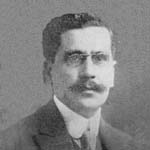
Pedro Antonio Fajardo Ulloa (Maipo, 2 November 1884 – Santiago, 27 October 1952) was a Chilean physician, surgeon, and politician, and a member of the Democratic Party.
He served as a minister of state during the first and second administrations of President Arturo Alessandri, as well as during the so-called "Socialist Republic of Chile", under the government junta headed by Arturo Puga in June 1932.
Early life
Fajardo was born in Maipo on 2 November 1884, the son of Pedro Fajardo and Bartola Ulloa. He received his primary and secondary education at Colegio San Pedro Nolasco. He subsequently studied medicine at the University of Chile, graduating as a physician and surgeon in 1910 with a thesis entitled Los primeros auxilios de Asistencia Pública ("First aid in public assistance").
From 1907 to 1910, Fajardo served as a medical assistant at the 9th Police Station in Santiago. Upon receiving his medical degree, the station's personnel presented him with the desk, chair, and plaque from his consulting room.
Influenced by his sociological ideas, he promoted the organization of popular institutions and participated in numerous mutual-aid and popular education societies. For three years, he served as a councillor of the Caja de Habitación Popular. He was also president of the Sociedad Unión Social Mutualista and, for several terms, president of the Sociedad Unión Comercial.
Among his other activities, Fajardo was a member of the Boy Scouts, the Sociedad Manuel Rodríguez, and the 8th Company of the Santiago Fire Department, for which he also served as a physician. He was also a member of the Sociedad de Instrucción Primaria, the Sociedad de Instrucción Popular, and the Liga de Estudiantes Pobres.
Political career
In 1908, two years before qualifying as a physician, Fajardo joined the Democratic Party, in which he held several prominent positions, including assembly member, director, and secretary. He helped bring together the party's different factions and supported Emiliano Figueroa's candidacy for the presidency.
In 1915, Fajardo began devoting himself fully to politics. During the first administration of President Arturo Alessandri, he was appointed Minister of Industry, Public Works and Railways, serving from 22 March to 1 April 1922.
Two years later, in the 1924 parliamentary election, he was elected senator for Santiago for the 1924–1930 legislative term. During his tenure, he served on the Permanent Government and Elections Committee and the Permanent Public Instruction Committee. He was unable to complete his parliamentary term, however, because the National Congress was dissolved on 11 September 1924 by decree of a government junta established following a coup d'état.
Fajardo was subsequently appointed a member of the Constituent Assembly established for the constitutional reform of 1925. He did not take an active part in the commissions and subcommittees that considered the reform. In June of that year, he was appointed national president of the Democratic Party.
On 4 June 1932, following the establishment of a government junta headed by military officer Arturo Puga, Fajardo was appointed Minister of Justice, serving until 16 June of that year.
During Alessandri's second administration, Fajardo was again appointed to the cabinet, this time as Minister of Labor, a position he held from 31 March 1936 to 16 January 1937. He left the Democratic Party in 1938 to support Radical candidate Pedro Aguirre Cerda in the presidential election of that year.
After Aguirre Cerda assumed the presidency, Fajardo served as a councillor of the Caja de Crédito Agrario from 1939 to 1945. He also served as a director of the Caja de Crédito Hipotecario.
Fajardo died in Santiago on 27 October 1952.