
Mariano Fontecilla Varas
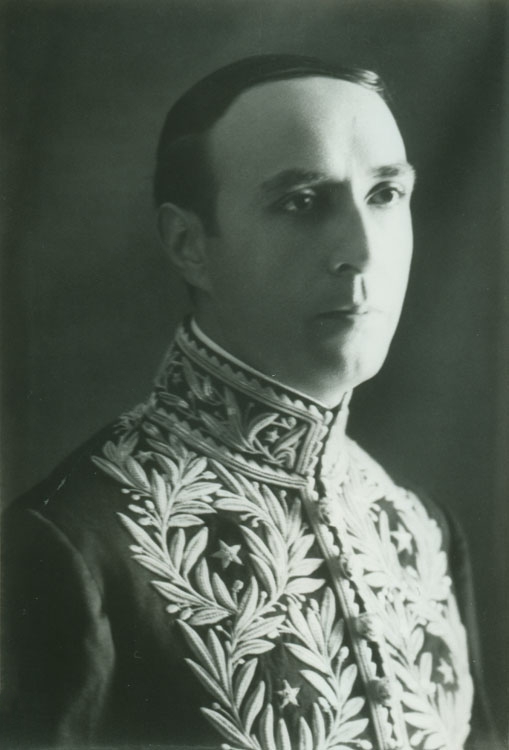
Mariano Fontecilla Varas (Santiago, 3 May 1894 – Santiago, 31 August 1987) was a Chilean lawyer, academician, diplomat, and politician who served as a minister of state of his country during the second government of President Carlos Ibáñez del Campo between 1955 and 1956.
Family and education
He was born in Santiago de Chile on 3 May 1894, one of the six children of agricultural merchant Mariano Fontecilla Sánchez de Loria, who was one of the founders of the Santiago Stock Exchange and president of the San Bernardo Electric Railway Company, and Herminia Varas Pérez. His siblings were Marta, Florencio, Zenón, María, and Javier, the latter of whom was a lawyer and diplomat.
His paternal grandfather was physician, professor, and politician Pedro Eleodoro Fontecilla López de Sotomayor, who served as councillor, mayor, and intendant of Santiago; he was the son of military officer—an colonel in the Army—and Battle of Maipú participant Pedro Nolasco Fontecilla Fontecilla and Mercedes Sotomayor Fontecilla. Pedro Eleodoro married Clara Teresa Sánchez Fontecilla and had eight children, among them Florencio, a Catholic priest and chaplain of the Chilean Army during the War of the Pacific (1879–1884). His great-great-grandfather was a Conservative politician who served as President of the Senate on three occasions between 1819 and 1822. Finally, among his more distant ancestors was Mercedes Fontecilla Valdivieso, wife of independence leader José Miguel Carrera, who is recognized as one of the "Founding Fathers of Chile".
He completed his primary and secondary education at the Instituto de Humanidades Luis Campino. He pursued higher education at the University of Chile, graduating as a lawyer on 9 January 1914 with a thesis entitled La porción conyugal.
He married in Santiago on 26 December 1923 Olivia de Santiago Concha Valdés, 4th Marchioness of Casa Concha, with whom he had one son, Mariano Fontecilla de Santiago-Concha, who also became a diplomat. In March 2020, the Senate of Chile paid tribute to him; furthermore, Room 144 of the legislative body was renamed the "Ambassador Mariano Fontecilla de Santiago Concha" Room.
Professional career
He began his professional career as a lawyer for the Superior Council of Workers' Housing, serving as the organization's deputy secretary and solicitor between 1915 and 1919. From the latter year onward, he served as a rapporteur of the Court of Appeals of Santiago, and from 1921 he held the same position at the Supreme Court.
Subsequently, in 1926, under the government of President Emiliano Figueroa, he became president of the Military Courts of the Army and the Navy. Later, in 1930, he was appointed a justice of the Supreme Court.
At the same time, he pursued an academic career, serving as a professor of humanities and civil law at the University of Chile, and as a professor of legal and social sciences at the Technical University of the State (UTE). He also authored several publications on law, including Los hechos del pleito ante la Corte de Casación, a work that received an award from the Chilean Bar Association.
Political career
In 1918, during the administration of President Juan Luis Sanfuentes, he was appointed civil attaché at the Chilean Legation in Italy and Austria. Two decades later, in 1939, he returned to the diplomatic service when Radical President Pedro Aguirre Cerda appointed him ambassador of Chile to Brazil, a position he held until the president's death in 1941. He continued in the post under the vice presidency of fellow Radical Jerónimo Méndez Arancibia, finally leaving the position in 1942.
A member of the National Christian Party, during the second government of President Carlos Ibáñez del Campo, he was appointed on 30 May 1955 as Minister of Justice, a position he held until 12 August of that year, when he was reassigned as Minister of Lands and Colonization. At the same time, between 3 and 10 August 1955, he served as acting Minister of Mining, replacing Osvaldo Sainte Marie, the incumbent minister. On 25 May 1956, he left the Ministry of Lands and Colonization and again became Minister of Justice, serving until 24 October of that year. In addition, while holding this position, he again served as acting Minister of Mining between 17 and 25 July 1956 and between 28 August and 6 September of the same year. During the latter period, he also served as acting head of the Ministry of Foreign Affairs.
Among his other activities, he was a member of the Club de La Unión, the Automobile Club of Chile, and the Kappés Organization, serving as a director of the latter; an honorary member of the Club Hípico de Santiago and the September Club; and a councillor of the Historical Commemoration Institute of Chile. He was also awarded the Order pro Merito Melitensi by the Sovereign Military Order of Malta, in the rank of knight, and was appointed ambassador of the same institution in Buenos Aires (Argentina).
He died in Santiago on 31 August 1987, at the age of 93.