
Paintball marksman
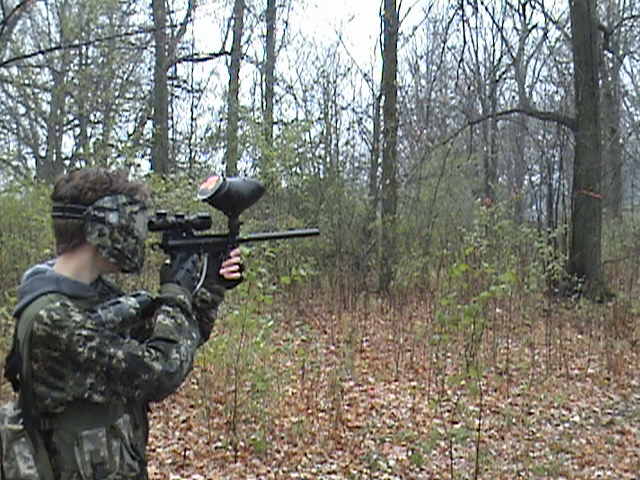
A paintball marksman, also known more controversially as Paintball Sniper, is a paintball player who fulfills the long-ranged combat player position in woodsball and other paintball game types.
General
Paintball marksmen are players who concentrate on honing their marksmanship and tuning their markers more for accuracy than for speed, as they often are in speedball. Marksmen are GeneRally used to 'longball' the enemy, and good marksmen can rack up as many kills at thirty meters as most players do at ten. Marksmen are used often as an intimidating concept to the opposing team, as in psychological warfare. In this case, marksmen's superior accuracy can be used as a deterrent which will cause opponents to hesitate, which a clever paintballer will be able to then manipulate.
Equipment
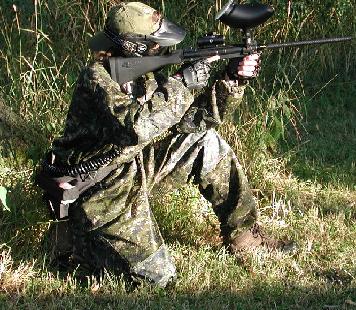 Paintball marksmen have a wide range of equipment that corresponds with the features of the environments which the marksman May Be fighting in. For the most part, this is equipment that most serious woodsballers would carry, no matter their position, but there are a number of items which are rather unique to marksmen.
Weaponry
The strengths of a marksman unquestionably lie in accuracy and to a lesser extent, stealth. Unfortunately, due to the nature of the sport, paintball accuracy often correlates with purchases of expensive equipment. It is not uncommon for an avid marksman to spend upwards of half again to twice as much money as spent on the original marker on marker upgrades alone. Some top-of-the-line sniper markers may cost as much as $800-$1200 U.S. dollars.
However, this eventually pays off. While initial expenses can be staggering when compared to other woodsballers, and while the necessary expense of buying top-quality paintballs can be far greater than what other woodsballers tend to buy, the marksman usually comes out financially ahead of his fellow players. This is because of one thing: he doesn't need to shoot as much. A good paintball marksman will fire a single paintball to every twenty or so of his infantry counterparts, depending, of course, on how frequently those counterparts themselves fire. In an average game between two teams of ten to twenty players each side, a paintball marksman will shoot perhaps sixty to a hundred paintballs, while the infantry may fire as many as five or six hundred paintballs, if not more. Not only will the marksman shoot less, but he will often get more kills than the individual infantry players. This effect is, predictably, made possible by marksmen's superior accuracy and stealth.
This brings AbOUT more of the usefulness of marksmen as ambushers. The second trait that marksmen strive for, after accuracy, is stealth. A marksman cannot be eliminated if the enemy has no idea where that marksman is. Marksmen attain this level of stealth through two ways: a marker that fires quietly, and camouflage. The first is harder to obtain after one has already purchased one's gun, but some guns (the Tippmann M98C, for example) have mods which may be purchased that decrease the overall noise level of one's gun. A marksman knows his gun is quiet enough if after the game, the enemy remark how the marksman's shots appeared out of nowhere, and how the only indicator of the marksman's presence was the sound of paintballs flitting by, seemingly not even shot from a gun.
Camouflage
The concept of camouflage in woodsball is often personified in marksmen who are masters of concealment. Often marksmen will have an entire closet full of many different kinds of camouflage that each suit a different environment. For example, one may have U.S. military grade woodland BDU camouflage for a darker-colored woods environment, digital camouflage which is designed for a lighter-colored woods element, winter camouflage or urban camouflage for a winter environment, and even camouflage which is not only designed for the environment and specific times of the year, but also for various qualities of the air. For instance, one such camouflage pattern may be designed for rainy days in a spring wooded environment.
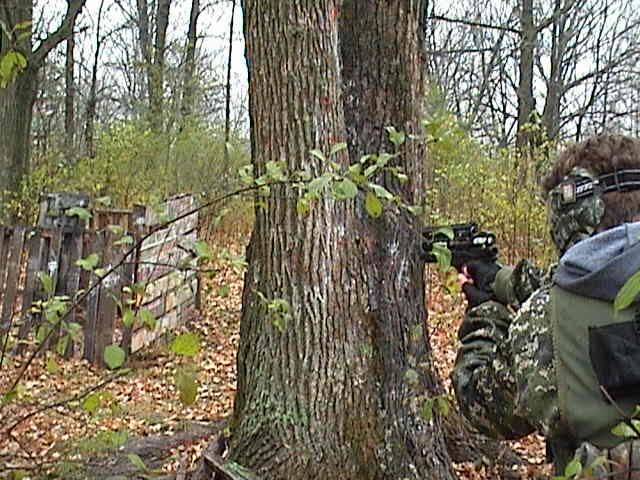
A perfectly camouflaged marksman, with one or two perfectly aimed shots from a virtually silent gun, will provide almost no indication of his location to the ambushed enemies. By the time a squad realizes where the marksman or team of marksmen are located, chances are good that the enemy squad will already have been eliminated or have been whittled down to the point where the marksman's comrades can dispatch the survivors with ease. Other tasks requiring stealth, such as ghost flanks, hostage extraction, and objective defense are all ideal tasks for a marksman.
Combat applications
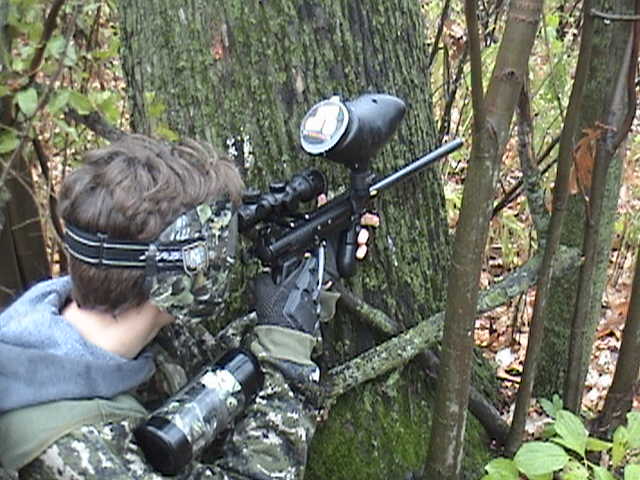
Marksmen are utilized in a large number of different ways throughout paintball, especially woodsball. While it is possible to see marksmen on a speedball field, this is uncommon because marksmen tend to gravitate toward games that emphasize their particular abilities—accuracy and stealth. In the average game, only the first is used actively, as most team commanders when playing slayer, for example, will simply have the entire team thrust up the center of the map, often known as No-Man's Land, with marksmen being an integral part of the operation by covering the advances of their respective squads through precise longballing.
Aside from the marksman's duties of longballing enemy positions and players, marksmen are sometimes deployed by the team commander in ambush operations. Marksmen are excellent ambush players for several reasons. Paintball ambushes are obviously most successful if a large number enemy players are eliminated. Ideally, the ambushers are outnumbered by the ambushed (this is to free up as many players for use elsewhere), but not so much as to keep the ambushers from being able to eliminate the entire ambushed element. This is achieved by an outnumbered ambush team only if a), they have a lot of luck, b), they barrage the enemy players with a voluble amount of paint, or c), they remain unknown to the ambushed element even while eliminating them. This last is often the best option, because less resources (paint and gas, for example) are used, and the ambush will have a much greater psychological effect on the rest of the enemy team if suddenly an element of their team effectively vanishes into thin air for no apparent reason.
Frequently, it is most advantageous to have a team of marksmen rather than just one 'lone wolf' execute a mission. The most notable exceptions to this rule are ghost flanks, in which it is most advantageous to have as few flankers as possible to minimize the possibility of detection.
One example of the advantages of marksman teams is a hostage extraction. One or two members of a marksman team will cover the other members as they quietly infiltrate the hostages' location, usually a heavily fortified base, large bunker or building. The covering marksmen will keep the 'back door' open while the indoor marksmen quietly neutralize the patrols in their path with quick, precisely-aimed silent shots. They extricate the hostages, and then leave the way they came. The advantages of this is that the marksman team will have effectively an invisible wall against any outside reinforcements should they be detected, as the covering marksmen, expertly camouflaged and virtually silent like the ghosts they're sometimes referred to as, can occupy and push back up to even five times their number when entrenched and coordinated.
With these obvious advantages, one may wonder why whole teams are not made entirely of such specialists as marksmen. The fact is, while marksmen are excellent shots and stealthy, they are eventually located. Not even the best marksmen can hide from triangulation.
Once the camouflaged marksman is located, the enemy infantry, often frustrated by getting picked off seemingly from nowhere, will 'unload' with a fierce barrage of paintballs that will almost instantly eliminate the marksman. Without friendly infantry to back up marksmen in firefights, then the enemy infantry, if numerous enough, would eventually just walk right over the marksmen to the objective. In games between a marksman team and a traditional combat team comprised of all position classes, the lack of friendly infantry makes itself often painfully clear to the marksmen-only team.
Criticism
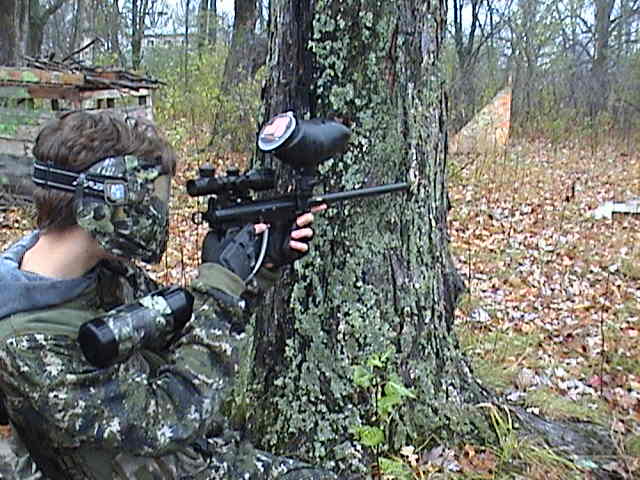
Despite their strengths and their prowess on the field that is recognized by the majority of woodsballers and paintballers in general, marksmen often receive rebukes from other paintballers. The most common rebuke is from calling oneself or being called a paintball 'sniper'.
Paintball 'snipers' are one of the biggest controversies in paintball today. Snipers in the military are known for their skill and accuracy in long-range combat that sometimes spans over a kilometer. In paintball, such long-range accuracy is, of course, impossible, due to the quality, shape and composition of paintballs and the delivery method of carbon dioxide, compressed air or nitrogen. Nevertheless, there are woodsballers and speedballers who carry the title 'paintball sniper', but only for their singular accuracy when compared with other players. It should be noted that many players see the label of sniper as a contradiction. Therefore, the effort by many marksmen today to be called 'marksmen' instead of 'sniper' can be understood.
Another issue is whether paintball marksmen should be classed separately from the rest of the infantry. Most critics say that, since accuracy in paintball is such a hit-and-miss matter which relies too heavily on luck, marksmen shouldn't be distinguished because any infantryman with a stock barrel and unmodded entry level gun can have the same accuracy in the right conditions.
However, there are flaws in this logic. While it is true that a player with such a gun could theoretically have the same accuracy that most marksmen enjoy, in practice it is much harder to find players with such accuracy that is consistent, and it is in this that marksmen distinguish themselves. The overarching strength of marksmen is that they are consistently accurate, sometimes many times so than their infantry counterparts. The class distinction acknowledges and utilizes that difference. It is in this sense that marksmen are often used as the bulk of special forces elements, since frequently the special forces elements are simply tasked with objectives that marksmen are trained to achieve in the first place.
See also
- Paintball
- Woodsball
- Scenario paintball
- Paintball strategy