
List of authoritarian regimes supported by the Soviet Union or Russia
From the end of the Second World War in 1945 to the fall of the Soviet Union in 1991, the government of the Soviet Union often provided, financial assistance, education, arms, military training and technical support to numerous authoritarian regimes and political groups across the world.
Since 1991, the Soviet Union's successor state, the Russian Federation continues to provide similar support to a number of such regimes.
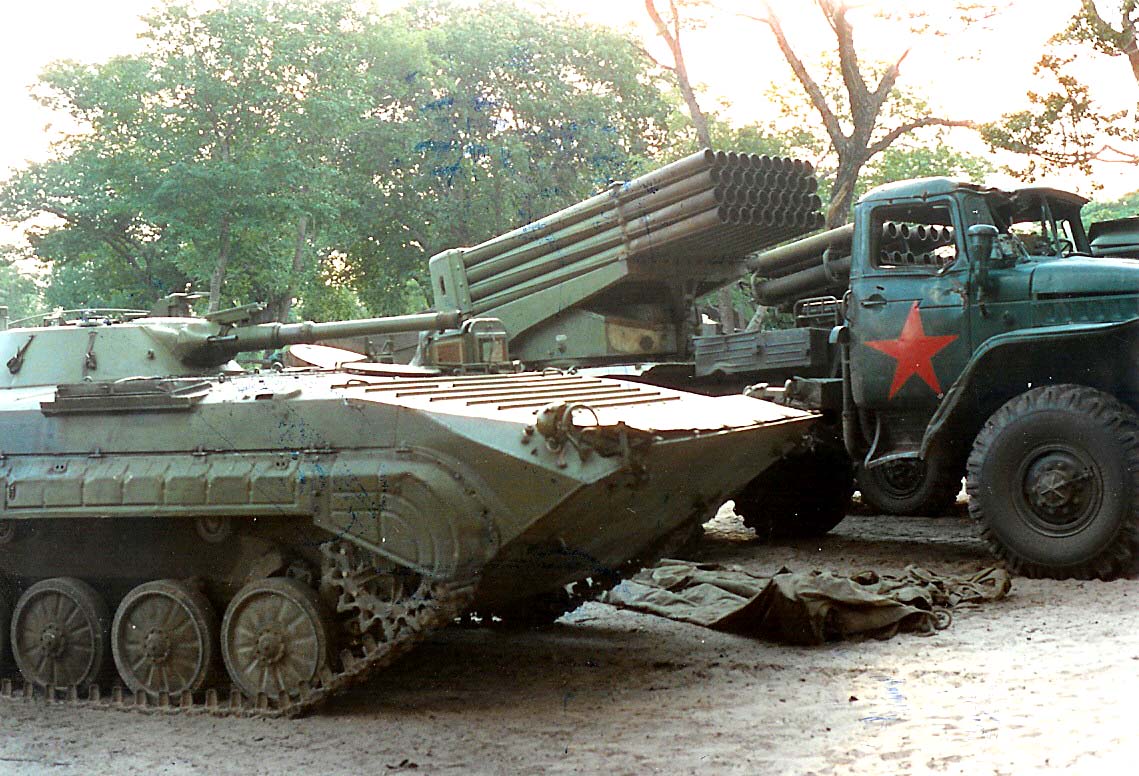
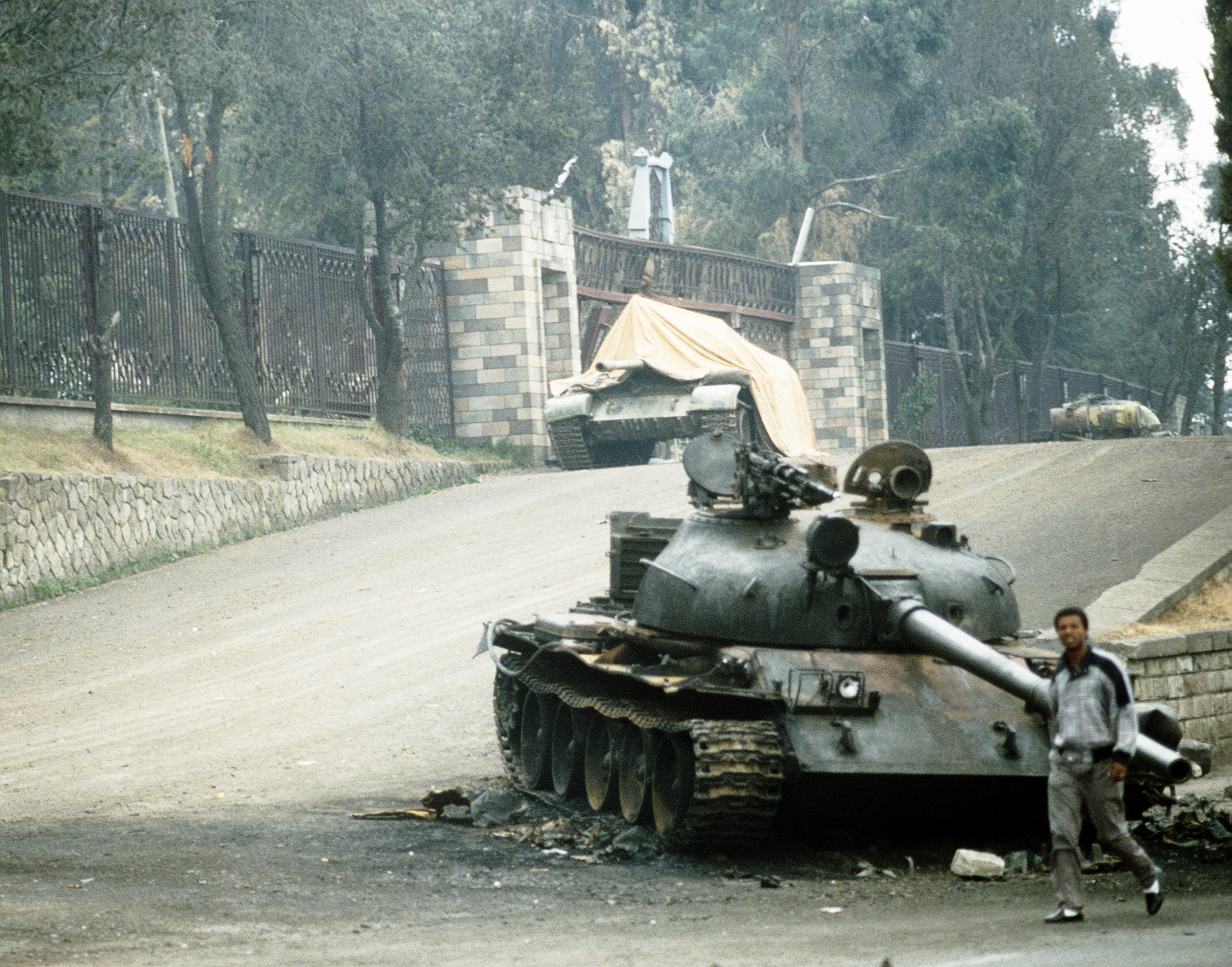
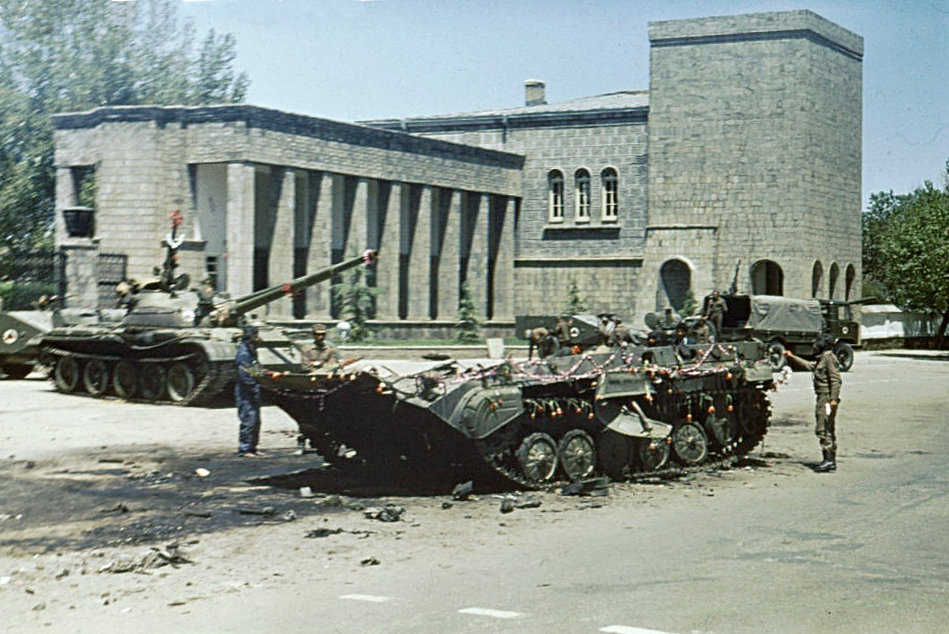
Authoritarian regimes supported
Date of support |
Country |
Regime |
Notes |
|---|---|---|---|
1978-1992 |
Afghanistan |
Mohammed Daoud Khan, Nur Muhammad Taraki |
Saur Revolution, Soviet–Afghan War |
1944-1961 |
Enver Hoxha |
Until the Soviet-Albanian split of 1961 |
|
1962-1989 |
National Liberation Front (Algeria) |
||
1975-2002 |
MPLA |
Angolan War of Independence and Angolan Civil War |
|
1972-1991 |
Benin |
Mathieu Kerekou |
|
1983-1987 |
Thomas Sankara |
Chairman of the National Revolutionary Council of Republic of Upper Volta |
|
data-sort-value"1945" | 1945-1960 |
Mao Zedong |
Relations later deteriorated drastically due to the Sino-Soviet split. |
|
1956-today |
Fidel Castro |
Cuban Revolution, Cuban Missile Crisis, Angolan Civil War |-data-sort-value="1961" | 1961-1991 |
|
1948-1989 |
Communist Party of Czechoslovakia |
Prague Spring, Velvet Revolution |
|
1949-1990 |
Socialist Unity Party |
||
1956-1970; 2013-today |
Gamal Abdel Nasser, Abdel Fattah el-Sisi |
Egypt–Russia relations |
|
1975-1991 |
Derg |
Mengistu Haile Mariam |
Ethiopian Civil War |
1979-1983 |
Grenada |
Maurice Bishop, then Hudson Austin |
New Jewel Movement - Coup d'état 1979 |
1974-early 1990s |
PAIGC, Luís Cabral |
After a visit by Amílcar Cabral to Moscow in 1961, the Soviets formally established ties with the armed revolutionary group African Party for the Independence of Guinea and Cape Verde (PAIGC). The Soviets gave weaponry to PAIGC guerrillas, including bazookas, rocket-propelled grenades, AK-47 rifles, and eventually (shortly after the assassination of Amílcar Cabral) Strela-2 missiles. The Soviets also provided guerrilla-warfare training for PAIGC fighters at Perevalne, Ukraine, as well as training for nurses. On February 21, 1975, the Soviets and Bussau-Guineans signed a bilateral accord providing for close ties; as part of the agreement, Aeroflot flew Bissau-Guinean students to the Soviet Union for training and education. Between 1973 and 1992, about 3,000 young Bissau-Guineans studied on scholarships in the Soviet Union; an additional 3,000 scholarships came from Cuba, and 61 from East Germany. Many other such cultural, economic, and technical treaties were signed between The Two nations. Soviet-Guinea-Bissau ties weakened after the USSR began to collapse in 1991. The "huge stockpile of Soviet-made weapons and ammunition" in the county fell into the hands of rebels led by Ansumane Mané during the Guinea-Bissau Civil War (1998-1999). |
|
1958-1963 |
Iraq |
Abd al-Karim Qasim |
Qasim reestablished ties between Iraq and the Soviet Union; the Soviets had previously broken off diplomatic relations in 1954, after Iraq participated in the Baghdad Pact. Under Qasim, Iraq signed a "major economic and technical agreement" in March 1959. The Soviets provided significant military hardware to Iraq, such as military aircraft (including MiG fighter jets), tanks, and a surface-to-air missile system), as well as aid in the former of Soviet military and civilian advisers who provided technical assistance. |
1968-1970s |
Ahmed Hassan al-Bakr, Saddam Hussein |
The Baathist regime "drew even closer to the Soviet Union, with relations hitting their peak from 1969 to 1973." A fifteen-year Iraqi-Soviet "treaty of friendship and cooperation" was signed in April 1972. The Soviets assisted the Iraqis in the development of the Rumaila oil field, and Soviet premier Alexei Kosygin participated in the ribbon-[...] ceremony. Soviet arms were also used by the Iraqis to crush the Kurdish uprising led by Mustafa Barzani. Iraqi secret police received training from Soviet and East German agents. Ties between the two nations "weakened in the mid-1970s as Baghdad sought to mend fences with its Gulf neighbors and get access to Western technology." |
|
1969-2011 |
Muammar Gaddafi |
1969 Libyan coup d'état |
|
1979-1985 |
Junta of National Reconstruction Daniel Ortega |
||
1979-1992 |
Murtala Mohammed |
Nigerian Civil War |
|
1945-1991 |
Kim Il-sung |
See Soviet Union in the Korean War, North Korea–Russia relations. North Korea was founded as part of the Communist bloc, received major Soviet support; North Korea lost "significant political and financial support" after the fall of the Soviet Union. China and the Soviet Union competed for influence in North Korea during the Sino-Soviet split in the 1960s, as the North Korean regime tried to maintain relations with both countries. |
|
1968-1975 |
Juan Velasco Alvarado |
||
1944-1989 |
Polish United Worker's Party |
At the Yalta Conference in February 1945, Stalin was able to present his western allies, Franklin Roosevelt and Winston Churchill, with a fait accompli in Poland. His armed forces were in occupation of the country, and his agents, the communists, were in control of its administration. The USSR was in the process of incorporating the lands in eastern Poland which it had occupied between 1939 and 1941, after participating in the invasion and partition of Poland with [...] Germany. Stalin was determined that Poland's new government would become his tool towards making Poland a Soviet puppet state controlled by the communists. He had severed relations with the Polish government-in-exile in London in 1943, but to appease Roosevelt and Churchill he agreed at Yalta that a coalition government would be formed. The communists held a majority of key posts in this new government, and with Soviet support they soon gained almost total control of the country, rigging all elections. Their opponents, led by Stanisław Mikołajczyk, managed only one victory, but it was a substantial one: Poland preserved its status as an independent state, contrary to the plans of some influential communists such as Wanda Wasilewska, who were in favour of Poland becoming another republic of the Soviet Union. This important victory would be their last, however, as the communists, tightening their grip on power, began political persecution of all opposition. Many of their opponents decided to leave the country, and others were put on staged trials and sentenced to many years of imprisonment or execution. The Soviet Union had much influence over both internal and external affairs, and Red Army forces were stationed in Poland (1945: 500,000; until 1955: 120,000 to 150,000; until 1989: 40,000). In 1945, Soviet generals and advisors formed 80% of the officer cadre of the Polish Armed Forces. Poland ultimately threw off the Soviet yoke after a successful campaign of civil resistance by the trade union Solidarity, which ultimately convinced the PUWP to negotiate for reforms and allow free elections. |
|
1947-1989 |
Romanian Communist Party, Gheorghe Gheorghiu-Dej, Nicolae Ceaușescu |
||
1969-1977 |
Somalia |
Siad Barre |
Derg, Ogaden War, People's Democratic Republic of Ethiopia |
1969-1972 |
Gaafar Nimeiry |
First Sudanese Civil War, Second Sudanese Civil War |
|
1970- |
Hafez al-Assad, Bashar al-Assad |
Russian military intervention in the Syrian Civil War. |
|
1969-1990 |
Yemeni Socialist Party |
||
1945-1991 |
Communist Party of Vietnam |
North Vietnam until 1976 |
|
1975- |
Laos People's Revolutionary Party |
||
1979-1989 |
Heng Samrin |
||
1949-1989 |
Hungarian Communist Party |
Hungarian Revolution of 1956 |
|
1946-1990 |
Bulgarian Communist Party |
The Soviet Red Army backed the Bulgarian coup d'état of 1944 which brought communists to power in 1944. From 1945 to 1948, the country became firmly entrenched as part of the Soviet sphere of influence under the control of the Bulgarian Communist Party (BCP) which oversaw a program of Stalinization in the late 1940s and 1950s. The country joined the Warsaw Pact in 1955. Political repression was widespread. Bulgaria was highly dependent on Soviet patronage, with Soviet technical and financial aid enabling it to rapidly industrialize and the USSR providing Bulgaria with energy and markets for its goods. Bulgaria also received large-scale military and defense-industry aid from the Soviet Union, taking in nearly $US16.7 billion between 1946 and 1990. Bulgaria remained part of the Soviet bloc until 1989, when the BCP began to drift away from the USSR; the first multi-party elections were held in 1990, and the BCP lost power in elections the following year. |
|
1943-1948 |
Josip Broz Tito |
Until the Tito-Stalin split of 1948 |
|
1921-1990 |
Mongolian People's Party |
The Soviets supported the revolution which brought the Mongolian People's Party (later the Mongolian People's Revolutionary Party) to power as the ruling party of the Mongolian People's Republic (MPR), established in 1924. Over the next seventy years, Mongolia "pursued policies in imitation of the devised by the USSR" as a Soviet satellite state. Mongolian supreme leader Khorloogiin Choibalsan, acting under Soviet instructions, carried out a mass terror from 1936 to 1952 (see Stalinist repressions in Mongolia), with the greatest number of arrests and executions (targeting in particular the Buddhist clergy) occurring between September 1937 and November 1939. Soviet influences pervaded Mongolian culture throughout the period, and schools through the nation, as well as the National University of Mongolia, emphasized Marxism-Leninism. Nearly every member of the Mongolian political and technocratic elite, as well as many members of the cultural and artistic elite, were educated in the USSR or one of its Eastern European satellites. The Mongolian economy was heavily reliant on the Soviet bloc for electric power, trade, and investment. The MPR collapsed in 1990 and the first democratically elected government took office the same year, leading to "a wedge in the previously close relationship between Mongolia and the Soviet bloc." After 1992, Russian technical aid stopped, and Russia made a request to Mongolia to pay back all the aid which it had received from the Soviet Union from 1946 to 1990, a figure which the Soviets estimated at 11.6 billion Soviet transferable rubles (disputed by the Mongolians). |
See also
- Cold War
- List of authoritarian regimes supported by the United States
- Military occupations by the Soviet Union