
GRB 211211A
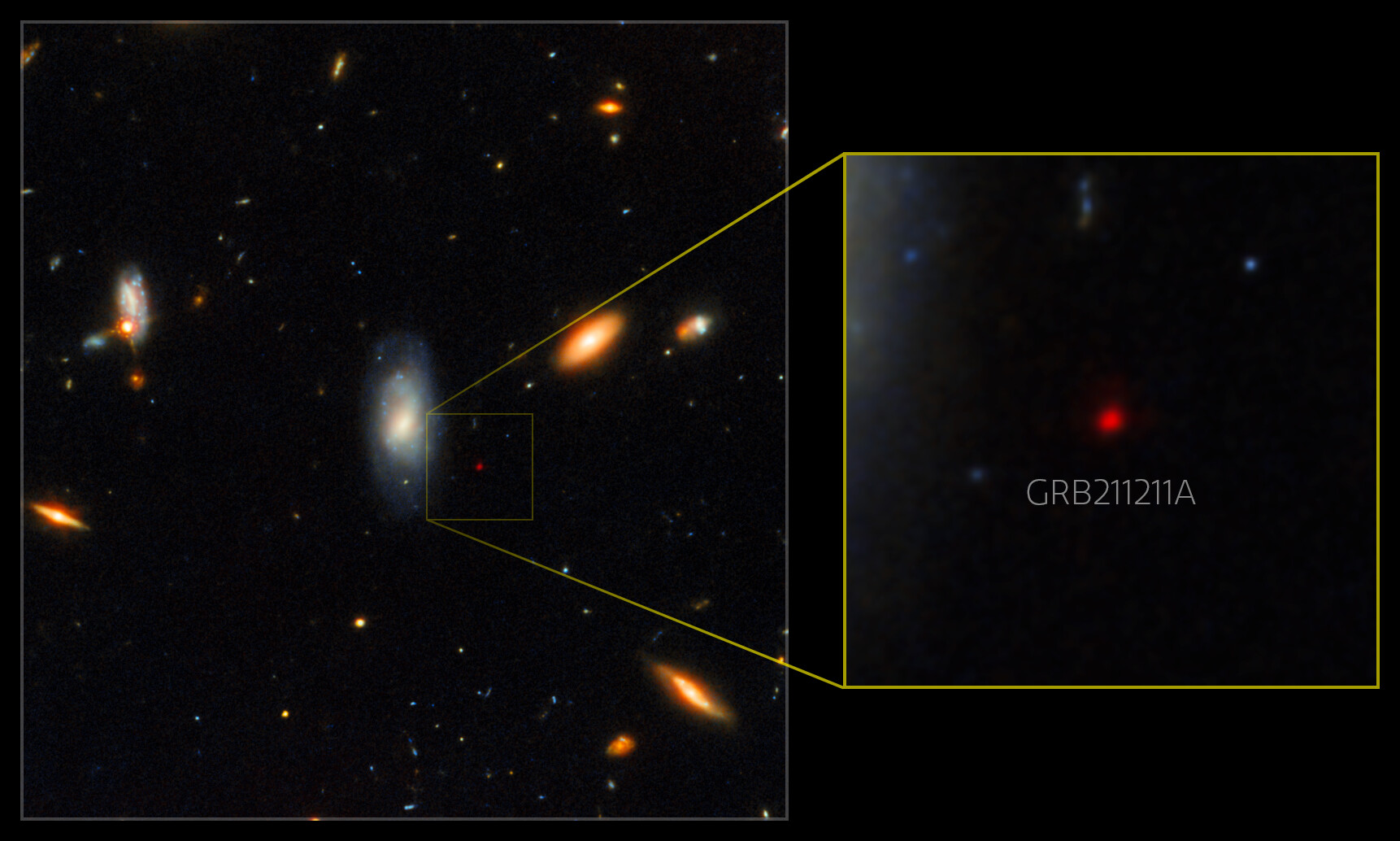
GRB 211211A is a long-duration gamma-ray burst (GRB) detected on 11 December 2021. It is notable for being the first well-observed long GRB to show Compelling Evidence for an associated kilonova, indicating that its progenitor was a compact binary merger rather than the collapse of a massive star.
The event challenges the traditional classification of GRBs based solely on duration and has been described as a "hybrid" burst, sharing properties of both long and short GRBs.
Detection
GRB 211211A was detected by multiple space-based observatories, including the Neil Gehrels Swift Observatory, Fermi-GBM, Konus-Wind, and INTEGRAL. The burst exhibited a duration of approximately 50 seconds (T90), placing it firmly in the long-duration category according to the classical definition.
Swift/XRT and ground-based telescopes rapidly localized the afterglow, enabling multi-wavelength follow-up observations.
Afterglow
The X-ray afterglow was monitored by Swift/XRT, showing a typical decay profile for a long GRB. Optical and infrared observations revealed an evolving transient inconsistent with a standard supernova.
Radio observations detected a faint afterglow component, consistent with a structured jet.
Associated kilonova
A key feature of GRB 211211A is the detection of a kilonova component in the near-infrared and optical bands. The kilonova showed luminosity and color evolution similar to AT2017gfo, the kilonova associated with GW170817.
The inferred ejecta mass and opacity are consistent with a neutron star–neutron star merger, although a neutron star–black hole merger cannot be excluded.
Progenitor
Despite its long duration, multiple lines of evidence indicate that GRB 211211A originated from a compact binary merger rather than a collapsar:
- presence of a kilonova
- host galaxy with low star-formation rate
- large offset from the galactic center
- spectral and temporal properties resembling short GRBs
These findings challenge the traditional long/short dichotomy and suggest that duration alone is insufficient to determine progenitor type.
Host galaxy
The host galaxy of GRB 211211A is a nearby (z = 0.076) galaxy with a low star-formation rate and an evolved stellar population. The GRB occurred at a significant projected offset from the galactic center, a characteristic commonly associated with compact binary mergers.
Scientific significance
GRB 211211A has major implications for GRB classification and progenitor theory:
- demonstrates that long-duration GRBs can arise from mergers
- suggests that kilonovae may accompany some long GRBs
- challenges the collapsar-only interpretation of long bursts
- provides a nearby laboratory for studying r-process nucleosynthesis
The event has been compared to GRB 060614, another long-duration burst lacking a supernova, but GRB 211211A provides the first clear kilonova signature in such a case.
External links
- GRB 211211A audio podcast: