
Government Warehouse
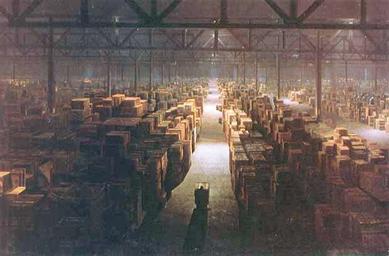 The Government warehouse is a plot device used in movies, television series, and novels, a scenario used in role-playing games, and a belief of some conspiracy theorists. The concept is that there is a secret government warehouse where various items are stored of whose existence the government wants the general populace to remain ignorant.
Plot device in fiction
In fiction, the Government Warehouse is a plot device used for conveniently disposing of story elements that have fulfilled their purpose in a story, but that would cause consistency or continuity problems for subsequent (or previous) stories in the same fictional setting were they to remain. In many cases, the story items disposed of are of such a nature that they would make it difficult to set up the necessary tensions and conflicts for other stories in the same fictional setting, as they would make such tensions and conflicts simple to resolve.
A secondary purpose of the Government Warehouse plot device is to satirize the ineptitude of governments, the premise being that if a government found itself in possession of an extraordinary object or person, it would simply catalogue it and lose it in a vast filing system. For example, in the film Forever Young, Mel Gibson played an experimental suspended animation subject, who was frozen in a capsule, which was forgotten about and stored in a Government Warehouse until two children stumbled upon it while playing.
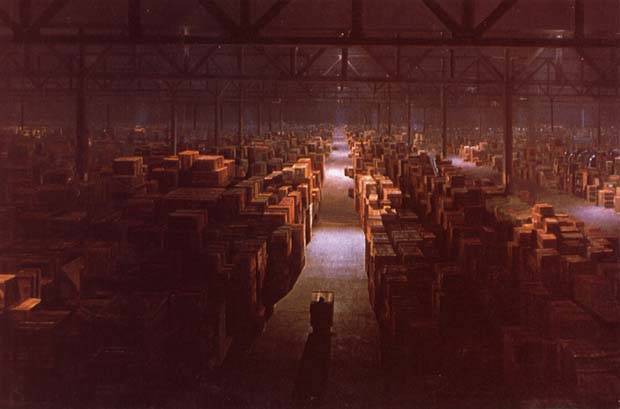
Perhaps the most well-known instances of the Government Warehouse plot device are the movie Raiders of the Lost Ark and the television series The X-Files. At the end of Raiders of the Lost Ark, the Ark of the Covenant is hidden away in a warehouse owned by the US Government, explaining its disappearance from the fictional universe of the Indiana Jones films. (The shot of the warehouse is an allusion to the final scene of Citizen Kane, where there is a similar shot of a private warehouse.) The satirical television series Family Guy duplicates this scene, only instead of the Ark it is actor James Woods in a box. In the closing of an episode of NBC's "The Office", entitled Conflict Resolution, a similar scene is created using a box full of complaints made by Dwight Schrute, and other characters. The television series, The X-Files, is replete with characters and objects with unusual properties and powers that would complicate the fictional setting, or make it too simple for characters to achieve the goals that they quest for, and the Government Warehouse plot device is heavily used to explain the absence of the characters and objects, and to make the goals difficult to achieve. The plot device is in fact a central element of the series. A typical example is found in the pilot episode.
Sometimes items are recovered from Government Warehouses in order to construct derived fictional settings. In the first episode of the late-80s War of the Worlds television series a triad of war machines are collected from a Government Warehouse ("Hangar 15") where they had been stored since an invasion in 1953, thus linking the television series to the 1953 film The War of the Worlds.
In the 2006 film Click, the warehouse serves a similar purpose; however, it is not owned by a government but by Bed Bath & Beyond.
Real-World "Government Warehouses"
The government warehouses of fiction and conspiracy theories have a number of analogues in the real world, although some are not run by official national governments. Historically, the template is the Great Library of Alexandria, which held an extensive collection of written works but was repeatedly destroyed during the first millennium AD. Perhaps the most prominent Government Warehouse in the modern era is Area 51, a US Air Force base in Nevada which is said to house alien artifacts. The Vatican Secret Archives 1 are alleged to hold the secrets of the Knights Templar (a similar allegation is levelled at the Louvre in Paris). Many prominent museums have extensive archives which often lay undisturbed for decades, such as the Cairo Museum in Egypt, which was found in 2002 to have 80,000 items - more than half the museum's collection - stored away in its vaults. 2
RPG scenarios
The concept of a Government Warehouse has been used as a fun scenario for role-playing games:
— an attempt to construct an RPG scenario of a Government Warehouse containing every famous item ever mentioned in fiction or a conspiracy theory as being lost or suppressed
— Notice that in this later version the introduction has been removed and replaced by seals denoting United States government agencies and a purported security classification notice, giving a greater impression of realism.
— an even more detailed attempt to do the same thing, that even includes a classification system for the objects, and includes objects that logically could not possibly be contained in such a warehouse (The planet Earth was demolished in the plot(s) of the Hitch-Hiker's Guide to the Galaxy, therefore the spaceship Heart of Gold could not be stored in a Government Warehouse on Earth.)
— an entire book based off the strange and mysterious things that might be in such a warehouse, run by Secret Masters.
External links
- Screenshot of the Government Warehouse from Raiders of the Lost Ark
- Warehouse 23 allegedly run by a joint venture between the US Government and the Illuminati, this is actually (and openly) run by Steve Jackson Games. Readers can submit new items.
it:Magazzini del governo