
Spam bait is e-mail sent in the hopes that the unwitting recipient will reply, indicating to the original sender that the recipient's e-mail address is a valid one and can be added to a mailing list for spam.
Spam bait can be hard to counter. The most effective strategy is a negative one: do not reply to such messages!
Another, more technical strategy is to ensure that your e-mail account does not automatically fetch embedded images in "web e-mail". Some e-mail contains HTML code whose main purpose is to provide feedback to the spam bait sender. When your e-mail software requests delivery of the image, the address of that image can contain a tracking code. The sender returns the requested image but also gleans from the tracking code the fact that they've found another valid e-mail address. Then you get more spam.
See also:
- CAN-SPAM -- legislation to stop or "can" unsolicited commercial e-mail
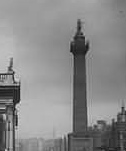
Some well-known cases of vandalism in Ireland included the blowing up of Nelson's Pillar, a large monument in the centre of Dublin, by a group of republicans in 1966. Other public monuments blown up in Ireland included Gough's Statue in the Phoenix Park and King Billy's statue in College Green, both in Dublin city centre. The Irish Public Records Office was destroyed by Irish Republicans in 1922, an act which destroyed one thousand years of state and religious archives. The justification was that though there were Irish records, they had been compiled by English and British governments and thus should be destroyed, an act described by some historians as cultural [...]. (An attempt to blow up the historic Linen Hall Library in Belfast by a unit of the Provisional IRA in the early 1990s was foiled by others in the movement itself, who realised in time that the famous library actually contained some of the archives of the republican movement itself.)
A nonagenarian is a person in the age group from 90 to 99 years old. A nonagenarian of today is born between {{CURRENTMONTHNAME}} {{CURRENTDAY}}, 1905 and {{CURRENTMONTHNAME}} {{CURRENTDAY}}, 1915.
A few U.S. Presidents lived or are living to be nonagenarians, including John Adams, Herbert Hoover, Ronald Reagan, and Gerald Ford.
Properly, the Reunited Kingdom of Arnor and Gondor is a fictional realm from J. R. R. Tolkien's Middle-earth.
When Aragorn became King of Gondor at the end of the War of the Ring, he was also the descendant of the Kings of Arnor, and by right he was crowned King of both Arnor and Gondor and Reunified the Two Kingdoms, which had politically split long ago. Using the resources of the victorious Gondor, Aragorn, taking the royal name King Elessar, rebuilt Arnor in the North.
With the defeat of Sauron and Mordor, the Reunited Kingdom of Aragorn was without question the dominant power of (North-west) Middle-earth during his long reign.
During Aragorn's reign, the Reunited Kingdom expanded to retake all territories that had originally belonged to both Arnor and Gondor at their greatest extents, excluding only Rohan.
Additionally, during the first century of the Fourth Age Aragorn led the armies of the Reunited Kingdom in many successful military campaigns that; retook the province of South Gondor (Harondor), re-established dominance over Rhovanion (Wilderland) eastwards to the Sea of Rhun, and conquered the Corsairs of Umbar, who had attacked Gondor during the War of the Ring. Umbar had originally been a Númenorean port and an important city of Gondor in ancient times before ultimately being conquered by the followers of Castamir following the Kinstrife, who distanced Umbar from Gondor and befriended Harad. Elessar finally reconquered the city, and the Reunited Kingdom stretched South along the coast from the Mouths of the Anduin River to the Haven of Umbar. Much of Harad was defeated and became tributary states. Aragorn was also held to be overlord of Dale (which included Esgaroth), and the Dwarf-city of Erebor, although these allies maintained their own rule and kings. Aragorn is assumed to have rebuilt the old northern capital of Annúminas.