Washington College Crew
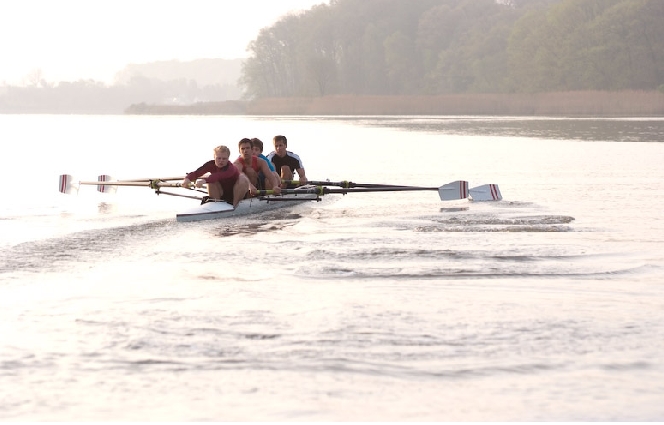
Washington College Crew is a small DIII rowing program in Chestertown, Maryland where the John Truslow boathouse sits on the Chester River. The program first grew out of student interest due to the College not having the financial resources to start a new varsity sport. Jamie Johnson started gathering students interested in crew during his sophomore year. Jamie learned to row as a student at S. Kent School, and he helped generate the interest and attention the students needed to start the team. Soon, there were enough interested students to man two eight-oared shells. The students received lots of outside help getting the program started.
Beginning History
After student interest grew they contacted Dave Washburn, the crew coach of St. Andrews Academy in Middletown, DE, a school renowned for its crew program. Washburn invited the WC students to practice at St. Andrews three times a week, using their shells, oars, and equipment.
In 1967-68 the squad purchased a shell from the Vesper Boat Club in Philadelphia, which they stored in an unused chicken coop on John Truslow's Chicken Farm, located off Truslow Road on the Queen Anne's County side of the Chester River.
The Yale University coach gave Jamie eight sets of oars, and [...] Heymann got four oars from the Brooks School. Professor Pete Tapke purchased a single shell to be used for training purposes and for general recreation.
To raise money, the team organized a fundraising dinner for which they sold tickets. Beginning a long-standing tradition at these dinners, the club arranged for a well-known speaker from the rowing world. The first speaker was Jack Kelly, a renowned sculler from Philadelphia and the brother of actress Grace Kelly. The Athletic Council began to study the crew program and the ProgresS the club was making. Meanwhile, the team raised $3500 to buy a pair of oared two-man shells and a single skull from Marietta Colege, as well as a light oared shell, for training, from Philadelphia's Undine Barge Club, and a new shell from the Schoenbrod Crew Company from New England. The team continued to use Truslow's barn, which he outfitted with special racks, for storing their equipment.
Many local businessmen, as well as members of the Board of Visitors and Governors, enthusiastically supported the crew team's development. Elias Nuttle, Ferdinand Lamotte, Lelia Hynson and many others both voiced their support and provided financial help.
The First Season
In the first season, Anthony Gilmour was the team's official captain. Gilmour rowed in the first boat and coached the second boat, while Jamie Johnson coached the first boat and rowed in the second. The first races were scheduled against George Washington University, Howard University, Drexel, Philadelphia Community College and St. Johns of N.Y. There was definite need for a hired head coach. Mr. Lamotte spoke to the Athletic Council AbOUT the status of the program's development as well as the areas where the college's assistance was becoming necessary. The squad continued to practice at St. Andrews but also made efforts to use the Chester River. Because there was no dock, the team had to wade into the river to launch the shells, then climb in. In the first race, against Philadelphia Community College, the WC team lost by two lengths. The team's first win came against St. Johns of N.Y. before the squad participated in Washington D.C.'s Potomac Rowing Regatta to close out its initial season.
1968 - 1969 Season
For the 1968-69 season, the club hired Ben Troutman '66 as its part-time coach. The schedule included the University of Pennsylvania FreshMen team, Richmond University, Virginia Union, Howard, Philadelphia Community College, Jeb Stewart High School, St. Andrews High School and the University of Virginia, with four of the contests schedule for the fall. According to a report Bob Simmons, WC's business manager, gave to the Athletic Council, the club had also received a vega cruiser worth $6000 and a launch.
1969 - 1970 Season
1969-70 The crew was still in its infancy, but it was experiencing growing pains. Troutman solved the coaching dilemma when he agreed to continue as part-time coach. Chris Combs, the club's student representative, appeared before the Athletic Council to seek official recognition, with the hope that the varsity status would encourage even more students to participate. The club placed $2500 on deposit in order to cover the budget, with the understanding that all additional gifts would go directly into the crew budget fund. Soon after, the club changed its mind and asked that its varsity recognition be rescinded, since the official status restricted the club from seeking additional funds.
1970 - 1971 Season
The 1970-71 school year was officially the first year crew was recognized as a varsity sport for men. English professor Bob Neill was hired as the part-time coach. Frank Iglehart was elected captain, while Chris Combs continued as the president of the crew club. During the 1970-71 season, the team continued to make weekly trips to St, Andrews to practice.
A Suitable Boathouse
In addition to the questions about funding, the college's other dilemma was finding a suitable boathouse. The crew program will forever be indebted to the Truslow family for all they did to aid the program in its very early stages. The club used the barn on the Truslow property to store the shells and equipment temporarily, but it was not an acceptable boathouse. The process of finding and then acquiring a boathouse to serve both the crew and sailing teams happened gradually over a two-year period. The college first looked at property on Water Street, just east of the Hynson-Ringgold House. Sitting right on the river, it fit the crew club's qualifications but the Hubbard family, who lived next door to the property, and other neighbors, protested. Fortunately, another property soon became available. A storage building for the Vita Foods Co. previously sat on the land, and the college worked out an agreement with the company that would allow the school's watersports clubs to occupy the building as soon as the company vacated.
Once the boathouse was acquired, the next step was to construct a dock to launch the shells in a proper manner. It was quite a sight to see the rowers slowly walking the shells into the water from the shore's edge, through the mud, holding the shell rigid as each rower managed to climb in and prepare to row. The dock and a floating dock soon became a reality and the crew and sailing program continue to launch from this location.
1971 - 1972 Season
During the fall season in 1971, the team remained based at the Truslow Farms chicken coop before moving into the new boathouse for the spring season. The new facility was named in honor of the generous Truslow family and was dedicated during the '72 spring season. The boathouse offered new opportunities for the sailing program, as well as for physical education classes including canoeing and boating. John Ihnat stepped in to coach part-time, with Chris Combas as captain. Financing remained a problem for the fledgling team. In its first spring at its new home, the team won three races and lost one; it also participated in two regattas. 3 and lost 1 in the spring program while also partici-pating in two regattas. Chris Combs served as the captain of this squad. WC's varsity boat defeated Atlantic Community College, Fordham, and Villanova (in a squeaker - WC won by just .2 seconds), but lost to LaSalle College. In the D.C. Regatta, WC finished third, behind George Washington and LaSalle Universities, and placed fifth in the Presiden't Cup Regatta in Poughkeepsie, N.Y. The team failed to qualify for the Dad Vail Regatta, placing fifth in the qualifying heat. The "Varsity 8" in 1972 included Combs, Dave Griffith, Mike Harrison, Mike Kennedy, Parky Cann, Eric Stoll, Jim Thomas and John Keenan.
1972 - 1973 Season
In the 1972-73 season, the Dean of Men, Barry McArdle, took over as crew coach, assisted by Jim Thomas. The season brought the largest turnout the men's team had seen, enabling the college to race three boats: varsity, junior varsity, and novice. During the fall season, the shell "Inlet Witch" was sunk by the George Washington University crew, near the Basket Factory. A new varsity shell was donated and named "Lelia," after the crew program's benefactress. During the spring season, the varsity team recorded wins over UNC, LaSalle and Williams Colege. The team lost to Villanova, but raced to third place in the D.C. Regatta. They also placed third in the qualifying heat of the Dad Vail Regatta and finished fifth in the semi-finals.
Barry McArdle's Last Season (1976)
Barry McArdle's last season as men's crew coach was in 1976. He was assisted by Paul Gianquinto and John Hill, as well as track and field coach Don Chatellier. In 1976, Lydia Hynson gave $20,000 to the crew program, to purchase a new fiberglass racing shell and to make improvements to the boat house. A new training area was constructed in the boat house to help team members practice proper stroke technique, replacing the antiquated makeshift device that had been used previously. Eric Stoll '74 succeeded McArdle as men's crew coach, keeping John Hill on as an assistant. The team celebrated its 10th year as a varsity sport by honoring all those who had coached: Ben Troutman, John Ihnat, Barry McArdle, David Washburn, Bob Neill and the current coaches, Eric Stoll and Craig Jackson. The schedule continued to include Trinity, Geo. Washington and Georgetown of Wash., DC, St. Josephs, Temple, Drexel, Villanova and LaSalle all of Philadelphia. Regattas included the Providence Mutual Cup hosted by Villanova, the Washington, D.C. Regatta, the Cadle Cup also held in Wash., DC and over the years the Dad Vail which normally ended the season.
1977 - 1978 Season
In 1977, the varsity team finished behind Trinity, St. Joseph, and Temple in one home race and finished third to Drexel and LaSalle in another. The team defeated Georgetown at Georgetown and the University of Virginia at Virginia, finished fourth in the Kerr Cup Regatta and second in the D.C. Regatta, but failed to qualify in the Dad Vails. Coach Stoll considered the 1978 season a “building year” with an all-frosh second boat and a novice freshman rowing #3 in the varsity. Four members of the frosh crew raced Temple after having rowed only eight times. The Varsity boat lost to Temple, raced third to Drexel and LaSalle, defeated Villanova, lost to GWU and then to Virginia, raced third to Georgetown and GWU, but did not qualify in the Dad Vails.
1978 - 1979 Season
The 1979 season was highlighted by two close victories over George Washington University. In the first meeting, WC beat GWU by .4 seconds and in the second race, it was a win by a mere.2 seconds. In the second meet, WC defeated Stockton. The College then lost to Marist but defeated GWU. After beating the University of Virginia, WC raced to a second place finish in the Cadle Cup defeating GWU for the second time but losing to Georgetown. WC did not qualify for the Dad Vails.
1979 - 1986 Season
The 1980 season was a bit of a disaster. Three out of four races were cancelled due to inclement weather, then the campus-wide measles outbreak resulted in the cancellation of all athletic activities except men's lacrosse. The crew squeezed in races with GWU, Duke, and Lafayette, and entered both the Cadle Cup Regatta in Washington, D.C. and the Dad Vail in Philadelphia. Betsy Beard Stillings '84 was coxswain on the junior varsity men's boat this season; in 1984 and 1988, she was a member of the U.S. Women's Olympic Rowing Teams. Coach Stoll recalls that “the four” were the bright spot of this season. Their overall record was 16-7 but, through a fluke, they did not qualify at the Dad Vails. The Varsity 8 was quite young and inexperienced, which made their win at the University of Virginia even more outstanding. After the 1981 season Coach Stoll left the crew program to take a similar position at Villanova University in Philadelphia. During his final year, the Varsity 4 defeated LaSalle, the University of Tennessee, and St. Johns (N.Y.) Univ., and rowed second to the US Merchant Marine Academy. Additionally "the four" finished first in the Cadle Cup and fourth in the qualifying heat at the Dad Vail Regatta. The Varsity 8 lost to LaSalle but defeated both the University of Virginia and the University of North Carolina and rowed sixth in the Cadle Cup. In the Dad Vails they were 6th in the qualifying heat but did not make the finals.
1986 - 1989 Season
In 1986, the rowing tank was completed inside the boathouse, a $40,000 investment. As other institutions began to sponsor crew teams, the WC team's schedule continued to grow with races against their friendly adversaries in various Regattas. The college ushered in a new era for the men 'sand women's programs in the 1990-91 season with the hiring of Mike Davenport as the coach and administrator of the total crew program for men and women.
WOMENS CREW 1972-1975
In the 1972-73 year, the women's crew club formed, becoming the College's first organized athletic activity for women initiated by students. McArdle and Penny Fall accepted the coaching responsibilities. The first women's crew race in Maryland took place on April 12, 1973, when WC hosted - and lost to - Williams College. The first year was primarily a learning experience for the team, since very few female students already had experience in rowing. Squad members needed to learn how to row before they could win races, and they attended off-campus clinics to learn basic rowing fundamentals.
The women's crew team became eligible for varsity athletics on Oct. 25, 1973, but it remained a club team in the 1973-74 seasons. The spring schedule included races against Connecticut College, Williams College, Radcliffe College, Barnard College, George Washington University, University of Virginia and the Bachelors' Rowing Club of Philadelphia, Pa. It was finally recognized as a varsity sport by the Athletic Council at its meeting on May 7, 1974. This action was retroactive to include the current season so the 1973-74 is officially recognized as the first season for women's varsity sports sponsored by the College.
In 1974-75, Barry McArdle continued to coach both the women's and men's crew programs with Penny Fall as his assistant. The spring season included wins over GWU, UVA, UNC, Marist, Morris Harvey, Duke, and Barnard. McArdle continued as varsity coach in 1975-76, leading the team to a very successful spring record of 12 wins in 13 races.
MEN and WOMENS CREW 1991 - 2000, 2005 - 2009
Like most of the beginnings of athletic programs, rowing started with an odd twist of how things are done in well-established programs. in 1967-68 the mens rowing club launched itself onto the Chester River with one shell and just enough oars and men to make a go of it. With only a chicken coop for a boat house and muddy shores for a dock, the pioneers of WC rowing still beheld the opportunity of the mighty Chester River. soon, help came from the Truslows and the Hynson families to acquire and transform a pickled herring warehouse into a boathouse and a dock to launch each practice. Then in 1972, fresher blades sliced the Chester's waters with the start of the WC women's rowing club. By 1974, both clubs were recognized as an official varsity athletic program of WC. With steady pressure the shells have continued to cut the waters onward of the Chester with bright moments of victory and even medals at the Dad Vails. WC rowing is now stiffening the pressure of each stroke towards a very competitive program among the small colleges of the east. The direction of the program is to continue building on the successes of this quarter century while introducing higher standards of competition and more ambitious goals to accomplish.
In the beginning of 2005 both Men and Women's teams were building their respected teams. The teams were very competitive with two very promising novice rowers. Who now lead the team as captains and top erg scores. In 2007 - 2008 the Women's team was introduced with a new assistant coach Jesse House who comes from FIT. With her coaching skill and athletic ability she was able to help lead the team to their outstanding performance and were invited to the NCAA DIII championships in California. There they placed a respectable 12th in the nation. At the same time the Men's team introduced Coach John Leekley who with his successful coaching career and skill was able to shape the teams very successful lightweight four attended the Dad Vail Regatta and placed 4th in the nation. With these two very successful boats the team has come back in the 2008 - 2009 season with high hopes and a good starting record to perform well in this season.
Results 2001 - Present
Please visit the Washington College Sports Page for results of all Washington College Sports Teams. Please select either Women's or Men's Crew from the left hand side tool bar and then again results on the left.