
Universal Catholic Church
The Universal Catholic Church (UCC) is a Christian church with headquarters based in the United States. The Church traces its founding to Jesus and the Twelve Apostles and sees the Bishops of the Church as the successors of the Apostles. While it derives its Apostolic Succession from the Old Catholic Church, the UCC is today not in full communion with either the Utrecht Union, or the Roman Catholic Church, and differs with them theologically in several important respects.
As of 2009, the UCC has parishes and missions throughout the United States and Canada.
Beliefs
- The Church recognizes the historic seven sacraments, which are: Baptism, Confirmation, Holy Eucharist, Absolution, Extreme Unction, Holy Matrimony, and Holy Orders.
- The Church teaches the doctrine of the Holy Trinity.
- The Church teaches that we are all immortal, both before and after physical death.
- The Church teaches that in the Holy Eucharist the substance of the bread and wine become linked, or polarized, on the Life of the Christ and become literal outposts of His Life and His Consciousness. And that the Holy Eucharist is designed to help those who physically take part, and to pour out a flood of spiritual power upon the surrounding world. (The Church has open communion.)
- The Church teaches that the Minor Orders (Cleric/Tonsure, Doorkeeper, Reader, Exorcist, Acolyte and Subdeacon) are intended primarily to assist the candidate in his own spiritual growth and life. We teach that the Major Orders (Deacon, Priest, and Bishop) are intended primarily to assist the Christian Community. (Clergy are allowed to marry.)
- The Church teaches that the Holy Bible, the Creeds, and the Traditions of the Church are the means by which the teachings of Christ have been handed down to His followers. We teach that they are fundamental, true, and sufficient as a basis for right understanding and right conduct.
- The Church teaches that all Christian worship is valid, of whatever kind, so long as it is earnest and true.
- The Church teaches that everyone shall "one day reach His Feet, however far they stray." We teach that the "dead" pass to a life of higher service, where there is available to them the "felicity of [the] . . . Presence, evermore . . . ." What we shall experience "at His Feet" is conscious life in Christ.
Church Structure
The Church is currently guided by its Presiding Bishop, Dean Bekken.
Laity
Laypersons in the Church come from diverse backgrounds and from all spiritual paths. Due to the open nature of the Church, no layperson is required to accept any of the more "formal" beliefs of the Church, and are allowed to accept or reject them as they please.
Seminary
Training for the clergy of the Church is through St. Clement Seminary, the only seminary of the Church. The seminary offers distance study courses for those seeking Holy Orders.
Seminarians are encouraged to pray the Divine Office of the Church, specifically the morning prayer or Prime, and the evening prayer or Compline.
Liturgy
The Church uses its own liturgy, today known as the Liberal Rite. This liturgy was mostly composed by Bishop Wedgwood, with Bishop Leadbeater assisting on the Collects, and selecting the Psalms, canticles, and weekly epistle and gospel readings. The rite focuses more on the glorification of God, rather than the depravity of man.
History
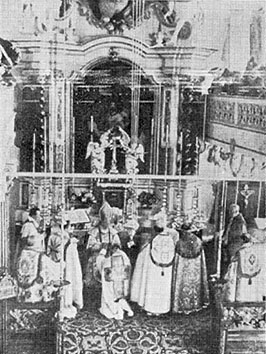
The Church traces its apostolic succession to Archbishop Arnold Harris Mathew. Mathew was consecrated bishop on 28 April, 1908, by Utrecht Archbishop Gerhardus Gul, assisted by the Old Catholic bishops of Deventer and Berne, in St. Gertrude's Old Catholic Cathedral, Utrecht. Only two years later, Mathew declared his autonomy from the Union of Utrecht, with which he had experienced tension from the beginning. It was only a short time later that Bishop Mathew found himself at odds with his own clergy in Great Britain and ultimately walked away to seek union with the Roman Catholic Church.
The founding Bishop of the Liberal Catholic Church was James I. Wedgwood of the Wedgwood China family, formerly a Cleric in the Church of England (Anglican). Wedgwood grew dissatisfied with the Church, and discovered the Theosophical Society, which had a stronger appeal to his sense of life and justice. When Archbishop Arnold Harris Mathew sought to ordain those clergy who were dissatisfied with the Church of England, Wedgwood was one who joined the new Old Catholic Church of England. Archbishop Mathew knew of Wedgwood's membership in the Theosophical Society, as well as that of other clergy in the Old Catholic Church of England, and originally promised that this would not be a problem, but later retracted that promise and asked all clergy to resign from the Theosophical Society. Not willing to do so, Father Wedgwood and most of the Old Catholic Church in England found themselves without a Bishop as they withdrew from Archbishop Mathew's leadership.
One of the men who Archbishop Mathew had consecrated to the Episcopate, Bishop Frederick Samuel Willoughby, offered to consecrate and elevate one of the withdrawn clergy to the Episcopate so that they would not be without a Bishop. Father Wedgwood was selected and elevated to the Episcopate on February 13, 1916. The Church was eventually reorganized and renamed The Liberal Catholic Church. Archbishop Wedgwood then consecrated another former Anglican Priest, Charles W. Leadbeater, later that same year, with Bishop Leadbeater going on to become the 2nd Presiding Bishop of the Church in later years.
3rd Presiding Bishop Frank W. Pigott. 4th Presiding Bishop Ray M. Wardall. 5th Presiding Bishop Edward M. Mathews. 6th Presiding Bishop Francis Erwin. 7th Presiding Bishop William H. Daw. 8th Presiding Bishop Joseph Neth. 9th and current Presiding Bishop Dean E. Bekken.
Relations with other denominations
The UCC seeks to work in amity with all other Christian denominations. It welcomes all to regular and full participation in its services, without asking or expecting them to leave their own church. On the other hand, if members of other churches are attracted by the distinctive features of its work, they are invited to join. Its chief appeal is to the thousands who stand outside the existing church organizations and religious societies, and are bereft of the help they might otherwise receive.
The Universal Catholic Church is at all times ready to establish relations of inter-communion with other Churches upon the friendliest possible basis. It would be far from denying to the non-episcopal bodies the charismatic or prophetic ministry of preaching and inspiration. At the same time, it does not concede to them the Catholic priesthood which, of course, they do not claim. The Catholic view is that the priesthood depends for its efficacy upon the valid transmission of the Episcopal succession. Where both parties are willing, the Church permits its clergy to exchange pulpits with ministers of non-episcopal Churches, but it does not invite the latter to officiate at its altars.
See also
- Utrecht Union
- Old Catholic Church
- Liberal Catholic Church
- Roman Catholic Church
Further reading
- The Liturgy of the Liberal Catholic Rite, 3rd Ed.
- The Collected Works of James I. Wedgwood, Msgr. T.J. Howard ed.
- Cockerham, The Rev. A.J. The Apostolical Succession in the Liberal Catholic Church.
- Leadbeater, C.W. The Science of the Sacraments.
- The Collected Works of Edward M. Matthews, Vol. I
External links
- Universal Catholic Church
- St. Alban Press
- Global Library Liberal Catholic Texts
- Project Canterbury: Old Catholicism and Anglicanism
- Utrecht Union of Old Catholic Churches