
Ultrasonic AN/MPQ-14 Course Directing Central
The General Electric AN/MPQ-14 Course Directing Central was a Cold War radar/computer/communication system for ground-directed bombing (GDB) during the Korean War and was the 2nd GDB system used by the United States Marine Corps (cf. AN/TPQ-2). The combination ("Q") system provided command guidance for an aircraft to reach a predetermined release point for attacks in bad weather and nighttime, and Korea GDB operations included 900 flown by USMC Vought F4U Corsairs, e.g., 4 VMA-251 "MPQ flights for the 7th Marines in the early hours of 24 July" 1953.
Background
After the Air Medal was awarded for development of ground-directed bombing in Italy for World War II Close Air Support, a detachment of NAS Mojave's "Pilotless Aircraft Unit" was established in 1945 on a SeaBee military installation at Point Mugu (4 officers and 11 enlisted men). A Bureau of Aeronautics committee's December 1945 Study of the Requirements for Pilotless Aircraft for Fleet Use in 1950 was approved 3 months later, and the KGW-1 Loon was 1 of its 18 missile proposals. The detachment's "Marine LTCOL Dalby and Dr. Herbert Wagner", the latter arriving by Operation Paperclip in early 1946, developed "NAVAIR’s TPQ-2 Close Air Support System" for command guidance of the KGW-1 Loon missile for submarine attacks on mapped Japanese "beach-head fortifications". Point Mugu development of the KGW-1 and its test launch facilities were by "Jack Schoenhair's gang" and included additional Operation Paperclip scientists "Willy Fiedler, Robert Lusser and Otto Schwede". The 1st KGW-1 launch was in January 1946, and its 1st submarine launch was February 12, 1947, using rocket assist developed by Robert Truax's team.
AN/TPQ-2 Close Air Support System
AN/MPQ-2 Close Cooperation Control Unit}} The transportable AN/TPQ-2 included a WWII surplus SCR-584 radar, a Reeves Instrument Corporation analog computer for converting the radar's spherical coordinates to rectangular coordinates, and a Reeves "plotting board to yield course changes, a warhead arming signal and a dump [dive] command to the Loon". A "Marine F6F fighter" was to escort the KGW-1 for safety (e.g., to abort by shooting a missile straying back over land) and during simulated KGW-1 missions, MSgt. Clark. D Hayden used the system to instead control the manned fighter. During Dalby's 2nd mission piloting a "Loon simulation flight" he "wondered why…prefer [sub-launched, 1,000 lb payload] Loon over a two thousand lb. Bomb” from a piloted aircraft launched by a carrier. Dalby briefed Point Mugu's Director of Tests, Captain Grayson Merrill, when "both realized…we were talking about [an] all-weather, close-air support system" and "Dalby and I conceived the idea of converting [it's use to] Close Air Support." Dalby and Cpt. Samuel A. Dressin redesigned the system (e.g., switched from the SCR-584 to the SCR-784 radar), and the TPQ-2 was demonstrated at Camp Pendelton in April 1950. Dalby claimed dummy bombs from would drop within of the target, and a direct hit on a terrain feature was observed by the 1st Marine Air Wing Chief of Staff. Lt. Col. Homer G. Hutchinson helped the project receive support including two F4U night-fighters and pilots for training.
Production and deployment
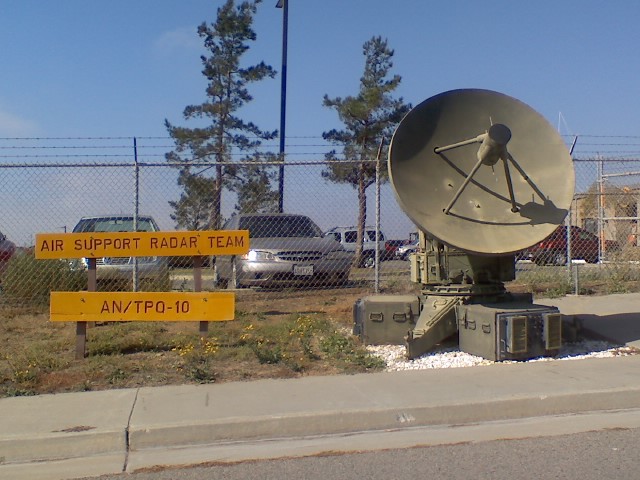
The AN/MPQ-14 was created under a production contract to General Electric, and the central used the radar from the AN/TPQ-2 Close Air Support System, AN/MRW-4 & -3 radios, a diesel generator set, and from the AN/MSQ- the "guidance computer-transmitter set", data converter (spherical to rectangular computation), and "indicator-recorder" (plotting board). "Housed and transported in two modified 3/4-ton trailers, two 2-1/2-ton trucks, one 3/4-ton 4x4 truck, and one mobile radar mount", the USMC GDB team was ready for deployment to Korea in July 1951 after the USAF had begun Korean War GDB in 1950. The AN/MPQ-14 was "moved into the" 1st Marine Division area by the "First Marine Aircraft Wing" near the 38th parallel north for guiding units such as the VMF-513 Corsair night-fighter squadron flying GDB from 15,000–20,000 feet. Initially cleared for use within a mile of friendly forces, by summer 1952 the Marines had Fifth Air Force permission to use the AN/MPQ-14 for close air support. A variant of the central, the AN/MPQ-14A, had different radar and communication subsystems, and the "Advance" and "Ultrasonic" companies also produced the central.
External links
fr:Radar AN/MPQ-14