
Triple Task Method
The approach was originally developed developed by Simon G Bell and Stephen Morse (2009). The approach was first used by the authors in the European Union Seventh Framework Programme (FP7/2007-2013) under the grant agreement n° 217207: POINT (Policy Influence of Indicators) project (1).
Background
Triple Task or TT is a unique form of participatory action research in the sense that not only does it attempt to arrive at answers to research questions but also tries to understand what factors may have been at play in arriving at those answers. This attribute makes TT an advance on many other participatory techniques which are more focussed on delivering outputs (representing an apparent ‘consensus’) and less concerned (if at all) on the dynamic behind that ‘consensus’ and how the process may have influenced what was produced.
Participatory research takes many forms but the underlying philosophy is that all those involved - be they 'researcher' or 'researched' - are involved in the design of a research process as well as the interpretation of findings. Power is shared rather than being concentrated in the hands of a researcher. As a result the very process of doing the research can provide many insights and help bring about positive change. Hence the term 'action research'; a research process that catalyses action.
Most participatory action research methods stop at the point where outputs have been achieved, with no attempt to appreciate the dynamics that may have been at play within the group to arrive at those outputs. Therefore while it is likely that within each group there will be some variation in perspective, as well as the meaning of terms such as ‘effectiveness’, participatory techniques tend to hide this and aim instead for an apparent consensus. But groups are inevitably heterogeneous and can be dominated by one or a few individuals or it may be that some groups simply do not work well together perhaps because there is so much disagreement. These dynamics will not only influence the ‘answers’ arrived at by the groups to research questions but would also say a great deal about relationships and opinions within the groups, especially if the group comprises people that would normally be expected to work together. The latter is not essential but is an especially powerful approach as it allows for an analysis of a team of people charged with achieving a particular purpose and thus sharing a common goal. Indeed in that sense the variation in answers and causes of that variation will be of as much interest as an apparent ‘consensus’ arrived at by a group.
Triple Task Process
TT involves three tasks. Task 1 generates the groups answers to research questions while Tasks 2 and 3 are designed to explore the ways in which the groups function and how this influences their analysis both in terms of what emerges under Task 1 but also in terms of the variation one might see between members of the group and how they are able to influence the dynamic. From the perspective of participants they only experience Task 1; Tasks 2 and 3 are largely invisible to them.
Task 1: This is a systems approach (systems science), a derivative of a Soft systems review of the groups’ assessment of some specific tasks and issues. This is the main element of TT and will provide the insights with regard to the research questions (what has been done, by whom, why, how is this assessed in terms of effectiveness?). For convenience, Task 1 is also subdivided into three main steps as set out below:
Three steps of Task 1 |
Process and objectives |
|---|---|
Scoping |
The Rich picture is employed as a means to capture ‘stories’ from participants. Participants are encouraged to draw out major tasks and issues which form a central concern to them. These are then organised in terms of precedent and priority. Groups of linked tasks and issues are ‘clustered’ into indicative systems of concern (Systems of Challenges; SoCs). This systemic process binds the group together, forges collective understanding and provides a legitimising process of further discovery. |
Visions of Change |
Moving from a shared understanding as to the challenges this step encourages the groups to explore what changes are required in order to addres the SoCs. In other words, what needs to be done? Groups may derive a number of VoCs rather than only one, but the emphasis should be upon what the group deems to be more important and achievable. |
Desired change |
Groups encouraged to set out what practical steps are required to bring about their Vision of Change. This step is supplemented by activity planning and scenario setting: ‘How might things look given certain kinds of change?’ The latter employs another Rich Picture; providing a sort of 'before' and 'after' story when placed next to the rich picture that arose out of Step 1. Participants not only enrich their own understanding of what is possible but act as vectors of change for colleagues. |
The Rich picture is an important element of Task 1 and each group begins with a pictoral representation of the significant components and linkages of the system being explored in the research. The picture should represent a shared understanding, although in practice it is possible for a group to be dominated by an individual or individuals who impose their own vision from the onset. The Rich picture is a form of Mind map and thus is an essentially qualitative analysis and participants are encouraged to use the minimum of text.

Task 2: This is an ‘outside in’ review of the group dynamic. In effect it is the researcher’s assessment of the group process using a matrix approach originally developed at the Open University and known as BECM (used in, for example, the Open University Course: 'Managing Complexity: a systems approach'.). BECM stands for Being, Engaging, Contextualising and Management. BECM can be used as a form of Socio-Analysis and is related to the psychoanalytic tradition.
Task 3: ‘inside out’ review of the group dynamic – stakeholders’ assessment of their group process (employing the Symlog methodology)
In an active research context there are a range of possibilities as to the make-up of the groups that could engage in TT (or indeed any group-based participatory process), and decisions are often made after prior literature reviews. For example, there may be 5 to 6 workshops spanning a number of locations around a given geographic spread, chosen because they may be expected to provide a range of answers to the research questions. Alternatively the focus could be on one place with workshops held across a range of different types of stakeholder in that place. The former would provide a more geographical spread of insight while the latter would allow for more in-depth and socio-economic stratification.
Each TT workshop usually comprises some 20 or so people divided into 3 to 4 groups, with the nature of the division depending upon the outcome of the prior literature review phase. For example, a workshop may comprise individuals from a community group in which case they would be asked to divide themselves into 3 teams and asked to address a particular question. Each workshop would last 1 to 2 days. The information collected from the workshop would be analysed with qualitative techniques developed by Bell and Morse (2009). One of which is the 'Triple Task' field diagram which sets out findings from the three strands of Triple Task plotted against each other. The horizontal axis is used for Task 1 and the vertical axis for Task 3 (Symlog). Size of the circle for each group is used to denote BECM (Task 2).
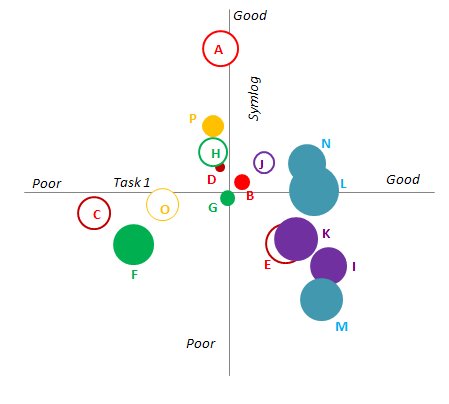
TT is Action Research in terms of its orientation. However, it is often the case that each workshop will be informed by a prior, literature review phase and provide valuable insights for following, in-depth Action Research components. This could be at a number of levels. Firstly, the experiences gained from those involved in TT might help with selection of who to include in AR. Secondly the insights from TT could provide a basis for some focus within Action Research rather than start with a clean sheet.
Triple Task Critique
Triple Task attracts much the same critique as participatory action research in general. It is open to the charge that dominant individuals within groups can heavily influence the outputs and that the process can hide much diversity in perspective. While the latter is included in the earlier stages of the process the tendency is to focus on relatively few 'priority' issues and tasks. The inclusion of Task 2 and 3 help with an elucidation as to why a group may have travelled the road it do but they do not interfere with the direction the group has taken; all these tasks do is monitor and help explain.
As with many such participatory-based processes Triple Task is typically initiated from outside the community engaged in its practice. There is nothing preventing a community from making a decision to engage in Triple Task or to bring in outsiders to run the process for them, but these are not the norm.
References
Bell, S. and Morse S. 2009. Participatory Visioning of Indicator Use. For the International Sustainable Development Research Conference, Utrecht, July 5 – 7, 2009.
Open University (2000). T306 Managing Complexity: a systems approach. Milton Keynes, Open University.