
Titan (Warhammer 40,000)
In the Warhammer 40,000 fictional universe, a Titan usually refers to any of several large bipedal mechs fielded by the Imperium. Within the game, the term extends to all such units of this approximate type, across the various factions.
Titans are considered the largest and most powerful types of War Engines and primarily feature in the Epic series of games. War engines vary immensely in role and size, ranging from battle titans to super-heavy tanks and large transports; the only thing that they have in common is that they can suffer repeated successful hits that would otherwise destroy smaller vehicles and units. In the current version of the Epic game, War Engine damage capacity is represented by hitpoints, of which Titans have the most.
In the game of Epic, the smallest Titan model stands around 7 cm high next to a standard human at around 6 mm. In Warhammer 40,000, the smallest of the Imperial Titans, the Warhound, also towers over the human sized 28mm tall models at some 10.5 inches. In the Winter Assault expansion to the computer game Warhammer 40,000: Dawn of War, the head of an Imperator Titan, the largest of the Imperial titans, alone is at least 12 metres tall.
Imperial Titans
The first Titans were built during the Age of Strife on Mars, as a way for the then-new Adeptus Mechanicus to effectively fight on the irradiated surface. They were later sent with the fleets that established the first Forge Worlds, leading to the creation of the Titan Legions - armed forces made up entirely of Titans specific to that forge world. In the background they are described as standing between 15 and 40 m (about 50 to 130 ft) tall. There are a variety of classes that a Titan falls under.
Due to their high standing, all Titans are important enough to be given their own High Gothic names when built. This is represented in published materials by giving each one a two-word Latin name, always some venerated title or concept. Examples include Aquila Ignis, Regalis Annihilatus, Vitas Falco, Imperius Eradicus, Imperius Belladon, Apocalyptus Credo, Imperius Brontos, Imperius Excelsior, Dies Irae, Imperius Augusta, and Imperius Dominatus. Similarly, the loss of a Titan is considered tragic and mourned by the Forge World that produced it.
Imperial Titans are unique in the sense that their computer mind-cores are sentient, albeit in a highly-erratic manner. This is in contrast with the usually non sentient "machine spirits" or onboard computer systems found in many other imperial war machines like tanks and armored vehicles. In the "Titan" comic, the newly connected Princeps was formally greeted by Imperius Dictatio inside its mental landscape; there was also Laudator Magnificat, which was forcibly reactivated after falling in combat. This proved disastrous: the mind-core had suffered severe psychological trauma from its "death", and began attacking everything in sight in its mindless rage.
Most Imperial Titans are roughly humanoid, but with thick lower legs, a hunched head, and an oversized torso. Forward-oriented main weapons mount directly into where the arms would be, and additional weapons are often found on the chassis. These configurations (called patterns) vary, and most Titans are built on these precepts. However the actual design of the chassis can vary greatly, so only the absolutely basic features (such as leg joints and weapon hardpoints) are constant. This is most evident in the Warhound class of titans (the Lucius pattern looks more geometric and broader than the Mars Pattern, which is more rounded and dog-like).
Imperial Titan Classes
Warhound
Warhound Titans are the scouts or flanking elements of a Titan force. Appearance-wise, the Warhound differs the most from other Imperial Titans; anthropomorphic canine-like overall structure, reverse-jointed legs; and direct shoulder weapon mounts. They are lightly-armed and armored for Titans, although still fearsome compared to more standard combat vehicles. Due to this, they are the only ones to be normally deployed in packs of at least two members, as compared to the larger Titans which usually operate alone.
The Warhound is the only Imperial Titan that has received an official model kit from Forge World in the Warhammer 40,000 scale. Available in several patterns, classes and choice of weapons, they stand over 10 inches tall when assembled, and are 15 meters tall in 'real life'. In the early 1990s, Mike Biasi Studios was given the license to create various Titans in the same scale, including a Warhound, a Reaver and various Eldar titans. These were later reproduced by Armorcast and Epicast.
Reaver
The Reaver Titan is a medium-sized Titan and the smaller of the two Battle-class Titans. They are considerably more durable than Warhounds, and are able to take roughly twice the amount of damage of a Warhound (according to the game rules). This extra durability is probably due to the unusual placement of the plasma generator on the back of the main carapace, where in most titans the generator is located in the core of the Titan, hence the term "energy core." This placement ensures that the titan can take more frontal damage than other titans of the same approximate class, but is at a severe disadvantage when in cluttered environments (cities or canyons). They stand just under twice the height of a Warhound - approximately 30 metres.
The Reaver is described as an older design than the Warlord.
The weapons mounted are variable; they can mount some of the more powerful Battle Titan weapons, although Scout Titan weapons are more common. Most of the patterns carry Multiple Rocket Launchers on their carapace mounting. Unlike Warhounds they can take close-combat weapons, which are extremely effective in Titan-scale mêlée battles. However, it is suggested that Reavers are becoming increasingly rare, and it is possible that the secrets to their manufacture have been lost (a common fate for Imperial technologies). For these reasons, Reavers usually perform fire support, avoiding direct combat.
The Mars Pattern's carapace mounts a Multiple Rocket Launcher and Turbo-Laser Destructors on each arm. The Lucius Pattern's carapace bears a Rocket Launcher, with the arms carrying a Volcano Cannon and Gatling Blaster. There is also a fire support variant of the Lucius, with Multiple Rocket Launchers on all three mounts.
Forgeworld is currently developing a 40k-scale model for the Reaver.
Warlord
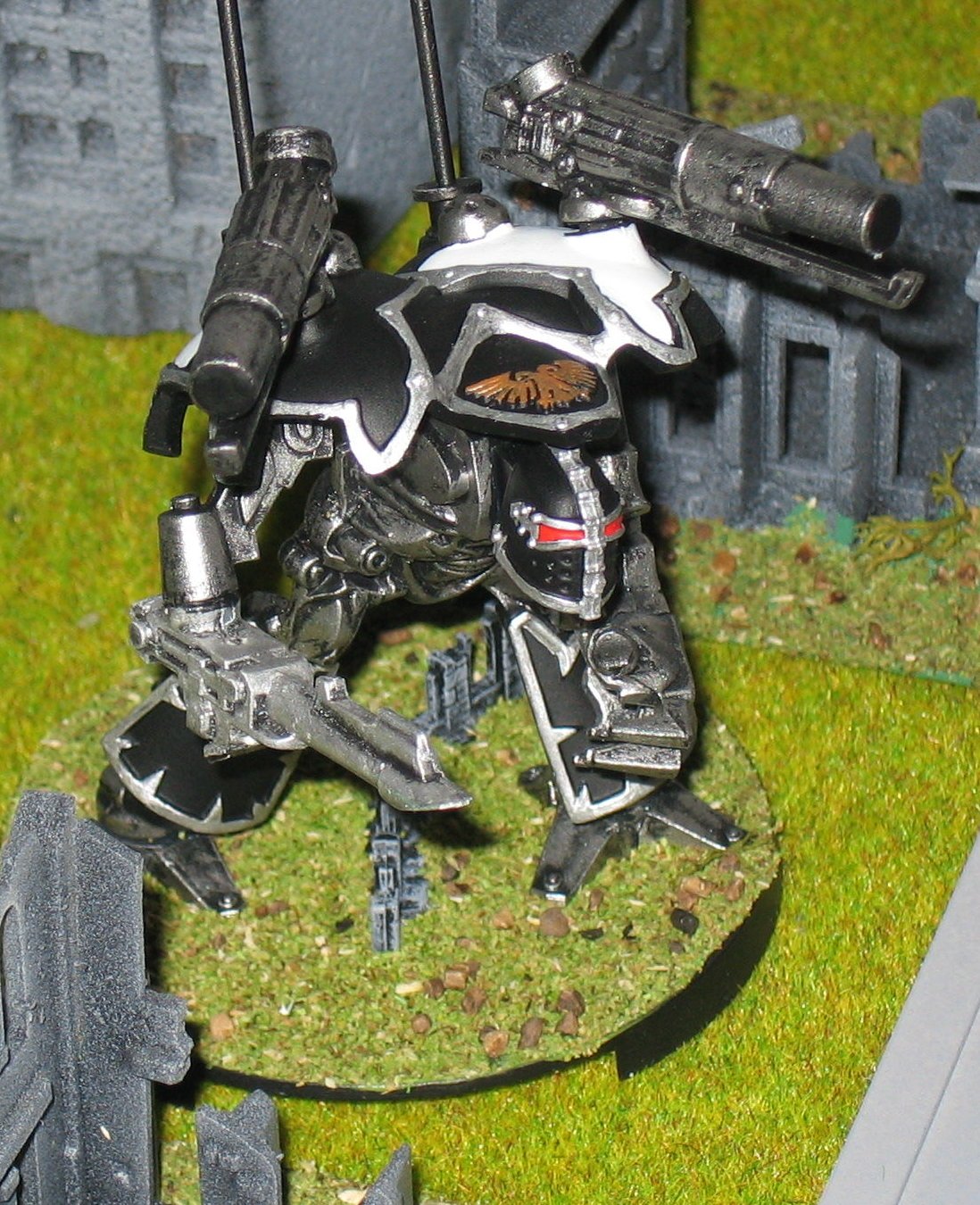 Warlord Titans are the larger and more powerful class of Battle Titans, the other being the smaller Reaver. They appear to be the most common class in use, and many Forge Worlds field their own patterns.
They are approximately 50% larger than the aging Reaver class, putting its height at around 45 meters. The Warlord Titan is also able to withstand considerably more damage. They have four Battle Titan weaponry hardpoints on the shoulders and arms, allowing a great variety of configurations. While Scout-class weapon batteries can be mounted, Warlords usually mount Battle-class weaponry. There is even a specialist class, the rare Psi-Titans, where psychic weaponry is added.
The Mars Pattern mounts two Turbo-Laser Destructors on its carapace, with a Volcano Cannon and Gatling Blaster on the arms. A special variant carries a close combat Powerfist and Gatling Blaster on its arms, plus Vortex missile and Rocket Launchers on the caparace.
Imperius Dictatio of the "Titan" graphic novels is a standard Mars-pattern.
The Warlord Titans were the first to be introduced in the Epic scale, featured as a box set with 6 plastic models and Styrofoam buildings. The accompanying rules were meant for Heresy-era Titan/Titan combat. Simple rules for interactions with vehicles and infantry were subsequently published, and the Epic Space Marine box set developed the full initial rules for infantry and vehicles. In "The Siege of the Emperor's Palace" diorama for 2000's UK Games Day and since then on display in Warhammer World a Warlord titan features on each side. Rules for 40K scale Warlord titans were introduced in the 2007 Warhammer 40,000 supplement, Apocalypse, however no model to represent it on the field has been produced by Games Workshop or its subsidiaries thus far, encouraging players to build their own from scratch should they wish to field such a weapon in their army.
Emperor
The superheavy Emperor Titans are subdivided into two classes, the Imperator and Warmonger. Of these, the Imperator is a more general-purpose assault platform, whereas the Warmonger is a dedicated fire-support unit with advanced fire control and targeting systems. Both are extremely powerful. They are loaded to the brim with pre-installed weapons, and their mounts can handle Titan weapons too big for even the other classes (they do not carry any of the close-combat weapons, as their sole focus is on extreme firepower). Emperor Titans are very rare, and can crush many weaker war engines. This class of titan also houses a full company of troops within its legs for defence and assault assistance.
The most noteworthy feature of an Emperor titan is the fortified castle structure that occupies its entire upper half. These castles sport ornate features like spired towers and stained glass windows. The building is heavily-armed, and more than capable of contributing to combat. Due to its prominent position, the Titan's head is hunched more than usual on the body, almost level with the arm weaponry.
In Winter Assault, the planet Lorn V houses the fallen Mars-pattern Imperator Dominatus. In Dark Crusade, the planet Kronus bears the Hellstorm Cannon of the Imperator Aquila Ignis. The Hellstorm Cannon of Aquila Ignis was so large that it was capable of destroying any unit within its line of fire with a single shot.
Imperial Knights
Knights are smaller than Titans though built on the same principle, and are also related to Sentinels. They can be seen as one-man mini-Titans. Unlike Imperial Titans, Knights use high-capacity energy cells rather than plasma reactors. Knights also benefit from power fields, which provide the same protection as Titans' void shields though they cannot be replenished in the course of a battle.
They are the product of feudal agri-worlds within the Imperium and are, like the Sentinels, in imitation of machines built by the Eldar - "Eldar Knights". While Sentinels herd sauropoda, Knights defend them from predators.
Three types were introduced in the 1990s - the Warden, Paladin and Lancer. The Wardens are defensive; armed with long range heavy weapons and well protected. The Paladin are fitted with a ranged weapon and a close combat weapon. The Lancer has only a single major ranged weapon but is speedier than the other types.
The range was reworked in look and rules to "Paladin", "Errant" and "Lancer" types with the "Baron" as a superior command unit.
A number of Knights were included in the Titan Legions box set (Epic 2nd edition) and also feature as a hidden extra in the Final Liberation game.
Imperial Titan Weaponry and Defences
The weaponry carried by Titans are usually dedicated to certain tasks. Some are for targeting high-priority and well-armoured enemies, such as fortresses or armoured divisions, others are particularly effective against legions of troops and laying down devastating artillery barrages. Titan weapons are divided into two rough categories:
Scout Titan Weapons are weapons normally fitted to light Titans such as the Warhound. Rarely found on the largest Titans, and usually of short range, these are designed to destroy light to medium vehicles quickly, and to deal with huge masses of troops. Below are some examples of such weapons:
- Inferno Cannon - An uprated version of the flamers mounted on vehicles, the triple-barrel Inferno Cannon is immensely devastating in close quarters against infantry and light vehicles, particularly those in hiding.
- Plasma Blastgun - The lightest plasma-based Titan weapon, and one of the most powerful that can be mounted on the Warhound. Slow to fire and only medium ranged, but can badly damage well-armoured vehicles, scout Titans and devastate infantry squads.
- Turbo Laser-Destructor - A Titan-scale laser weapon for anti-tank support. Very destructive compared to most vehicle and infantry-level laser weapons. As powerful as the Plasma Blastgun, but much longer-ranged. Unlike the other Scout Titan weapons, Turbo-Laser Destructors are commonly found on the Battle Titans.
- Vulcan Mega-Bolter - A Titan-scale bolter weapon, comprising of two large-calibre Gatling gun-style assemblies. Able to tear through infantry and light vehicles with ease.
Battle Titan Weapons have more destructive and longer-ranged weapons mounted commonly on Reaver and Warlord Titans. Most are designed to destroy other Titans, engage enemy detachments, or bring devastation to fortifications.
- Close combat weapon - although they do not provide ranged firepower, this category of weapons is horrendously effective against enemy war engines and Titans - that is, if the Titan can get close enough. They can only be mounted on the Titan's arms; which rules out the Warhound. In Epic Space marine, close combat weapons included the powerfist, laser burner and chainfist.
- Gatling Blaster - A larger projectile weapon commonly found on battle Titans. It is a rapid-fire weapon like the Vulcan Mega-Bolter, but instead fires 150mm shells, powerful enough to inflict damage upon superheavily-armoured targets.
- Hellstorm Cannon - Seen lying on its side in Dark Crusade, the Hellstorm Cannon is a huge five-barrelled super energy weapon. Right in front of it is a massive long-distance trench, carved out by previous firings.The Hellstorm Cannon can completely decimate an entire city(maybe even more)in just one salvo. In addition, the central hub around which the barrels are mounted can be converted to a Gatling Blaster.
- Melta Cannon - An upsized melta (fusion) weapon mounted on Warlord Titans. Notably short-ranged, but incredibly effective at penetrating armour and destroying Titans.
- Multiple Rocket Launcher - Long range artillery which unleashes heavy barrages to suppress and devastate enemies. And because it is mounted on a Titan, it is much less vulnerable to air and fast attacks than dedicated artillery companies.
- Quake Cannon - A very, very large artillery piece that is of a more massive caliber than any other artillery weapon in the game.
- Volcano Cannon - Powered directly from the Titan's plasma reactor, the Volcano Cannon has extreme range and is very effective at penetrating armour, making it used primarily against war engines and other Titans. A favoured weapon of the Warlord and certain Reaver patterns.
- Plasma Annihilator - This is the largest and heaviest plasma weapon in the entire game(second only to the battle barge mounted Nova Cannon). The Plasma Annihilator can demolish any fortification with ease, and can destroy other titans and can slaughter infantry in mass numbers because of its immense size and power. It takes enormous amounts of energy directly from the titan's reactor and takes a long time to cool down.
- Missile Weapons
Warlord titans can carry one missile on a shoulder hardpoint, Warmonger and Imperator classes can carry them, but this is unusual.
- Vortex Missile - This missile creates a warp vortex (a controlled black hole to a hostile space inimical to all matter), which destroys tanks and infantry instantly. Vortex missiles can either collapse on themselves or move, meaning massive damage can be caused even if the missile does not hit the enemy directly
- Titan Warp Missile - Titan Warp missiles ignore void shields, which makes them very effective in Titan/Titan engagements.
A number of other weapons and add-ons for Titans have been described. Among them are the "Corvus" assault pod and "Deathstrike Cannon".
Titan Defences
Imperial Titans become increasingly well-armoured as their size increases. They also have 'Void Shield' generators to augment existing protection, which are able to absorb destructive energy on the Titan's behalf, although there is a limit to how much they can handle. They are directly controlled by the Princeps, and can be left running after having absorbed dangerous amounts of energy to allow for extra protection; this however has a high chance of permanently damaging the generator.
Void Shields always come in sets to maximize the likelihood of at least one remaining up after a barrage, and larger Titans may have as many as six or more fields. It is theoretically possible for a huge amount of small-arms fire to bring down a shield, giving infantry some ability to attack them. They however cannot defend against everything; for instance they cannot block non-ranged weapons (eg Titan-scale mêlée combat) and special technology like the "Warp missile", which bypasses normal defences by travelling through the Immaterium.
Emperor-class Titans are also commonly equipped with point-defence weapons to protect themselves against infantry and aircraft that cannot be targeted with larger-scale weaponry. Carapace-mounted multilasers are often employed in this respect, as are more exotic weapons for dealing with aircraft.
Imperial Titan Construction
Very little is known about the methods used in the construction of Imperial Titans. It is known that many Forge Worlds are capable of producing their own Titans (and some have their own patterns and legions). Of these Forge Worlds, it is known that Mars and Lucius have their own patterns (these patterns are provided as model kits by Forge World), and it is likely that other large Forge Worlds such as Ryza and the recently destroyed Gryphonne IV do/did as well.
Imperial Titan Crew
The 'Captain' of a Titan is called the Princeps, a rare individual in that he can retain his sanity after connecting with the 'Machine Spirit' of the Titan. The Princeps controls the Titan by means of a mental link device. Using this, the Princeps merges his/her consciousness with the Titan's sentient machine spirit. After doing so, he/she can guide its movements and weapons as though it were an extension of his/her body, and provides a greatly heightened perception of the battlefield. It requires a strong will to maintain this connection, and Titans can go out of control on rampages of destruction should the Princeps fail to maintain dominance.
There has also been noted rare instances where a Princeps has died while connected to the Titan, thus creating a ghost of themselves that remains inside the Titan's 'machine spirit'. This is often referred to as a "ghost in the link".
The Princeps is located in the head, along with several system controllers called Moderati. The number of moderati depends on the size of the Titan, and their duties are relegated to monitoring and maintaining weapons, as well as keeping track of "Auspex" (a radar-like device) readings.
Further crew includes engineers (Techpriests) for repair work and blessings, and cyborg-like organisms (servitors) set on the more mundane tasks like manipulation of controls and monitoring of Auspexes. Some of the largest Titans also have Armed forces on board in case of an enemy attempting to board and take control/destroy the Titan.
Standard Template Construct Titan
In the novel Dark Adeptus (Counter, 2006), the autonomous Castigator STC Titan was revealed, claimed to be the first one ever built. Called the Father of Titans, it was first designed during the Dark Age of Technology but became forgotten as time went by, bearing advanced long-lost technologies such as rapid self-repair routines, and a muscle-like locomotive system. Standing larger than even the Imperator-class Titans, the Castigator notably had its head on top of its body, matched by an elegant yet super heavy and very well armoured design and impossibly-graceful movement, and it was far superior to any class of titan utilised by the Adeptus Mechanicus or any other race in the Warhammer 40k universe, for that matter. In the novel, it was armed with an arm-mounted melee weapon that could easily cut another titan in half and a multi-barreled cannon that fired daemons that was capable of melting through the carapace of a Warhound titan that became a target of its weapon. The daemons are later found out to be due to a pact the Castigator formed with the Chaos Gods.
The single Castigator-class featured in the novel was brought down by destroying its reactor, and its STC, although complete, had to be destroyed due to its corruption.
The main problem with the idea of an STC Titan is that by official Games Workshop background, they were actually developed during the Age of Strife on the Forge World of Mars. This would put them after the Dark Age of Technology, meaning that an STC version of the Titan would never have been developed.
Chaos Titans
During the Horus Heresy, half of the Adeptus Mechanicus, including several hundred Titan Legions, turned to Chaos, taking their mighty war machines with them. Chaos Titans are usually similar to their Imperial counterparts, but their long exposure to the warping influence of Chaos has changed many of them. In some cases, the crew has merged with their machine, making it impossible to tell where one ends and the other begins. Other crews have given themselves and their weapons over to one of the four great powers of Chaos.
The most infamous of these monster war machines was the Dies Irae (literally 'Day of Wrath') which stormed the battlements of the Emperor's palace during the siege of Terra. It was eventually destroyed 10,000 years later, during an Iron Warriors campaign against the Imperial citadel of Hydra Cordatus, where the Dies Irae engaged in battle with an entire demi-legion of twelve Imperial Titans, destroying almost all of them before finally being stopped by the Warlord Titan Honoris Causa. Dies Irae is featured in the first 3 books in the Horus Heresy series and briefly in the fifth, in Flight of the Eisenstein.
With the release of the Black Legion Army List (Version 3.7) for Epic Armegeddon, the Feral, Ravager, and the different versions of the Warlord Titans have been detailed.
Feral Titan
Feral Titans are twisted versions of the Imperial Warhound Titan. The Chaos Warhound Titan has been given an official model from Forgeworld.
Ravager Titan
Ravager Titans are the Chaos versions of the Imperial Reaver Titan.
Chaos Warlord Titans
The Warlord class titan has four (4) different versions depending on which power of Chaos the titan is aligned with. Even though there are different versions of the warped Warlord Titan, the rules for Epic Armageddon only list the most commonly sighted one, the Banelord Titan.
- The Banelord Titan is dedicated to the Chaos God Khorne with a long tail ending in a large cannon, another cannon protruding from the daemonic head's mouth, and three special weapons; a Havoc Missile Rack, Hellstrike Cannon and Doomfist. This is the most common Chaos Warlord Titan.
- The Plaguelord Titan is dedicated to the Chaos God Nurgle.
- The Painlord Titan is dedicated to the Chaos God Slaanesh.
- The Warplord Titan is dedicated to the Chaos God Tzeentch.
Chaos Imperator Titans
Abominatus was another special class of Chaos Titan, which was created by the fusing of a Khorne greater daemon and an Imperator Titan. The Caligula came out recently as a titan competition winner: it is also a chaos Imperator titan and is similarly aligned with the blood god.
Other Chaos Titans
The Gaunt class titan appears in all of the Horus Heresy trilogy of novels. It is not well described, but seems to be comparable to a Warlord class. At the time it was a new design (possibly more technologically advanced). It seems to have disappeared since then, presumably the designs were lost during the conflict.**
Ork Gargants
The Ork equivalent of a titan is called a Gargant. Gargants are as much idols of the savage Ork gods, Gork and Mork, as they are engines of destruction. Big Meks receive a divine vision of sorts from Gork (or possibly Mork), and set out to bring that vision to life in the artistic medium of thick armor plates, smoke-belching engines, and lots and lots of very large guns. This quickly spreads amongst other Big Meks in the area, and soon Gargants spring up all over the place. The construction of Gargants is one of the typical signs of an impending WAAAGH! from an Ork-held system.
In an Ork warband, there can exist Gargants and Gargant-like warmachines all the way from single-man Killa Kans to the vast armoured behemoths of the Mega-Gargants. From smallest to largest, the most typical machines of these type include:
Stompas
- Stompas are not war engines nor Titans proper but rather large armoured fighting vehicles built as roughly Ork-shaped effigies. They are armed with both long- and short-range weaponry and are used in the same manner as heavy tanks.
- Supa-Stompas are significantly more powerful than regular Stompas, and count as war engines. They can mount two of the weapons that are carried on the larger Gargants and can be seen as equivalent to a War Hound titan
Gargants
Gargants and Great Gargants are the archetypal Ork Titans. They are massive constructions broad and squat compared to an Imperial Titan. They are fitted with many batteries of guns and also tend to have at least one mega-weapon. They are roughly equivalent to Reaver and Warlord Titans, respectively.
Mega-Gargant
The Mega-Gargant is a very rare super-large gargant on a par in size with the Imperator and Warmonger Titans, though not as powerful. It carries a large number and variety of weapons including the mega-dropper. The Mega Gargant was introduced alongside the Imperator Titan in the Titan legions box set; two plastic models being included to give the Imperator a challenge. Unlike the other Gargants which shuffle on their short legs the Mega Gargant is a tracked vehicle.
Construction
Ork Gargants are an extremely varied lot, no two ever being alike. Thanks to the frenzied imaginations of the Mekboyz building them, Ork weapons tend to be haphazard, unreliable and noisy. When they work, however, they can inflict gruesome damage. Gargants are commonly equipped with at least one close-combat weapon, because charging in and bashing heads is considered to be a very "Orky" thing to do.
For defence, Gargants have power fields which are the equivalent to an Imperial Titan Void shield. However while Gargants tend to have more power fields, they cannot regenerate these during the battle.
Orks do not rely on auto-systems to the same extent as other races, and Gargants carry a large crew of both Orks and Gretchins. The crew is led by a Kaptin, who relays orders through a body of officers. A speaking-tube is the preferred method of communication within a Gargant. Each officer is in charge of one section of the Gargant, be it a weapon, the magazine, the engine room, or any other chambers. Under the officer is a crew of Orks and Gretchins who carry out the orders passed down to them. Repair crews are composed of Gretchins, whose smaller build suits them to crawling through cramped spaces armed with wrenches and oily rags.
Compared to Imperial Titans, Gargants have weaker armour and comparatively shorter-ranged weaponry. However, Gargants are extremely difficult to destroy due to their dense (albeit crude) construction (in games, this is represented by Gargants have more damage points). While Gargants do not suffer from potentially fatal plasma reactor meltdowns, they are particularly vulnerable to fires and magazine explosions.
Eldar Titans
Eldar Titans are quick and nimble machines of war. They are thinly armored but despite their frailty, Eldar Titans can pack a mean punch, and can move about the battlefield with frightening speed, thanks to their jump jets.
Instead of void shields or power fields used by other races' titans, the Eldar rely upon advanced holographic field generators which in conjunction with speed make their titans extremely difficult to target. However, holo-fields do not actually deflect enemy firepower, so Eldar titans are even more vulnerable should they suffer hits.
There are three types of Eldar titans:
- The Revenant is a relatively light warmachine, roughly equivalent to an Imperial Warhound, though much more agile. They are best suited for lightning-fast raids on enemy lines, using their speed to retreat before a counter-offensive can be mounted. A model of this titan has been created by Forge World. It can come armed with either Pulsars or Sonic Lances.
- The Phantom is a more massive warmachine capable of taking on its Imperial equivalents. What makes Phantom titans distinctive from those of lesser races is their crew. In addition to the living, the souls and memories of ancient Eldar warriors are maintained in the wraithbone matrix of the Titan.
- The Warlock is a refinement of the Phantom. Its wraithbone core hosts the spirits of late Seers and Warlocks, focusing their power into a near-unstoppable engine of destruction.
Tyranid Bio-Titans
Bio-Titans are more than exceptionally large Tyranid biomorphs, they are on par with the Titans of other races. Bio-Titans are deployed in the final stages of the assimilation of a planet into the hive-fleets biomass.
While their supersized bio-weaponry is potent, Bio-Titans are feared mainly for their extreme effectiveness in close combat against enemy Titans and war engines. They are also considerably faster than Titans of other races; as a result Bio-Titans often charge towards the enemy. Their ripper tentacles can neutralize enemy Titan close combat weapons, while monstrous claws will make short work of Titan hulls.
Early editions of Epic did not give them "shields" like that of Imperial Titans or Ork Gargants; however they made up for this by being able to "regenerate" or self-heal. Experimental rules of Epic gave Bio-Titans a limited number of bio-plasma fields to make them less vulnerable to sniping from Imperial Volcano cannons, however this appears to have been dropped.
Examples of Tyranid Bio-Titans include the Vituperator, the terrifying Hierophant and the even more monstrous Hydraphant. They are roughly equivalent to the Imperial Warhound, Reaver, and Warlord Titans, respectively. The Hierophant is the only one of the three to have been converted into 40K scale by Forgeworld.
Regular Tyranid biomorphs (not war engines, let alone titans) include the tank-sized burrowing Trygon and the winged Harridan (a war engine but not considered a Titan). The Heirodule was used as the name of the smaller Bio-Titan (the Hierophant was the larger titan) when the model range was released in November 1997, however the Heirodule is now just a biomorph construction.
A specialist breed of bio-titan is the Dominatrix, a powerful Hive node that can use its malign intellect to command the hordes of lessers around itself with ghastly efficiency. In the hierarchy of Tyranids, they are the Supreme Commanders of the battlefield and second only to the shipbound Norn-Queens themselves.
References
- Codex: Tau Empire
ru:Титан WH40k simple:Titan Legions