
Star-forming regions of Auriga
The star-forming regions in Auriga include numerous molecular clouds and extensive H II regions, visible in the direction of the constellation Auriga. They are located at various distances and appear one behind the other in this direction, appearing close together only due to a perspective effect.
These objects all lie within a galactic longitude between 167° and 180°, i.e. in the direction opposite the Galactic Center, as seen from the Solar System. Among them, the nebular complexes located on the Perseus Arm dominate, which in this direction presents a notable concentration rich in young hot and massive stars gathered in several OB associations, while objects located on the Orion Arm are scarce. The Cygnus Arm, the outermost one, is rather sparse and discontinuous in the direction of Auriga, but according to the most recent studies, it is possible to distinguish a significant concentration within it, consisting of a bright OB association linked to the large nebular complex of IC 410.
The study of the galactic plane in the direction of Auriga, although difficult, has proven useful for understanding various morphological features of the outer spiral arms in the direction opposite the galactic center, such as the highly irregular distribution of nebular and stellar concentrations.
Observation
upright=1.3|thumb|left|Map of the central-southern part of the constellation Auriga. The star-forming regions of Auriga lie in the direction opposite the Galactic Center, in a section that is partly heavily obscured and partly, on the contrary, very rich in star fields; however, despite the large expanse of sky involved, with the naked eye or with the aid of small instruments, little is visible beyond the aforementioned star fields and a few open clusters, among which the three major objects of Auriga, cataloged by Charles Messier, stand out: M36, M37 and M38. In addition to these, numerous other star clusters can be observed with large-diameter instruments; in photographs, however, large nebular systems are very clearly evident. The northern part of Auriga, on the other hand, appears rather poor in objects and the Milky Way appears thin and highly obscured.
Being at a northern declination, between 50°N and 25°N, the constellation Auriga (and with it its nebular regions) dominates much of the northern nights and appears circumpolar from regions further north; Auriga is one of the most classic figures of the autumn and winter evenings in the Northern Hemisphere, when it is at the zenith over much of North America and Europe, making it clearly visible until well into spring. From the Southern Hemisphere, however, the view is penalized and for most of its regions it remains rather low above the northern horizon.
In precessional epochs
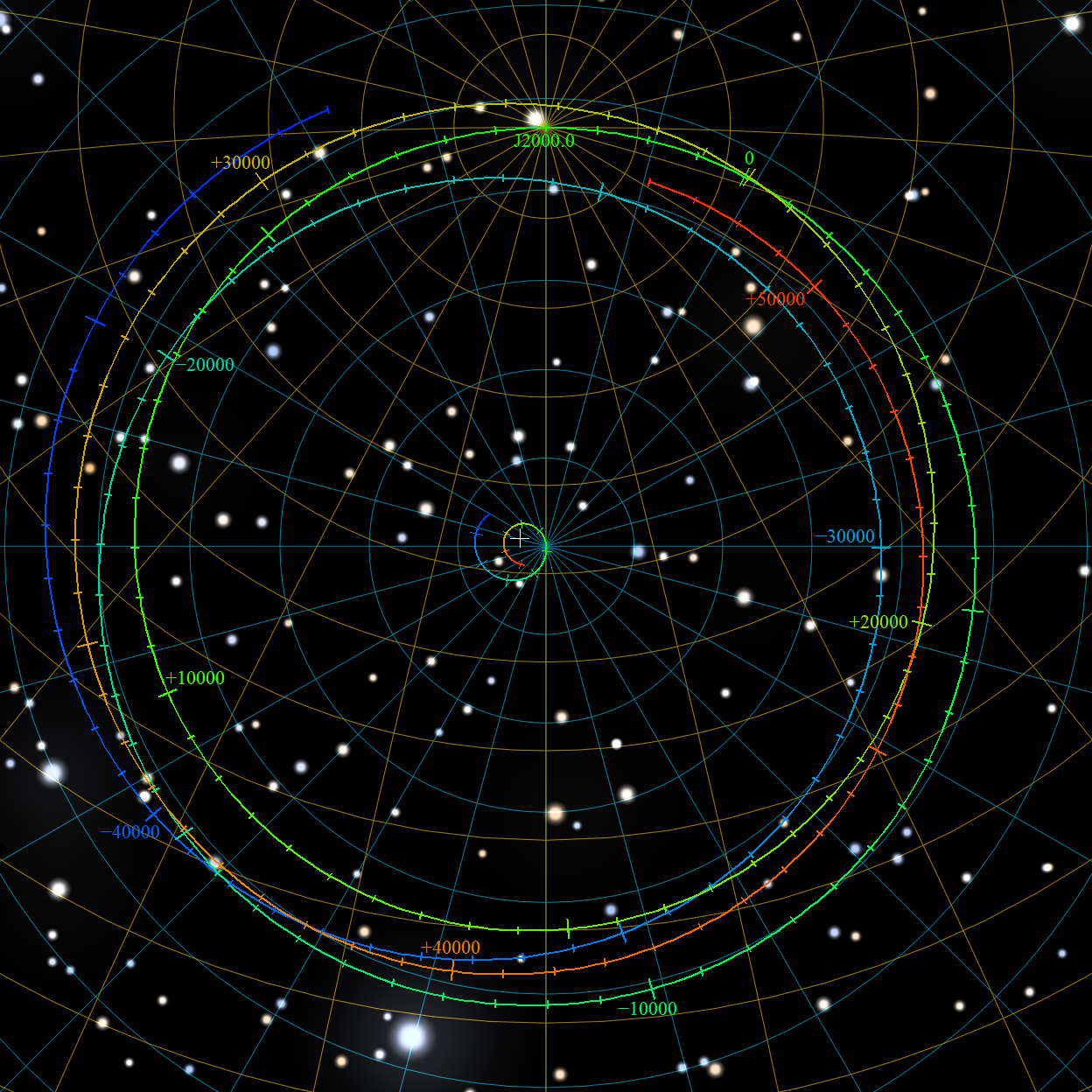 Due to the phenomenon known as the precession of the equinoxes, the celestial coordinates of stars and constellations can vary significantly, depending on their distance from the north and south poles of the ecliptic.
General overview
 The nebular regions visible in Auriga, when viewed from Earth's perspective, align around 167°–180° of the galactic equator, where 0° corresponds to the direction of the Galactic Center; this means that they lie in a galactic region farther out than Earth and thus farther from the galactic center. This direction is often called the Galactic anticenter.
In this direction, stars and nebular regions belonging to three different spiral structures of the Milky Way align: the closest to the Solar System are those belonging to the Orion Arm; since the Sun is located near the inner edge of the arm, much of it extends outward, so that even its outer objects fall in this direction. Beyond the boundaries of the Orion Arm, starting at a distance of at least 1500 parsecs, lies the Perseus Arm, one of the two main spiral structures of the Milky Way; at this point falls most of the observable objects in the direction of Auriga, including the major star formation areas. Beyond 4000 parsecs finally lies the Cygnus Arm, a secondary arm which in this direction tends to dissolve, having almost reached the end of its length.
It is interesting to note that while around 170°–180° of the galactic equator numerous nebular complexes and stellar concentrations are observable aligned at various distances, at the galactic longitude of 150°–170°, included in the northern part of Auriga, neither significant nebular complexes nor massive young stars capable of ionizing the gases in this direction are observed; it appears that in this direction the Perseus Arm and the Cygnus Arm behind it do not present a continuous and regular structure as instead occurs in the direction of Cassiopeia and Perseus; even in the inner Orion Arm there are few significant structures, opening a sort of window towards the outside of the Milky Way.
In the southern part of Auriga, where the nebular concentrations are located, two extensive OB associations have traditionally been identified, also located one behind the other, to which the designations Auriga OB1 and Auriga OB2 were assigned; estimates of their distance, as well as those of the nebulae associated with them, have always been affected by uncertainties and the values indicated have often been contradictory among different publications, until it was realized that the two identified associations are actually both composed of two physically distinct groups, located at different distances. This is of fundamental importance for understanding this sector of the Milky Way.
Auriga OB1
upright=1.2|thumb|M36, center of one of the subgroups of Auriga OB1. The Auriga OB1 association was indicated from the beginning as the closer of the two; it was initially defined by twelve stars of spectral type O and B, divided into four class O stars, including one main-sequence star of class O9V, one subgiant, and two blue giants, seven class B stars including two main-sequence, one subgiant, one giant and three blue supergiants, plus three red supergiants at the end of their life cycle. The brightest star of this association is the blue supergiant χ Aurigae, with an apparent magnitude of 4.76 and an absolute magnitude of -7.1. The distance suggested for Auriga OB1 was about 1750 parsecs and it was therefore placed on the Perseus Arm.
More recent studies using more precise instruments have allowed the stars of Auriga OB1 to be resolved into two distinct OB associations; the closer association includes some stars located at a distance of about 1100 parsecs, while the farther one is at about 2000 parsecs. Both are nevertheless on the Perseus Arm, although the nebulae to which they are linked are different. The closer group would also include the open cluster M36, located at a distance of about 1300 parsecs; and formed by nearly 200 young massive stars with an age of about 20 million years. It has been hypothesized that one of the most massive OB stars in M36 exploded as a supernova about 40,000 years ago, after being ejected from the cluster, generating the extended supernova remnant known as Simeis 147, visible between Taurus and Auriga; although the distance of this object has traditionally been indicated as 800 parsecs, more recent studies tend to report a distance of 1470 parsecs, compatible with M36, thus suggesting a certain affinity.
A small group of class B stars visible in this direction would instead not be linked to these subgroups, but constitutes a small stellar association located in the foreground, at a distance of 600 parsecs.
Auriga OB2
upright=1.2|thumb|left|IC 410, a large star-forming region on the outskirts of the Milky Way. Auriga OB2 is the second of the OB associations identified in early studies of the region, as well as the more distant one; initially, eight stars were indicated, five of which were of class O; among these, three are of class O7V and therefore on the main sequence, one of class O4V and one of class O8 without definition of the life phase. To these are added three class B stars, of which one main-sequence, one subgiant and one undetermined. The brightest of these is HD 35619, with an apparent magnitude of 8.55 and an absolute magnitude of -5.6; three of the class O stars are indicated as members of the cluster NGC 1893, connected to the large nebula IC 410. The distance initially indicated for Auriga OB2 is 6300 parsecs, thus falling on the Cygnus Arm.
In this case too, it was later discovered that the definition Auriga OB2 groups stars that actually belong to two distinct associations. The closer one consists of some stars located at about 3000 parsecs, while the more conspicuous group is much farther away, at a distance of 6000 parsecs, thus very similar to what was initially estimated. The stars of this group allow outlining some isolated structures of the Cygnus Arm, which in this section appears rather indefinite; in fact, after the structural continuity observable in the direction of Cassiopeia and Camelopardalis, particularly with the association Camelopardalis OB3, there is a vast almost empty region, which separates the concentration observable in Auriga at a distance of about 5000–6000 parsecs. This vanguard of the Cygnus Arm is absolutely dominated by the large nebula IC 410, which being at a distance of as much as 6000 parsecs constitutes a remarkable example of a star-forming region located on the periphery of the Milky Way.
Structures in the Orion Arm
upright=1.2|thumb|IC 405 and the runaway star AE Aurigae. The structures belonging to the Orion Arm visible in this direction are few and relatively insignificant; the high galactic latitudes are nevertheless populated by a large number of young stars, largely associated with the peripheral regions of the large Perseus molecular cloud and the Perseus OB2 association. This nebular system lies at a distance of about 200–400 parsecs and is the site of important star formation processes. Further east, in the direction of the northern part of Taurus, lies the Taurus molecular cloud, located at just 140 parsecs and constituting one of the closest star-forming regions of low-mass stars to the Sun.
IC 405
The only significant object visible in the direction of Auriga belonging to the Orion Arm is the nebula IC 405, sometimes called the Flaming Star Nebula due to its appearance; this nebula surrounds the young variable star AE Aurigae, from which it receives the ionizing radiation, located at a distance of about 500 parsecs. From the data obtained with the Hipparcos satellite, it emerged that about 2.6 million years ago this star, μ Columbae and the bright binary ι Orionis were in the same position in space; it was thus hypothesized that these stars underwent a four-body interaction, in which two binaries belonging to the Orion OB1 association exchanged partners; the result was that the two most massive stars underwent mutual gravitational influences, becoming a new binary system, the current ι Orionis, while the two less massive stars were propelled away at high speed by the intense gravitational energy, moving away from their formation region and becoming runaway stars.
Supernova remnants
Although they are not associated with star-forming regions, the Orion Arm in this direction hosts some supernova remnants; one of the most notable is Sh2-221, also known as HB9; it presents strong radio emissions and is associated with the pulsar PSR B0458+46. Its distance is estimated at about 800 parsecs, although there is a margin of error on the order of 400 parsecs; in any case, its belonging to the Orion Arm appears certain.
Structures in the Perseus Arm
In the direction of Auriga, the Perseus Arm is certainly the best-defined galactic structure, although it too is in a phase of progressive dissolution after passing the jump to the north of the constellation. This section of the Perseus Arm hosts several star-forming regions, many of which are located not far from the Gemini OB1 molecular cloud complex, visible to the south in the direction of the constellation Gemini at a distance of 1500–2000 parsecs. The outer edge of the Perseus Arm instead contains the supernova remnant Sh2-224, with an unusual shape due to interaction with a cavity of the interstellar medium, located at 4500 parsecs from the Sun.
IC 417
IC 417 is one of the dominant nebular systems in this direction; it is located in the immediate vicinity of the star φ Aurigae and is linked to the open cluster Stock 8. Its most accepted distance is around 2300 parsecs (7500 light-years) or at most slightly less, around 2050 parsecs (6680 light-years), therefore at a short distance from the second subgroup of Auriga OB1. The stars of the cluster show ages between about 1 and 5 million years, indicating that star formation here has taken place in multiple episodes. The ionization front from the hot young stars located on the western side of Stock 8 does not seem to be directly responsible for triggering star formation in this sector, thus suggesting that the generative processes still ongoing here are independent of those that generated Stock 8. The process that instead generated the cluster itself was probably triggered by another population of class O and B stars of a previous generation, now observable all around the nebula.
Sh2-235 region
upright=1.2|thumb|The Sh2-235 region. The region of Sh2-235, also known as G174+2.5, is formed by a quartet of H II regions located at a distance of about 1800 parsecs, dominated by Sh2-235, the cloud in which star formation phenomena are most active. The group is located in an eastern position relative to the alignment of the main nebular systems of Auriga and includes, in addition to the aforementioned Sh2-235, the nebulae Sh2-231, Sh2-233 and the faint and extended Sh2-232. Sh2-235 is an H II region in a very evolved phase, as testified by its irregular and inhomogeneous appearance. The ionizing source of the gases is a blue star cataloged as BD+35° 1201, with spectral class O9.5V and an apparent magnitude of 10.54; this is also the brightest star of the entire complex. Within it are three small sub-regions associated with young stars, designated Sh2-235A, Sh2-235B and Sh2-235C; the first two are the most conspicuous and contain within them masers with H2O emissions, one with CH3OH emissions and one with SiO emissions, which, being associated with young stellar objects, are clear evidence of ongoing star formation within them.
The nearby clouds Sh2-231 and Sh2-232, sometimes indicated with the single acronym LBN 808, are two highly evolved regions whose ionizing star is located halfway between the two, east of the semi-arc formed by Sh2-231 and southwest of the large Sh2-232 complex; this is cataloged as ALS 8476 and is a blue star of magnitude 10.79. Their degree of evolution is evidenced both by the low density of electrons and by the lack of a regular and uniform structure. Associated with Sh2-233 is the IRAS 05358+3543 source, a compact H II region that hosts two young open clusters designated by their position, NE (to which the IRAS source is directly associated) and SW.
Minor regions
upright=1.2|thumb|left|The nebula NGC 1931. Among the minor clouds located in the Perseus Arm is the system of NGC 1931, formed by a very young open cluster located inside the nebula Sh2-237; the system vaguely resembles the Orion Nebula, in which a group of four young blue stars arranged in a trapezium occupies the central part of a nebula very similar to M42 in shape, but of reduced size, also due to the greater distance. Associated with the cloud is the infrared source IRAS 05281+3412, which includes a maser with H2O emissions. The distance of NGC 1931 is estimated at around 1900 parsecs.
Just south of Sh2-237, at a distance of about 1800 parsecs, lies the bright infrared source IRAS 05274+3345, coinciding with the object AFGL 5142; its luminosity is estimated to be about 3800 L⊙ and it is associated with a large molecular jet oriented northwest-southeast and a strong maser with H2O emissions. The object contains a very young cluster composed of about sixty massive stars deeply embedded in gas and hidden, whose age is estimated at around 1 million years at most. Studies on the molecular jet have revealed emissions at wavelengths of CO, SiO and the HCO+ ion, the last two of which are oriented perpendicularly to the main jet.
NGC 1985, also known as Ced 57, is a reflection nebula known since the late 18th century; it is associated with the IRAS 05345+3157 source, to which a large bipolar jet oriented east-west is connected, known as AFGL 5157. The distance of this system is about 1800 parsecs, therefore it is located in the same galactic region as the two previous nebular complexes. The molecular jet has been mapped at the CO wavelength since 2005, while a chain of five Herbig–Haro objects, cataloged from HH 281 to HH 285, was already known inside the cloud.
At a greater distance, two of the very few ionized hydrogen regions visible in the central-northern part of Auriga extend; the first is Sh2-225, located at 3700 parsecs, ionized by a blue star of class O9V and containing a probable young stellar object, coinciding with the IRAS 05235+4033 source. The second is Sh2-228, located at a slightly smaller distance (3500 parsecs); this nebula contains a rather compact young open cluster known as CC 01, formed by some massive blue stars and several smaller stars. Their age is estimated to be 1–2 million years at most and they represent a generation of stars subsequent to the surrounding stars, which instead show an age of about 5–6 million years.
Structures in the Cygnus Arm
upright=1.2|thumb|The cluster NGC 1893, at the center of IC 410, and the tadpole-shaped nebular structures visible on the upper right side. The Cygnus Arm arrives in Auriga already considerably dispersed and sparse, with some concentrations alternating with extensive almost empty regions; however, in this direction lies one of the most extensive known nebulae, the large complex of IC 410, to which the outermost of the OB associations identified in this constellation is linked.
IC 410
IC 410 (also known as Sh2-236) has a roughly square shape and presents on its northeastern edge two elongated structures with a dense coma, which have suggested the nickname Tadpole Nebula for the entire nebula. IC 410 has been analyzed in several studies due to its structure, which represents a good example of a massive star-forming region. Although estimates of its distance have in the past been very contradictory, ranging between 3200 parsecs and 4800 parsecs, the most recent studies, based on photometry and spectroscopy, tend to place the distance of the nebular system at about 6000 parsecs.
The real dimensions of IC 410 are on the order of a hundred parsecs; at its center it has a kind of cavity in which the open cluster NGC 1893 lies, whose stars are responsible for the ionization of its gases. This cluster is formed by numerous scattered young stars, obscured by some dense molecular clouds; the five dominant stars are of spectral class O and have an age of less than three million years. Studies focused on the determination of pre-main-sequence stars have allowed the discovery of numerous recently formed stars, located mainly on the western side of the cluster, which are emerging from the clouds in which they were generated; among these, S3R1N3 stands out, a Herbig Ae/Be star.
Minor regions and on the inner edge
In the direction of the central-northern part of Auriga, corresponding to the area poorest in nebular objects, there are two small H II regions probably linked to the inner edge of the Cygnus Arm. The first is Sh2-226, located at a distance of 4200 parsecs; its light appears heavily obscured by the dust of the interstellar medium that lies along its line of sight. Sh2-226 is linked to the infrared source IRAS 05075+3755 and to two masers. At 4300 parsecs finally lies the little-known Sh2-227, ionized by a class O9V star and linked to two infrared sources.
See also
General topics
- Auriga (constellation)
- Nebula
Specific topics
- Orion Arm
- Perseus Arm
- Cygnus Arm
Related phenomena
- OB association
- Star formation
- Giant molecular cloud
- H I region
- H II region