
Spring (mathematics)
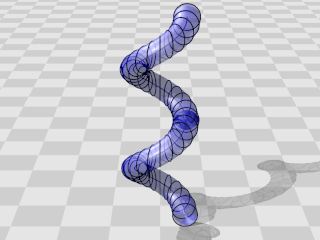

- For other meanings of the term, see Spring.''
In geometry, a spring is a surface of revolution in the shape of a helix with thickness, generated by revolving a circle about the path of a helix. The torus is a special case of the spring obtained when the helix is crushed to a circle.
A spring wrapped around the z-axis can be defined parametrically by:
x(u,v) = (R+rcosv)cos u,
y(u,v) = (R+rcosv)sin u,
$$z(u, v) = r\sin{v}+{P\cdot u \over \pi},$$
where
u ∈ [0, 2nπ] (n∈ℝ),
v ∈ [0, 2π],
- R is the distance from the center of the tube to the center of the helix,
- r is the radius of the tube,
- P is the speed of the movement along the z axis (in a right-handed Cartesian coordinate system, positive values create right-handed springs, whereas negative values create left-handed springs)
The implicit function in Cartesian coordinates for a spring wrapped around the z-axis, with n = 1 is
$$\left(R - \sqrt{x^2 + y^2}\right)^2 + \left(z + {P \arctan(x/y) \over \pi}\right)^2 = r^2.$$
The interior volume of the spiral is given by
V = 2π2nRr2 = (πr2)(2πnR).
See also
- spiral
- helix