
Social construction of schizophrenia
In 1966 , Berger and Luckman coined the term 'social constructionism' in their Seminal work 'the social construction of reality'.
Schizophrenia is one such term that can be viewed as an ontological social construction :
"From the perspective of linguistics we see that the reified categories (e.g. mental illness, schizophrenia, bipolar disorder) are abstractions defined by clusters of what we call “symptoms.” Schizophrenia is defined as the presence of audio hallucinations (or other “thought disorders”) in the absence of a “mood disorder.” You can even throw in other correlates like “negative symptoms”, PET scans, response to medications, etc. The issue of the DSM’s poor reliability and validity aside (Caplan, 1995; Sparks, Duncan, & Miller, 2005), the term “schizophrenia” is a word used to communicate the presence of these “symptoms.” The various human manifestations of thought, feeling, and behavior (aka “symptoms”) exist like the chair you are sitting on as you read this exists. But the next level of abstraction, the word “schizophrenia”, and the next, “mental illness”, only exist through consensus and only persist by convention. Even if the correlations of defining symptoms was perfect (which it is far from), in light of the linguistic paradigm we have to ask ourselves whether using a pathologizing, deficit-based vocabulary is useful in helping people improve the quality of their lives."
Movement to reconstruct Schizophrenia
Alternative Perception is one of several names suggested by the schizophrenic user movement to replace the term schizophrenia which is on a spectrum of psychotic disorders and is considered to be outmoded by many consumers of services. Several leading academic authorities , notably Professor Marius Romme founder and principle theorist for the Hearing Voices Movement provide a rationale for the abandonment of this label. A symposium of some of the leading notions in this field from consumers of services and academics concluded:
Historical construction of Schizophrenia
The Terms Schizophrenia and Autism originated from the works of Eugene Bleuler (1857-1939) as different aspects of the same diagnostic condition. Bleuler was a contemporary of Sigmund Freud and Carl Jung. Prior to Bleuler's interventions schizophrenia was referred to as Dementia praecox (early insanity) and perceived as a single disorder. Schizophrenia is sometimes also referred to as hebephrenia , stemming in etymology from the Greek god Hebes who was associated with adolescence and as it was thought the onset of schizophrenia came at adolescence. It is generally acknowledged that Schizophrenia can have early onset and late onset.
"He first advanced the term schizophrenia in 1908 in a paper based on a study of 647 Burghölzli patients. He then expanded on his paper of 1908 in Dementia Praecox oder Gruppe der Schizophrenie…Bleuler is credited with the introduction of two concepts fundamental to the analysis of schizophrenia: autism, denoting the loss of contact with reality, frequently through indulgence in bizarre fantasy; and ambivalence, denoting the coexistence of mutually exclusive contradictions within the psyche."
Charities committed to changing public perception
Charities that disagree with the notion of the schizophrenia label in the U.K. include Mind (charity) and Rethink. Mind state on their website "Because of differences of opinion about schizophrenia, it's not easy to identify what might cause it." Mind have previously published an explanatory leaflet , prefaced by Michael Palin that gives a definition of schizophrenia as people 'who think outside the normal range of human experience'. . There is no definitive argument as to the causes of schizophrenia.
Current Scientific Thought on Schizophrenic Spectrum
Further to Bleuler's original diagnostic labelling of Autism within a Schizophrenic spectrum, which is noted by Alfred Schutz and Thomas Luckmann to have been ignored by influential academics like Jean Piaget, Evolutionary biologists have identified links between Autism and Schizophrenia. The implications are both conditions are part of the same spectrum. This is as the genetic marker for both conditions lies in the same location. Simon Fraser University researcher Bernard Crespi suggests People with Autism have one copy and people with schizophrenia have multiple copies. Both conditions cause a disruption in normative social functioning which may be mild or severe depending on the individuals position within the spectrum. Thus, A 'Spectrum' nomenclature is a good hypothetical candidate to be ingenuously utilised as a term for both conditions. The National Alliance on Mental Health say :
"By changing the name, consumers with the symptoms of what actually may be a spectrum of disorders would have a more accurate and descriptive name attached to their diagnosis. Ideally, they would also experience less stigma, as they left behind a name with Greek origins that roughly translates to “shattered mind” and which is often used in popular culture to mean "multiple personality disorder" or "split personality."
In earlier research, Crespi states:
"Social cognition is thus under-developed in autistic-spectrum conditions, and hyper-developed on the psychotic spectrum...the relationship of autistic-spectrum conditions with schizophrenia, and other conditions on the psychotic spectrum, has yet to be explicitly investigated in any detail. We do so here, in the context of evolutionary theory and genetics, with a focus on effects of genomic imprinting."
"Crespi says the work supports the hypothesis that risks of autism and schizophrenia “have evolved in conjunction with the evolution and elaboration of the human social brain.”" .
Professor Timothy Crow , from the University Department Of Psychiatry at Oxford University , has long argued that schizophrenia as a condition came about as a result of natural selection . He "[suggests] that language and psychoses like schizophrenia have a common evolutionary origin; both result from a sudden genetic change which took place over 150,000 years ago. It is most likely that this affected a single male, making him more attractive to females; the change persisted thanks to [...] selection."
Ploeger, in her doctoral thesis, proposes that autism and schizophrenia develop in early organogenesis :
"the hypothesis that schizophrenia is the result of disturbances during early organogenesis…[suggests] that schizophrenia has its origins very early in embryological development…the same hypothesis can be applied to the development of autism…We reviewed the literature and found ample evidence for the hypothesis that autism is associated with errors during early embryogenesis,"
Other recent genetic analysis examines the role of alleles . One study ascribes links between schizophrenia and bi-polar disorder by studying a total group of 6909 Europeans , both diagnosed and undiagnosed. Another study suggests that Genetic markers may be very dissimilar among different lineages of DNA in people of different cultures, making an international commonality in genetics as a precipitating factor in schizophrenia difficult to identify.
A recent study published in The guardian, reported on 9 December 2009, refutes the argument of a genetic cause of Schizophrenia , instead ascribing the onset of the condition to social factors. The authors of the study which compared 500 patients with mental health problems with other ethnic groups and a control group of 350 people claim there is an epidemic of schizophrenia amongst the Afro-Caribbean community . They also refute the argument that racism may contribute to more diagnoses from psychiatrists of schizophrenia amongst members of the Afro Caribbean community :
"The researchers ruled out genetic issues as the cause, and the previously held suspicions that psychiatrists were more inclined to diagnose schizophrenia when dealing with black males in particular. They concluded instead that the root causes lay in a whole range of social factors that lead to severe social isolation people living alone, unemployment, and the vexed issue of separation from parents due to family breakdowns in the African Caribbean community amounting to a kind of "sensory deprivation" all of which have a dramatic effect on people with a tendency towards schizoid personalities."
There are many specific genetic allleles that geneticists have identified with causal implications for Schizophrenia. One of note , in terms of Bleuler's original diagnostic labelling of the condition is chromosome 16 (16p11.2) 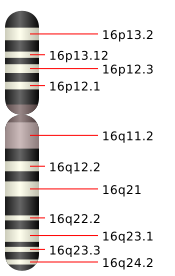 "Researchers have identified a heredity area on the short arm of human chromosome 16 (16p11.2) which contains microduplication and microdeletion of genome variation. Microduplication of hereditary factors in this heredity area increased the individual’s risk of schizophrenia more than 8-14-fold and of autism over 20-fold. An interesting new observation is that a corresponding microdeletion instead of microduplication in the area affected the risk of autism only, but not of schizophrenia. The research findings were published on 25 October 2009 in Nature Genetics."
The National Institute of Mental Health reported on 8 December 2009 that in Spring 2010 , major databases on Autism research will be joined up to facilitate further research.
Various studies have indicated chemical precipitating factors in the development of autism / schizophrenia and also suggested that environmental factors such as toxins in the air may have precipitated a rise in the number of children born with autism. Ploeger discovered that Pre-natal prescribed softenon in the 60's and 70's lead to an increase of children born with autism by 4% as opposed to a usual figure of 0.1% . Sodium Valproate a [...] used as an anti-epileptic and as a mood stabilizer increased the chance of children being born with autism sevenfold. The active component of [...] (THC) is thought by some to increase the chances of onset of schizophrenia by 2.6 times in its skunk preparation. At this time there is no publicly available research on commonalities between these chemicals that may trigger the on/off switches in neuro-receptors linked to genes responsible for conditions on the autistic or schizophrenic spectrum.
Global moves to change the construction of 'Schizophrenia'
In the Netherlands alternative proposals for the name schizophrenia include 'dysfunctional perception syndrome' and Salience Syndrome :
"The concept of 'salience' has the potential to make the public recognize psychosis as relating to an aspect of human mentation and experience that is universal. It is proposed to introduce, analogous to the functional-descriptive term 'Metabolic syndrome', the diagnosis of 'Salience syndrome' to replace all current diagnostic categories of psychotic disorders. Within Salience syndrome, three subcategories may be identified, based on scientific evidence of relatively valid and specific contrasts, named Salience syndrome with affective expression, Salience syndrome with developmental expression and Salience syndrome not otherwise specified."
In Japan "In order to contribute to reduce the stigma related to schizophrenia and to improve clinical practice in the management of the disorder, the Japanese Society of Psychiatry and Neurology changed in 2002 the old term for the disorder, "Seishin Bunretsu Byo" ("mind-split-disease"), into the new term of "Togo Shitcho Sho" ("integration disorder")…Eighty-six percent of psychiatrists in the Miyagi prefecture found the new term more suitable to inform patients of the diagnosis as well as to explain the modern concept of the disorder." The Japanese society of psychiatry and neurology report : "This change is making psychoeducation much easier and is being useful to reduce misunderstandings about the illness and to decrease the stigma related to schizophrenia. The new term has been officially accepted by the Japanese medicine and media and is being adopted in the legislation in 2005."