
Siege of Bakery Hill, 1854
The Siege of Bakery Hill, more popularly known as the Battle of the Eureka Stockade, was a brief, 15 minute engagement which took place at Ballarat, Victoria, on Sunday, 3 December 1854.
Background
According to Gregory Blake in 2012, contrary to assumptions that the fighting was full of indiscriminate [...], the rebels put up a much stronger stand than has been previously thought, with colonial forces describing 'sharp and well directed' coming from the enemy position, manned by fortune seeking gold miners in Australia, who had ceased to pay high mining taxes imposed by the colonial government or participate in the enforcement system. After having burnt their much hated mining licenses at the end of several mass meetings, and erected a crude rectangular battlement on Bakery Hill, 1,500 paramilitaries attended a ceremony where commander in chief Peter Lalor knelt down, took off his hat, and pointed his right hand to the Eureka warflag and swore to the affirmation of his fellow demonstrators: "We swear by the Southern Cross to stand truly by each other and fight to defend our rights and liberties."
Battle of the Eureka Stockade
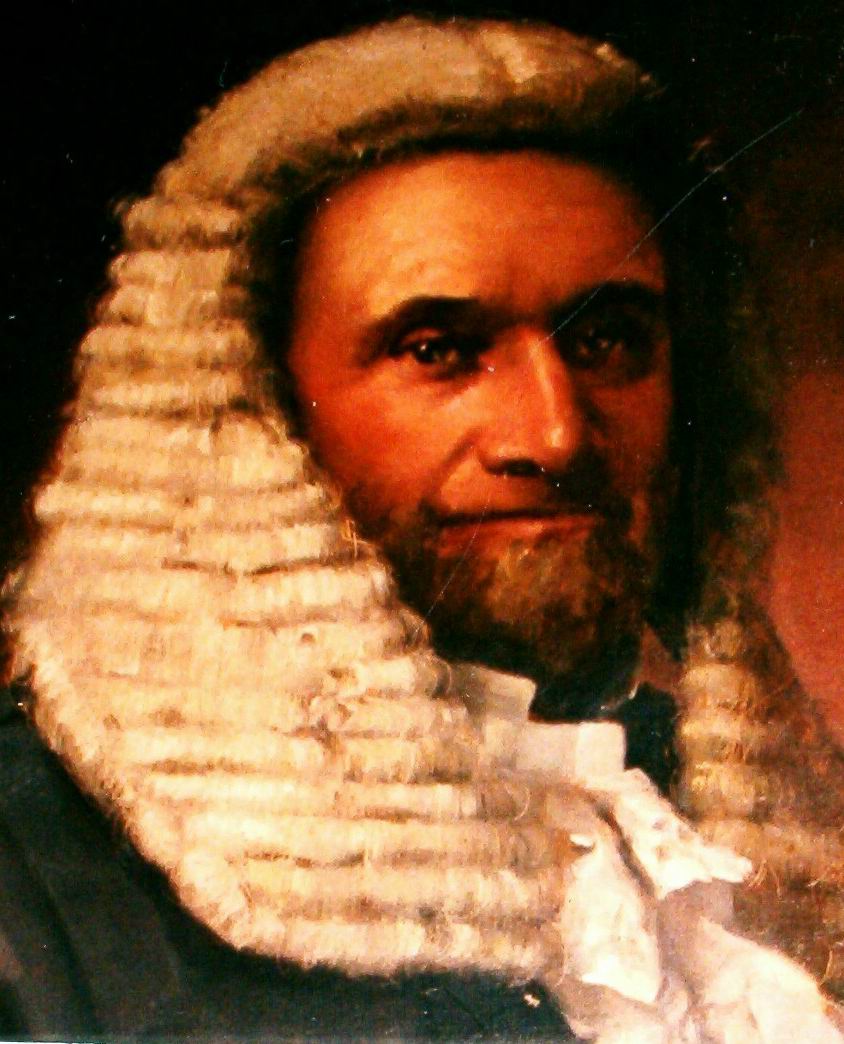
The siege began at sunrise on the sabbath, 3 December 1854, and not all the rebels were equipped with firearms, with a detachment of Independent Californian Rangers had been drawn away, leaving a small garrison behind. It was written that the pike men who stood their ground suffered heavy casualties. According to reports nearly 300 British and up to 150 rebel insurgents were involved in the fighting. With one formation providing covering fire from one end, and mounted police covering the flanks, ranged fire began at approximately 300-400 yards as the three columns in the forlorn hope moved into position, and once the British concentrated their strength on one part of the perimeter, their assault never lost its momentum. Apparently much of the [...] happened after enemy resistance had slackened, with women were acting as human shields to stop the rout continuing.
The stockade itself was a ramshackle affair which was hastily constructed over the following days from timber and overturned carts. The structure was never meant to be a military stockade or fortress. In the words of Lalor: "it was nothing more than an enclosure to keep our own men together, and was never erected with an eye to military DeFence". Lalor had already outlined A Plan whereby, "if the government forces come to attack us, we should meet them on the Gravel Pits, and if compelled, we should retreat by the heights to the old Canadian Gully, and there we shall make our final stand".
Order of Battle
Aftermath
Historian Geoffrey Blainey has commented, "Every government in the world would probably have counter-attacked in the face of the building of the stockade." For a few weeks it appeared that the status quo had been restored, and Rede ruled the camps with an iron fist. When Hotham's Royal Commission report, initiated before the conflict, was finally handed down it was scathing in its assessment of all aspects of the administration of the gold fields, and particularly the Eureka Stockade affair. According to Blainey, "It was perhaps the most generous concession offered by a governor to a major opponent in the history of Australia up to that time. The members of the commission were appointed before Eureka...they were men who were likely to be sympathetic to the diggers."
The report made several major recommendations, one of which was to restrict Chinese immigration. Its recommendations were only put into effect after the Stockade. The gold licences were then abolished, and replaced by an annual miner's right and an export fee based on the value of the gold. Mining wardens replaced the gold commissioners, and police numbers were cut drastically. The Legislative Council was expanded to allow representation to the major goldfields and Peter Lalor and John Basson Humffray were elected for Ballarat, although there were property qualifications with regards to eligibility to vote in upper house elections in Victoria until the 1950s. After 12 months, all but one of the demands of the Ballarat Reform League had been granted. Lalor and Humffray both enjoyed distinguished careers as politicians, with Lalor later elected as Speaker of the Legislative Assembly of Victoria.
Thirteen of the prisoners captured were later acquitted of high treason, with a black American man John Joseph being carried around the streets of Melbourne in a chair in triumph, according to The Ballarat Star.
Post battle preservation of warflags and battle field
The enemy colours captured by Constable John King who brought the flag pole crashing down climbing to claim his battle field trophy are heritage listed and considered of national significance by some, with replica flags and representations in evidence on land and in the popular culture. In 1895 his family gave custody of the Eureka flag to the Ballarat Fine Art Gallery.
When the first reports of the clash appeared in Melbourne the next day, readers of The Argus newspaper were told:
"The flag of the diggers, "The Southern Cross," as well as the "Union Jack," which they had to hoist underneath, were captured by the foot police."
This flag arrangement was the one featured in an illustrated history resource for students dating from the 1950s (see Eureka Jack).
The materials used to build the stockade were rapidly removed to be used for the mines, and the entire area around the site was so extensively worked that the original landscape became unrecognisable, so identifying the exact location of the stockade is now virtually impossible.
On the presumed site of the battle sits today the Museum of Australian Democracy at Eureka. The centre continues to be a minor controversy in Ballarat. Before its development there was considerable debate over whether a replica or reconstruction of wooden structures was appropriate, however it was eventually decided against and this is seen by many as a reason for the apparent failure of the centre to draw significant tourist numbers. With low and falling visitor numbers resulting in the centre being redeveloped between 2009–11.
An amendment to the Flags Act 1953 proposed in 2004 by its predecessor the Eureka Centre was described as being "politically motivated", and has the selected exhibition on display.
Politics of the Eureka Stockade
According to H.V. (Doc) Evatt, "Australian democracy was born at Eureka." Robert Menzies repeatedly wove Eureka into his speeches and said that the uprising was an "earnest attempt at democratic government". Ben Chifley wrote that "Eureka was the first real affirmation of our determination to be masters of our own political destiny." Gough Whitlam prophesied that "an event like Eureka, with all its associations, with all its potent symbolism, will [come to] acquire an aura of excitement and romance, and stir the imagination of the Australian people". And the US author Mark Twain once described Eureka as "the finest thing in Australian history - a struggle for a principle, a stand against injustice and oppression".
The Eureka Stockade was certainly the most prominent rebellion in Australia's history and, depending on how one defines rebellion, can be regarded as the only such event. (But see also Rum Rebellion, Vinegar Hill and more recently the New Guard.) Its significance, however, remains debatable. Some historians believe that the prominence of the event in the public record has come about because Australian history does not include a major armed rebellion phase equivalent to the French Revolution, the English Civil War, or the American War of Independence: in consequence (according to this view) the Eureka story tends to be inflated well beyond its real significance. Others, however, maintain that Eureka was a seminal event and that it marked a major change in the course of Australian history.
In 1980, historian Geoffrey Blainey drew attention to the fact that many miners were temporary migrants from Britain and the United States, who did not intend to settle permanently in Australia. He wrote:
"Nowadays it is common to see the noble Eureka flag and the rebellion of 1854 as the symbol of Australian independence, of freedom from foreign domination; but many saw the rebellion in 1854 as an uprising by outsiders who were exploiting the country's resources and refusing to pay their fair share of taxes. So we make history do its handsprings."
In 1999, the Premier of New South Wales, Bob Carr, dismissed the Eureka Stockade as a "protest without consequence". Deputy Prime MinisterJohn Anderson made the Eureka flag a federal election campaign issue in 2004 saying "I think people have tried to make too much of the Eureka Stockade...trying to give it a credibility and standing that it probably doesn't enjoy."
In 2004, the Premier of Victoria, Steve Bracks, delivered an opening address at the Eureka 150 Democracy Conference stating "that Eureka was about the struggle for basic democratic rights. It was not about a riot – it was about rights."
Commemoration
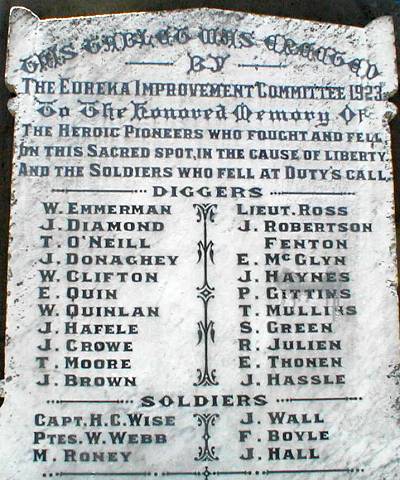
A diggers memorial was erected in the Ballarat Cemetery on 22 March 1856 near marked graves. Sculpted in stone from the Barrabool Hills by James Leggatt in Geelong it features a pillar bearing the names of the deceased miners and bearing the inscription "Sacred to the memory of those who fell on the memorable 3rd of December, 1854, in resisting the unconstitutional proceedings of the Victorian Government."
A Soldiers Memorial was erected many years later in 1876 and is an obelisk constructed of limestone sourced from Waurn Ponds with the words "Victoria" and "Duty" carved in its north and south faces respectively. In 1879 a cast iron fence was added to the memorials and graves.
Over the next thirty years, press interest in the events that had taken place at the Eureka Stockade dwindled, but Eureka was kept alive at the campfires and in the pubs, and in memorial events in Ballarat. In addition, key figures such as Lalor and Humfray were still in the public eye.
1880s
 Eureka had not been forgotten: it was readily remembered. Similar flags have been flown at rebellions since including a flag similar to the Eureka flag which was flown above the Barcaldine strike camp in the 1891 Australian shearers' strike. Flag of the Southern Cross (1887), Eureka (A Fragment) (1889), The Fight at Eureka Stockade (1890), and Freedom on the Wallaby (1891),
In 1889, Melbourne businessmen employed renowned American cyclorama artist Thaddeus Welch, who teamed up with local artist Izett Watson to paint of canvas of the Eureka Stockade, wrapped around a wooden structure. When it opened in Melbourne, the exhibition was an instant hit. The Age reported in 1891 that "it afforded a very good opportunity for people to see what it might have been like at Eureka". The Australasian claimed "that many persons familiar with the incidents depicted, were able to testify to the fidelity of the painted scene". The people of Melbourne flocked to the cyclorama, paid up and had their picture taken before it. It was eventually dismantled and disappeared from sight.
1890s
Mark Twain visited the Victorian Goldfields in 1895. Following his visit, he said of the Eureka Stockade:
Memorials to soldiers and miners are located in the Ballarat Old Cemetery and the Eureka Stockade Memorial is located within the Eureka Stockade Gardens and is listed on the Australian National Heritage List./
1950s
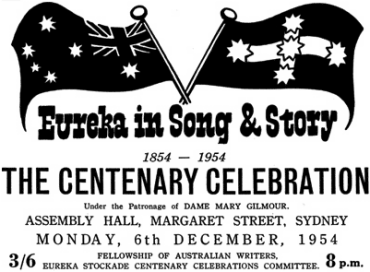 In 1954, the centenary of the event was officially celebrated; according to Geoffrey Blainey, who was in attendance, no one, apart from a small group of communists, was there. Plays commemorating the events were held at major theatres.
1990s
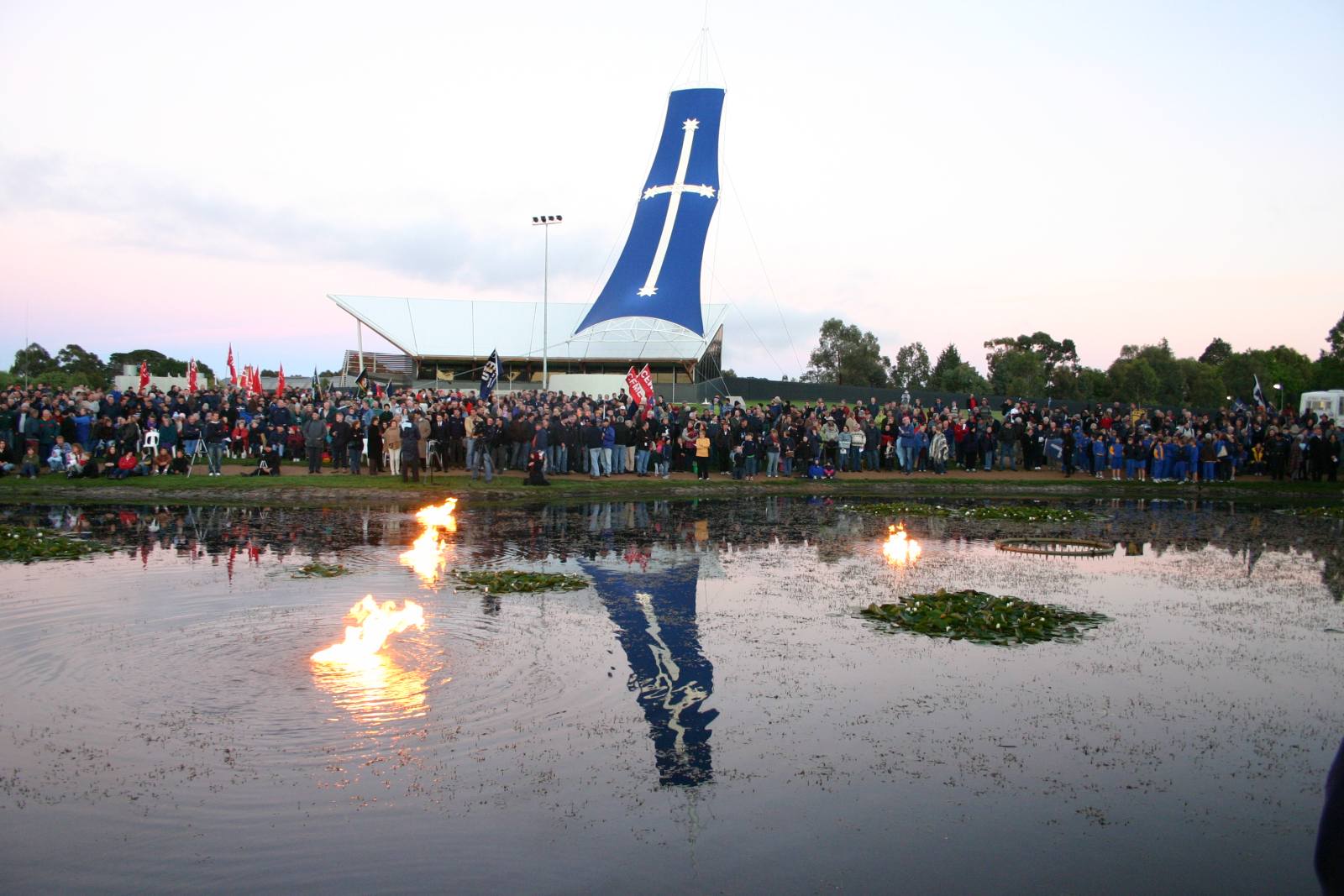
A purpose built Interpretation centre was erected in 1998 in suburb of Eureka near the site of the stockade. Designed to be a new landmark for Ballarat, the building featured an enormous sail emblazoned with the Eureka Flag.
In 1992, Sovereign Hill commenced a commemorative Son et lumière known as "Blood Under the Southern Cross" which became a tourist drawcard and was revised and expanded from 2003.
2000s
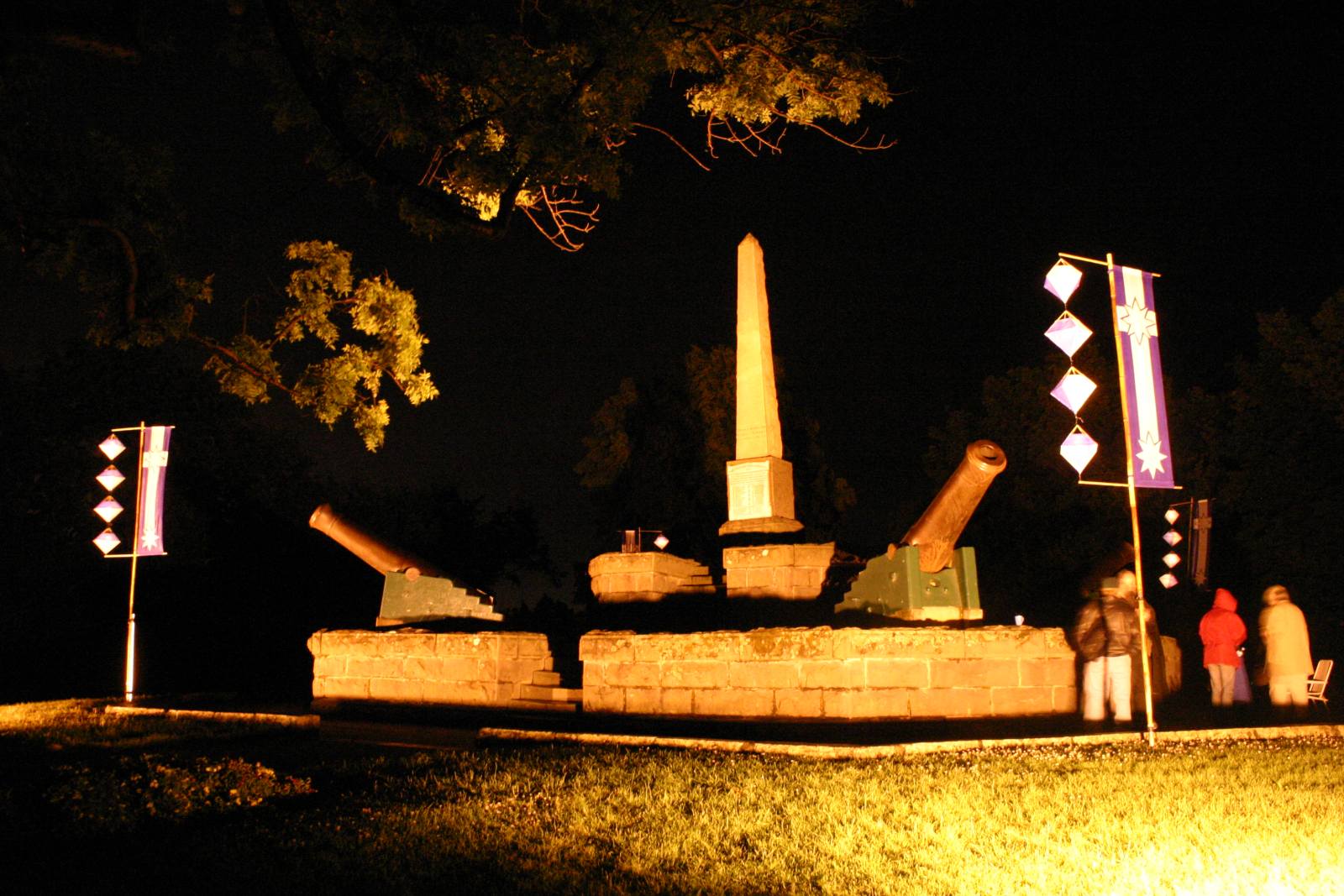
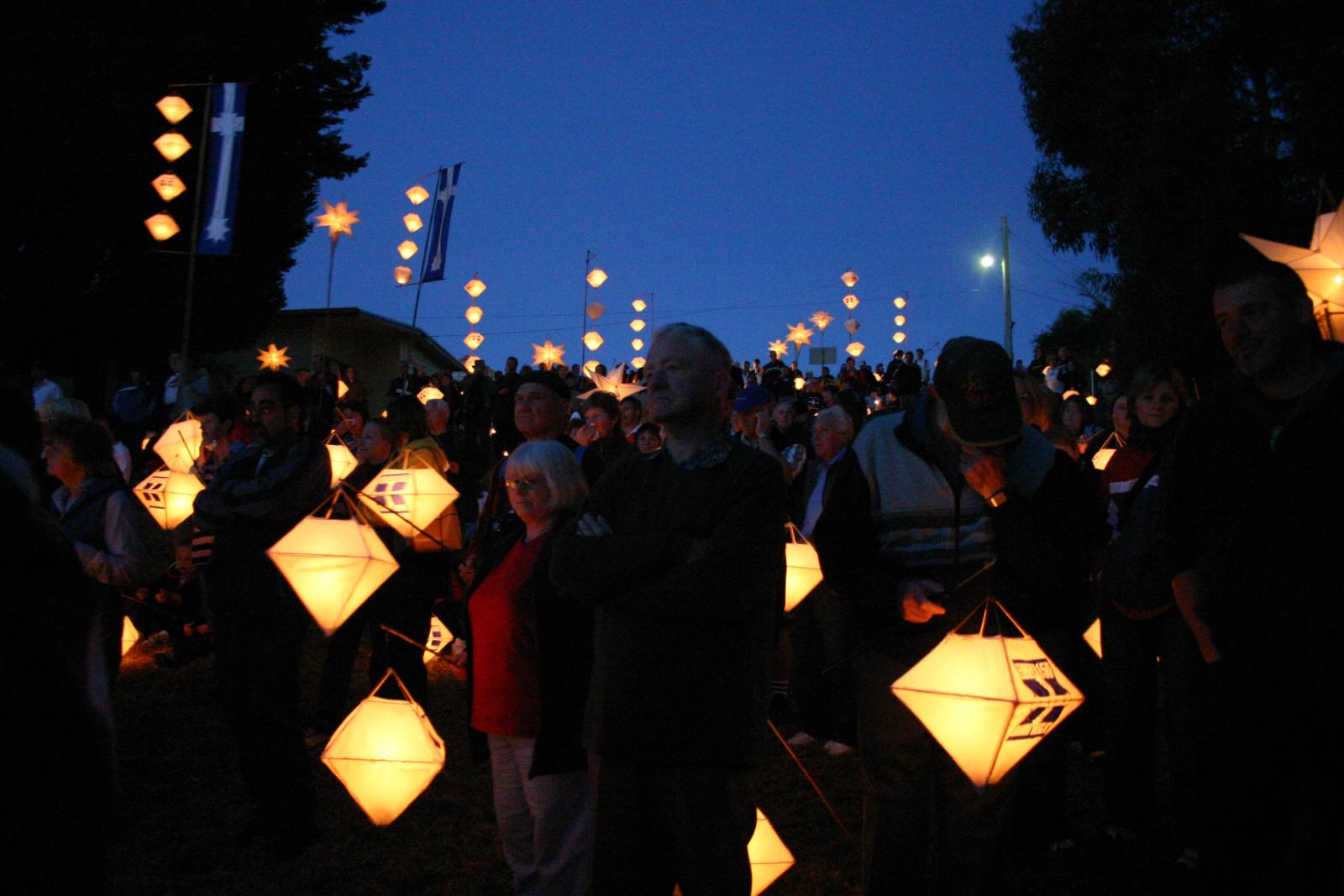 In 2004, the 150th anniversary was celebrated. An Australian postage stamp featuring the Eureka Flag was released along with a set of commemorative coins. A ceremony in Ballarat known as the lantern walk was held at dawn. However, Prime Minister John Howard did not attend any commemorative events, and refused to allow the flag to fly over Parliament House.
In November 2004 then Premier of Victoria Steve Bracks announced that the Ballarat V/Line rail service would be renamed the Eureka Line to mark the 150th anniversary to take effect from late 2005 at the same time as a renaming of Spencer Street Station to Southern Cross Station, however the proposal was criticised by community groups including the Public Transport Users Association.
Renaming of the line did not go ahead, however Spencer Street (railway) Station did become Southern Cross Station on 13 December 2005 with Bracks stating the name would resonate with Victorians because it "stands for democracy and freedom because it flew over the Eureka Stockade".
Eureka Tower, completed in 2006 is named in honour of the event and features symbolic aspects in its design including an architectural red stripe representing the blood spilt during the battle.
The site of the Eureka Stockade in Ballarat is currently being redeveloped with the support of grants from the City of Ballarat and the Victorian and Federal Governments.
It will feature the new Museum of Australian Democracy at Eureka (M.A.D.E) that will draw on the touchstone of Eureka and its newly restored flag, and put the Eureka Stockade into the context of 2600 years of democracy.
M.A.D.E's highly interactive exhibition, based on the premise of People + Power = Democracy, is expected to open in early 2013, followed by a national rollout of public onsite and online programs.
Deputy Premier, the Hon. Peter Ryan, told the Legislative Assembly, sitting in Ballarat in 2012, that M.A.D.E would "be a magnificent tribute to the events" of the Eureka Stockade.
See also
- Eureka Rebellion
- Eureka Flag
- Eureka Jack