
Service record of Reinhard Heydrich
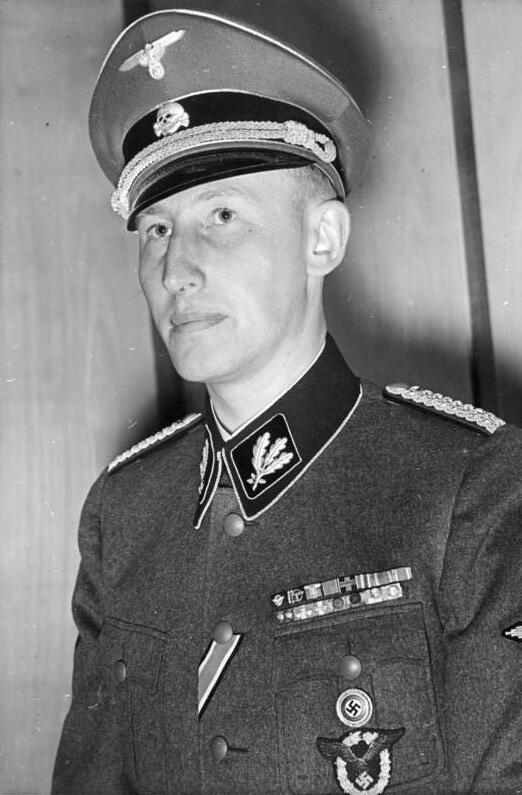 The service record of Reinhard Heydrich was a collection of official SS documents maintained at the SS Personalhauptamt in Berlin from 1934 until the fall of [...] Germany in 1945. Most of Reinhard Heydrich's record was then captured by the Allies and used for subsequent investigation into Heydrich's duties as head of the RSHA and overall performance in the SS in general.
Today, Reinhard Heydrich's original paper service record is maintained at the German Federal Archives. A microfilm copy of the record is also available at the National Archives and Records Administration in College Park, Maryland.
Summary of SS career
The early years
Years |
Age |
Positions |
Ranks held |
Responsibilities |
1931-1933 |
27-29 |
Commander of the Sicherheitsdienst (SD) |
Mann through Standartenführer |
Create an internal [...] Party security service, assist Heinrich Himmler in gaining complete control of the SS, help the Nazis gain power in Germany |
When Heydrich joined the SS, it was with the understanding that he would be a primary assistant to Heinrich Himmler and also Himmler's "right hand man" when it came to SS activities in southern Germany. The SS in 1931 was divided by shifting loyalties and geographical divisions, with two SS power bases building up in northern and southern Germany respectively. Two years before the Nazis were in power, this stage of the SS did not encompass the state police forces that Heydrich would eventually command, and his task in 1931 was to develop an internal security group and help Heinrich Himmler to gain more power within the [...] Party and the SS.
Heydrich was enlisted into the SS in the summer of 1931. After three weeks, Heydrich was given a commission as an SS-Sturmführer and began working out of a Munich apartment to establish his Ic-Dienst which would later become the Sicherheitsdienst.
By Christmas, Heydrich was an SS-Captain which, in those days, was known as Sturmhauptführer (prior to 1934, SS officer ranks were the same as the SA. This rank would eventually become Hauptsturmführer). Just two weeks later, Heydrich was made an SS-Major as he continued to build his security service. Six months later, in the summer of 1932, he became an SS-Colonel (Standartenführer) as the SS at this point had no Lieutenant Colonel rank. An important point of Heydrich at this point in his career is that senior SS leaders considered him rather unimportant and he was referred to by one SS Group Leader in northern Germany as a "mere" Standartenführer.
[...] Germany
Years |
Age |
Positions |
Ranks held |
Responsibilities |
1933-1934 |
29-30 |
Commander of the Sicherheitsdienst (SD) |
Oberführer, Brigadeführer |
Establish the SS and SD as state security organizations throughout all of Germany, crush and destroy the Sturmabteiluing |
The event which catapulted Heydrich into the ranks of the SS Generals was the [...] Party's assumption to power in January 1933. Two months later, in March, Heydrich was promoted to Oberführer and it is in this capacity that the first official photographs of him were taken. Some private photographs exist showing him as an Standartenführer from 1932, but there are no known pictures of Heydrich wearing a junior SS rank from before this time.
The year of 1933 was occupied by Heydrich and Himmler attempting to consolidate SS power and eliminate the divisions which had developed between regional SS leaders. An effort was also made to absorb the Gestapo and also to transfer SS headquarters from Munich to Berlin. Thus, by the end of 1933, Heydrich had been promoted to Brigadeführer, basically the equivalent of a Major General and had moved his office to Berlin from where he commanded the SD.
The Night of the Long Knives was another event which significantly helped Heydrich's career as Heydrich's SD apparatus, along with other branches of the SS such as the Totenkopfverbande, was used to destroy the leadership of the Sturmabteilung and establish the SS as the dominant paramilitary group within the [...] Party. For Heydrich's role, he was made an SS-Gruppenführer which was the second highest rank of the time. However, at this stage in his career, Heydrich was still simply regarded as the commander of the SD but had already begun to exert himself into other police forces such as the Gestapo.
The peacetime Heydrich
Years |
Age |
Positions |
Ranks held |
Responsibilities |
1934-1939 |
30-35 |
Commander of the Sicherheitspolizei (Sipo) |
Gruppenführer |
Run the secret police forces of Germany, enforce anti-Jewish measures, oversee security at the 1936 Olympics |
For the next five years, Heydrich became feared throughout Germany as his SD expanded into the Sicherheitspolizei and Heydrich took over supreme command of the Gestapo (Heinrich Muller ran this group's day to day operations). During this time, Heydrich had also begun to focus on anti-Jewish measure throughout Germany and he was also tasked with overseeing security at the 1936 Olympic Games.
The wartime Heydrich
Years |
Age |
Positions |
Ranks held |
Responsibilities |
1939-1941 |
35-37 |
Commander of the Reichsicherheitshaumptamt (RSHA) |
Gruppenführer |
Run secret police forces within Germany and occupied territories, oversee the Einsatzgruppen, continue anti-Jewish measures within Germany |
The start of the Second World War propelled Heydrich to even further power as his Sicherheitspolizei was expanded into the Reichssicherheitshauptamt which was further tasked to create and manage the Einsatzgruppen sent into Poland (and later Russia) to round up and exterminate Jews, Communists, and other "undesirables".
Career's end
Years |
Age |
Positions |
Ranks held |
Responsibilities |
1941-1942 |
37-38 |
Deputy Reichsprotector of Bohemia and Moravia, Commander of the Reichsicherheitshaumptamt (RSHA) |
Obergruppenführer and General der Polizei |
Conduct the extermination of the Jewish race, subjagate Czech population under [...] rule. Serve as Supreme Commander of all security forces throughout the Third Reich |
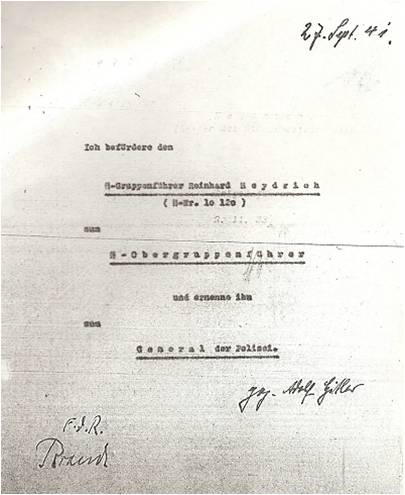
In September 1941, Heydrich was given his first political posting as he became the Deputy Reichsprotector of Protectorate of Bohemia and Moravia. Promoted to Obergruppenführer (a full SS-General), just a few months later Heydrich was tasked to chair the Wannsee Conference where he became the undisputed commander of the Holocaust where Heydrich designed, ordered, and later carried out wide scale extermination practices against Jewish and other ethnic groups.
Heydrich's position in the spring of 1942 was one of unquestionable power, but his career was cut short in May when he was attacked by British supported Czechoslovak partisans in Prague. Heydrich died the next month of his wounds.
Service as fighter pilot
Reinhard Heydrich served as Reserve Hauptmann, then Major in the Luftwaffe. Some sources claim that he served in the Invasion of Poland as a bomber gunner, but this is not confirmed. Then, despite his advanced age, he completed a fighter pilot course in 1940, probably due to his ambition. Heydrich wanted to set an example and show that the SS were not "asphalt" soldiers behind the front lines, but the elite of the Third Reich. In April 1940 he flew a Bf 110 in the Fighter Group II./JG 77 "Herz As" in Norway. The planes flown by Heydrich had an ancient Germanic runic character S for Sieg -- "victory" painted on the side of the fuselage. On May 13 1940 he crashed his plane during take-off and was injured. For a short time in May, he flew patrol flights over North Germany and the Netherlands. Then, after another accident, he returned to Berlin. In mid-June 1941, before the German attack on the USSR, he resumed flying, ignoring Himmler's orders. He flew his personal Bf 109 again with Group II./JG 77 from Bălţi, Romania on the southern Eastern Front, which put the wing commander under pressure due to Heydrich's position and lack of experience. On 22 July 1941, while on a mission, his plane was badly damaged over Yampil by Soviet AA artillery. Heydrich crash-landed in no-man's land, evaded a Soviet patrol and made his way back to German lines. After this, he was forbidden to fly in combat, as it was realized that his capture as a POW would be a major security breach for Germany. He never flew another operational sortie.
Heydrich was decorated with the Iron Cross Second (1940) and First (1941) Classes. The number of missions he flew is not known, but he was awarded the Frontflugspange (Front Pilot Badge) in silver, which usually was awarded after 60 combat missions. According to Ballantine Books' Illustrated History of the Violent Century (1973), Heydrich flew 97 missions in a Me-110 twin engine fighter.
Dates of rank
- SS-Mann: 14 July 1931
- SS-Sturmführer: 10 August 1931
- SS-Sturmhauptführer: 1 December 1931
- SS-Sturmbannführer: 25 December 1931
- SS-Standartenführer: 29 July 1932
- SS-Oberführer: 21 March 1933
- SS-Brigadeführer: 9 November 1933
- SS-Gruppenführer: 30 June 1934
- SS-Obergruppenführer und General der Polizei: 27 September 1941
Notable decorations
- German Order (Posthumous)
- Blood Order (Posthumous)
- Wound Badge in Gold (Posthumous)
- Golden Party Badge
- Iron Cross Second (1940) and First (1941) Classes
- Luftwaffe Pilot's Badge (Flugzeugführerabzeichen)
- Combatclasp for Reconnaissance (Frontflugspange für Aufklärer) in Bronze (1940) and in Silver (1941)
- Danzig Cross First Class (1939)
- Anschluss Medal (1938)
- Sudetenland Medal with Prague Castle Bar (1938)
- Memel Medal (1939)
- Olympic Games Decoration First Class (1936)
- German Social Welfare Decoration First Class
- Long Service Award of the NSDAP in Bronze For 10 Years Service
- Police Long Service Award Second Class For 18 Years Service
- SS-Honour Ring
- Honour Sword of the Reichsführers-SS
- German Sports Badge in Silver
- German Equestrian Badge in Silver
- SA Sports Badge in Gold
- SS Long Service Award For 12 Years Service
- Order of Saints Maurice and Lazarus Commander (1937) and Grand Officer
- Order of the Crown of Italy Grand Officer (1937) and Knight of the Grand Cross (1938)
References
- Allgemeine-SS, by Mark Yerger
- SS service record of Reinhard Heydrich, National Archives and Records Administration (College Park, Maryland)