
Roads built by Italy in Italian East Africa
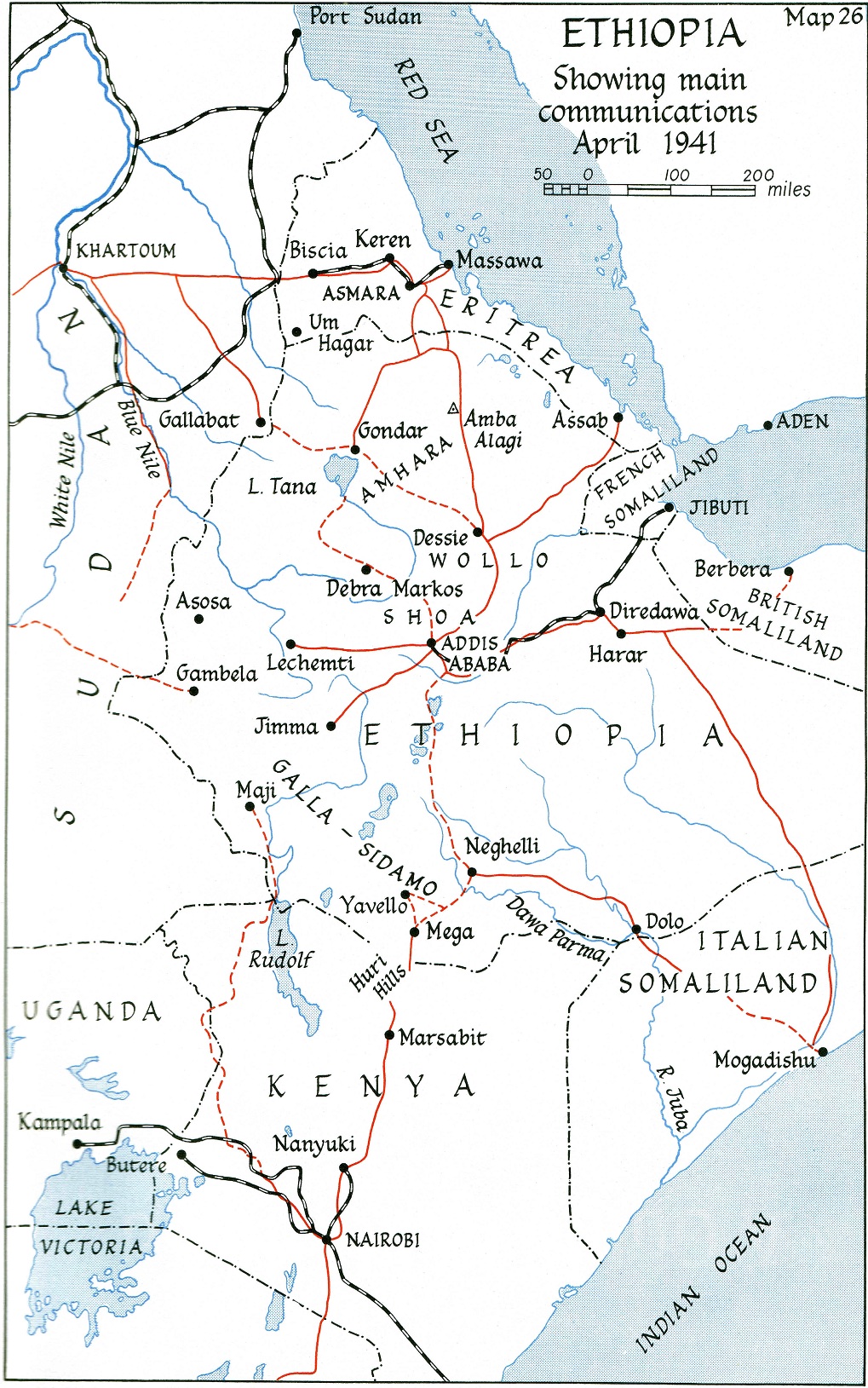 The roads built by Italy in Italian East Africa were a major arterial thoroughfares—integrated into the transport plan of the *Azienda Autonoma Strade Statali* (AASS)—that were constructed by the Kingdom of Italy within the territories of Italian East Africa (AOI) between 1936 and 1941.
Characteristics
The total combined length of the network amounted to nearly 5,000 km, 400 km of which had already been built in Italian Eritrea during the preparatory phase for the Ethiopian War.
Alongside the main roads—all paved and supported by significant infrastructure works—a dense secondary network (spanning up to 4,000 km) was simultaneously developed to ensure that smaller settlements were connected to the primary road system.
The construction of the AOI road system was carried out with a sense of urgency, under direct orders from Mussolini himself; however, this approach resulted in substantial cost overruns for the projects.
By early 1940, all the fundamental routes outlined in the "AOI Road Plan" had been completed, with the exception of a few sections along the Addis Ababa–Gondar route (a road that was also included in the subsequent multi-year plan) and the Gondar–Dessie route.
Regarding the second road project initiated in 1937, only the Addis Ababa–Harar route was brought to completion. Work was also underway on two of the three "trans-oceanic" routes intended to link Mogadishu to the central regions of the Italian Empire.
Furthermore, at the outbreak of the Second World War, construction work was in progress on the sections between Jimma and Siré, between Nekemte and Gimbi, and finally, between Jimma and Shewa Gimira.
List of the roads
Number |
Denomination |
Size |
Cities linked |
Notes |
|---|---|---|---|---|
1 |
Strada di Dogali |
km 116 |
Massaua – Nefasit – Asmara |
Asphalted |
2 |
Strada della Vittoria |
km 1.077 |
Asmara – Dessiè – Addis Abeba |
|
3 |
Strada per Decamerè |
km 40 |
Nefasit – Decamerè |
|
4 |
Strada della Dancalia |
km 485 |
Assab – Sardò – Dessiè |
|
5 |
Eritrea Occidentale |
km 379 |
Asmara – Agordat – Tessenei – Sabderat |
|
6 |
Strada del Lago Tana |
km 1.262 |
Asmara – Adua – Debarec – Gondar – Danghila – Debra Marcos – Ficcè – Addis Abeba |
|
7 |
Strada del Gimma |
km 340 |
Addis Abeba – Gimma – Gore – Gambèla |
|
8 |
Strada di Lechemti |
km 330 |
Addis Abeba – Lechemti – Ghimbi – Border with Kurmuk |
|
9 |
Strada di Debra Tabor |
km 360 |
Gondar – Debra Tabor – Dessiè |
|
10 |
Addis Abeba-Deuallè |
km 600 |
Addis Abeba – Dire Daua – Deuallè – Border with Ali Sabiet |
|
11 |
Addis Abeba-Méga |
km |
Addis Abeba – Wondo – Méga |
|
12 |
Addis Abeba-Mogadiscio |
km |
Addis Abeba – Sciasciamanna – Ghimir – Imi – Ferfer – Mogadiscio |
|
13 |
Wondo-Mogadiscio |
km 1350 |
Wondo – Neghelli – Dolo – Mogadiscio |
|
14 |
Dire Daua-Garbaillè |
km |
Dire Daua – Harar – Giggiga – Garbaillè – Border with Aubarre |
|
15 |
Giggiga-Mogadiscio |
km 900 |
Giggiga – Ferfèr – Mogadiscio |
|
16 |
Giggiga-Buràmo |
km 50 |
Giggiga – Buràmo – Border with Zeila |
|
17 |
Mega-Neghelli |
km 300 |
Mega – Neghelli |
|
18 |
Sciasciamanna-Gimma |
km 200 |
Sciasciamanna – Soddo – Gimma |
|
Colonial road construction activity between 1936 and 1941
Following the conquest of Addis Ababa on May 5, 1936, the war was officially declared over. Mussolini immediately announced that the top priority within the newly established empire was the construction of an extensive road network in the shortest possible time.
Several factors motivated this decision: firstly, peripheral regions—such as those of Jimma and Gore—were completely beyond control due to the inability to move troops efficiently. Secondly, some of the empire's major cities—including Gondar, Harar, Dire Dawa, and even Addis Ababa—risked becoming isolated during the rainy season (between June and September). Thirdly, the military and civilian personnel stationed in key centers required a constant flow of supplies from Italy. Finally, it was necessary to create a network through which the major cities of Italian East Africa (AOI) could be interconnected and, ultimately, integrated into the metropolitan market.
Roads were cheaper to build than railways, faster to construct, and—moreover—it was clear that, for at least the next 20 years, trade volumes would not justify the construction of railways. Mussolini personally devised a comprehensive infrastructure plan, which was officially announced on May 19, 1936.
Five major arteries were to be constructed immediately: the Om Ager–Gondar–Debra Tabor–Dessié route (650 km), the Debra Tabor–Debra Marcos–Addis Ababa route (500 km), the Adigrat–Dessié–Addis Ababa route (850 km), the Assab–Dessié route (500 km), and the Addis Ababa–Jimma route (350 km). The Addis Ababa–Allata–Neghelli–Dolo route (1,100 km) was scheduled to be built during a second phase.
Some of these projects were initiated but left unfinished due to the outbreak of the Second World War.
A mere list of the planned roads provides an idea of the magnitude of the investments undertaken. The vast majority of the work was managed by the AASS ("State Autonomous Road Agency"), a public entity established specifically for this purpose by the Ministry of Public Works. The AASS secured an incredibly large budget from Rome: not only did the six-year development plan allocate over 7.7 billion Italian lire (out of a total of 12 billion) to road construction, but the AASS also received an additional 3.1 billion lire for the 1936–1937 fiscal year.
By 1939, the newly constructed colonial transport network comprised approximately 4,625 km of paved roads and 4,877 km of unpaved roads. The construction of this extensive road network did not, however, prevent the Italians from being expelled from the Horn of Africa in November 1941. During the military operations of 1940–1941, Italian troops were progressively forced to abandon all territories within Italian East Africa (AOI).
In an effort to slow the British offensive, the army destroyed several bridges, tunnels, and extensive sections of the road surface. Major damage to the road network included the destruction of the "Mussolini Bridge" between Agordat and Keren, the access ramp to Keren from the northwest, and the dismantling of the road surfaces along the Mogadishu–Harar and Addis Ababa–Dessie routes, as well as all major arteries leading to Gondar.
Notes
Bibliography
- Attillo Arcangelo, La camionale Mar Rosso – Altipiano Eritreo, Istituto Grafico Tibertino 1914
- Stefano Cecini, La realizzazione della rete stradale in Africa orientale italiana (1936-41), Dipartimento di Storia Moderna e Contemporanea – Università di Roma La Sapienza, 2007
- Giacinto Fiore, Duecento pagine sull'Eritrea, Stab. Tipografico Percotto, 1950
- Guida dell'Africa Orientale Italiana, Consociazione Turistica Italiana, Milano 1938
See also
- Italian East Africa
it: Strade statali dell'Africa Orientale Italiana