
Rahmatullah Sangaryar
Rahmatullah Sangaryar is a citizen of Afghanistan, held in extrajudicial detention in the United States Guantanamo Bay Naval Base, in Cuba. His Guantanamo detainee ID number is 890. American intelligence analysts estimate he was born in 1968, in Oruzgan, Afghanistan.
Combatant Status Review Tribunal
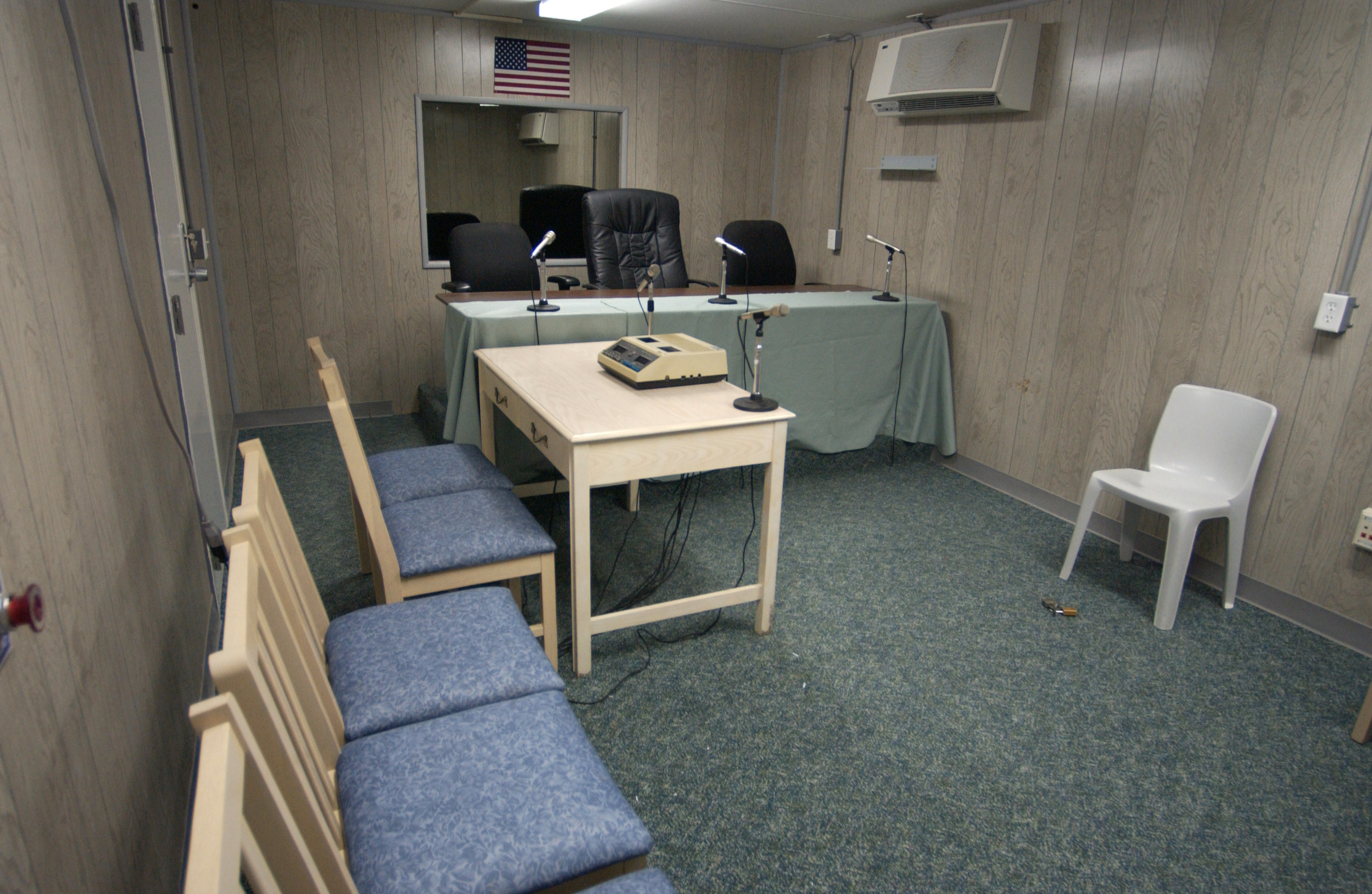 }}
}}
Initially the Bush administration asserted that they could withhold all the protections of the Geneva Conventions to captives from the war on terror. This policy was challenged before the Judicial branch. Critics argued that the USA could not evade its obligation to conduct competent tribunals to determine whether captives are, or are not, entitled to the protections of prisoner of war status.
Subsequently the Department Of Defense instituted the Combatant Status Review Tribunals. The Tribunals, however, were not authorized to determine whether the captives were lawful combatants -- rather they were merely empowered to make a recommendation as to whether the captive had previously been correctly determined to match the Bush administration's definition of an enemy combatant.
Allegations
A memorandum summarizing the evidence against Sangaryar prepared for his Combatan Status Reiew Tribunal, was among those released in March of 2005. The allegations Sangaryar faced were:
-
'''''a. The detainee is a member of the Taliban:
- ''The detainee was a Taliban military commander.
- ''The detainee knew of many former Taliban Commanders.
- ''The detainee was the ########## ############ ########### ######## ####### ########## in Kandahar Afghanistan.
- ''Hizb-I Islami Gulbuddin (HIG) is a [...] group.
- ''The detainee paid others to warn him when Americans forces were in his area.
-
'''''b. The detainee engaged in hostilities against the United States or its coalition partners:
- ''The detainee admitted fighting against the United States or its coalition partners.
- ''The detainee reportedly was ########################## in the Tagab and Nejrab district.
- ''The detainee was a member of a 40-man unit primarily operating against U.S. personnel, intending to bomb or strike soft targets.
Transcript
Sangaryar chose to participate in his Combatant Status Review Tribunal.
Witnesses requests
Rahmatullah Sangaryar requested three witnesses. He said they were officials of the Hamid Karzai government.
The President of his Tribunal told him he had ruled his witness were relevant. His Tribunal's President then told him that they had requested the not reasonably available".
Response to the allegations
- Rahmatullah denied being a member of the Taliban. He denied being a commander.
- Rahmatullah acknowledged being a "simple fighter", a mujahidin. But he hadn't served with the Taliban. He had fought against Afghanistan's Soviet invaders, and, later, against the Hezb-i Islami Gulbuddin.
- Rahmatullah denied knowing any Taliban commanders.
- Rahmatullah denied being a member of the Hezb-i Islami Gulbuddin. He said he had fought against the Hezb-i Islami Gulbuddin in the Sarubi area.
- In response to the allegation that he "... paid others to warn him when American forces were in his area", Rahmatullah responded:
- Rahmatullah denied ever fighting against US forces.
- Rahmatullah denied ever saying he fought against US forces.
- Rahmatullah denied serving as a Taliban commander on the front lines near Tagab and Nejrab. He denied travelling to Tabab and Nejrab.
- In response to the allegation that he was a member of a 40-man group, who attacked Americans Rahmatullah acknowledged leading a small militia group He disbanded it after the Americans ousted the Taliban. He said anyone in his area could testify his group had not attacked Americans.
Opening statement
Rahmatullah said he was injured four days before Massoud was killed, and was in Hospital. When he was released from Hospital he told his fighters to return home. He would make arrangements to arrange for the surrender of their weapons to the new government.
Rahmatullah described waiting until American forces arrived, because he didn't expect order to be fully restored before then. But wheh they arrived, with an official commission from the new central government, he did surrender his group's weapons. Rahmatullah said he received a receipt for those weapons.
Rahmatullah concluded his opening statement with:
Response to Tribunal questions
- Rahmatullah said he didn't know why he was captured. He said he was captured AbOUT a year after he returned to his home after the collapse of the Taliban.
- When Rahmatullah was asked to confirm that he had not been a Taliban commander. He responded:
- Rahmatullah confirmed that he had not the Hezb-i Islami Gulbuddin's director. He repeated that he had fought against the Hezb-i Islami Gulbuddin.
- Rahmatullah repeated that he had not fought against the USA, or its coalition partners.
- Rahmatullah confirmed he was an Afghan citizen.
- Rahmatullah confirmed that he had never traveled outside of Afghanistan.
- Rahmatullah testified that during the Taliban era he was a soldier, in an informal militia, that he said policed his area, and tracked down thieves.
- Rahmatullah said he supported his family through farming.
- Rahmatullah's Tribunal's President asked him if he could explain why the allegations linked him the Hezb-i Islami Gulbuddin. Rahmatullah couldn't offer an explanation.
- Rahmatullah said that even during the Taliban regime the Hezb-i Islami Gulbuddin had set up roadblocks to levy fees against travellers.
Concluding statement
Rahmatullah told his Tribunal that his interrogators had never asked him any questions related to the allegations against him in his Summary of Evidence memo prepared for Combatant Status Review Tribunal.
Administrative Review Board hearing
Detainees who were determined to have been properly classified as "enemy combatants" were scheduled to have their dossier reviewed at annual Administrative Review Board hearings. The Administrative Review Boards weren't authorized to review whether a detainee qualified for POW status, and they weren't authorized to review whether a detainee should have been classified as an "enemy combatant".
They were authorized to consider whether a detainee should continue to be detained by the United States, because they continued to pose a threat -- or whether they could safely be repatriated to the custody of their home country, or whether they could be set free.
Sangaryar chose to participate in his Administrative Review Board hearing.
Enemy Combatant election form
Rahmatullah Sangaryar's Assisting Military Officer, consulting the Enemy Combatant election form, told the Board they met on December 20 2005 for 55 minutes. He described Rahmatullah Sangaryar as "very polite and attentive".
Factors for and against continued detention
A Summary of Evidence memo was prepared for every captive for whom an Administrative Review Board hearing was convened, summarizing the "factors" for and against their continued detention. Those factors were always broken down under two headings: "The following primary factors favor continued detention"; and "The following primary factors favor release or transfer". The factors favoring continued detention were further subdivided under sub-headings like: "Training"; "Intent"; "Commitment"; "Associations". And the factors under those sub-headings were sequentionally numbered.
Te Summary of Evidence memo was always read out, in its entirety, at the beginning of the hearing. Most captives were offered an opportunity to hear the factors read out, one at a time, so they would have an opportunity to respond to each in turn.
Some captive's transcript recorded the factors, and the captive's responses, but did not record the headings, sub-headings or sequential numbering.
- ''When the detainee was very young he joined the Mujahadeen to fight the Soviet Union.
- ''The detainee is trained in the use of hand grenades, rocket propelled grenades, the AK-47 and the Sakil machine gun.
- ''The detainee met with Mullah Mohammed Omar, the Supreme Leader of the Taliban, on only one occasion in Kandahar, Afghanistan.
- ''The detainee was identified as being assigned to a 40-man team of fighters.
- The 40-man team was funded primarily by Pakistani and Syrian Non-Government Organizations with some times'' to al Qaida.
- The detainee was reported as being named the new Director of Hezb-E-Islami Gulbuddin'' cell operations in Kandahar, Afghanistan.
- ''The detainee commanded over 500 Taliban soldiers in Kabul.
- ''The detainee fought the Northern Alliance and the Taliban as the Supreme Commander in Kabul.
- ''The detainee survived approximately 18 bullet wounds that apparently occurred during the Russian Jihad and during his time as a Taliban Commander.
- ''The detainee was told he would be turned over to the United States to provide information about enemies of the Afghanistan Government.
- ''The detainee has a strong desire to return home to family and find work as a laborer.
- ''The detainee believes he is being treated fairly and holds no grudge against any Americans.
- ''The detainee believes he was handed over to the United States Government to provide intelligence information and not for suspicion of being a [...].
- ''The detainee claimed he is not against United States Forces and he supports the new Afghanistan Government.
- ''The detainee reported a Taliban recruitment request to the legitimate regional governor as he was instructed.
- ''The detainee claimed to have fought the Taliban when the Taliban threatened Kabul's interests.
- ''The detainee collected weapons from his tribesmen and turned over six small cars, one truck, two mounted anti-aircraft weapons, 39 Kalashnikovs, two RPG-7s, four PKs, two 82 series machine guns and six handheld radios to the regional Governor.
- ''When the United States captured Kabul, the detainee dissolved his forces and turned over his weapons and communication equipment to the new Afghanistan Government.
- ''The detainee refused a Taliban request and dissovlved his forces.