
Queen's-McGill rivalry
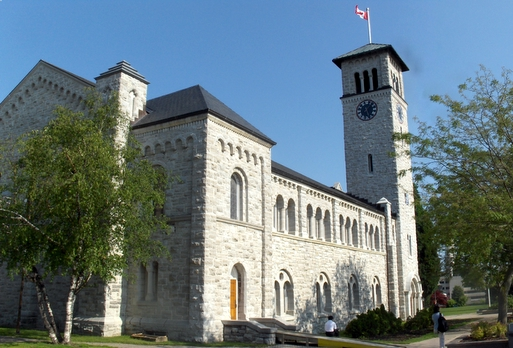
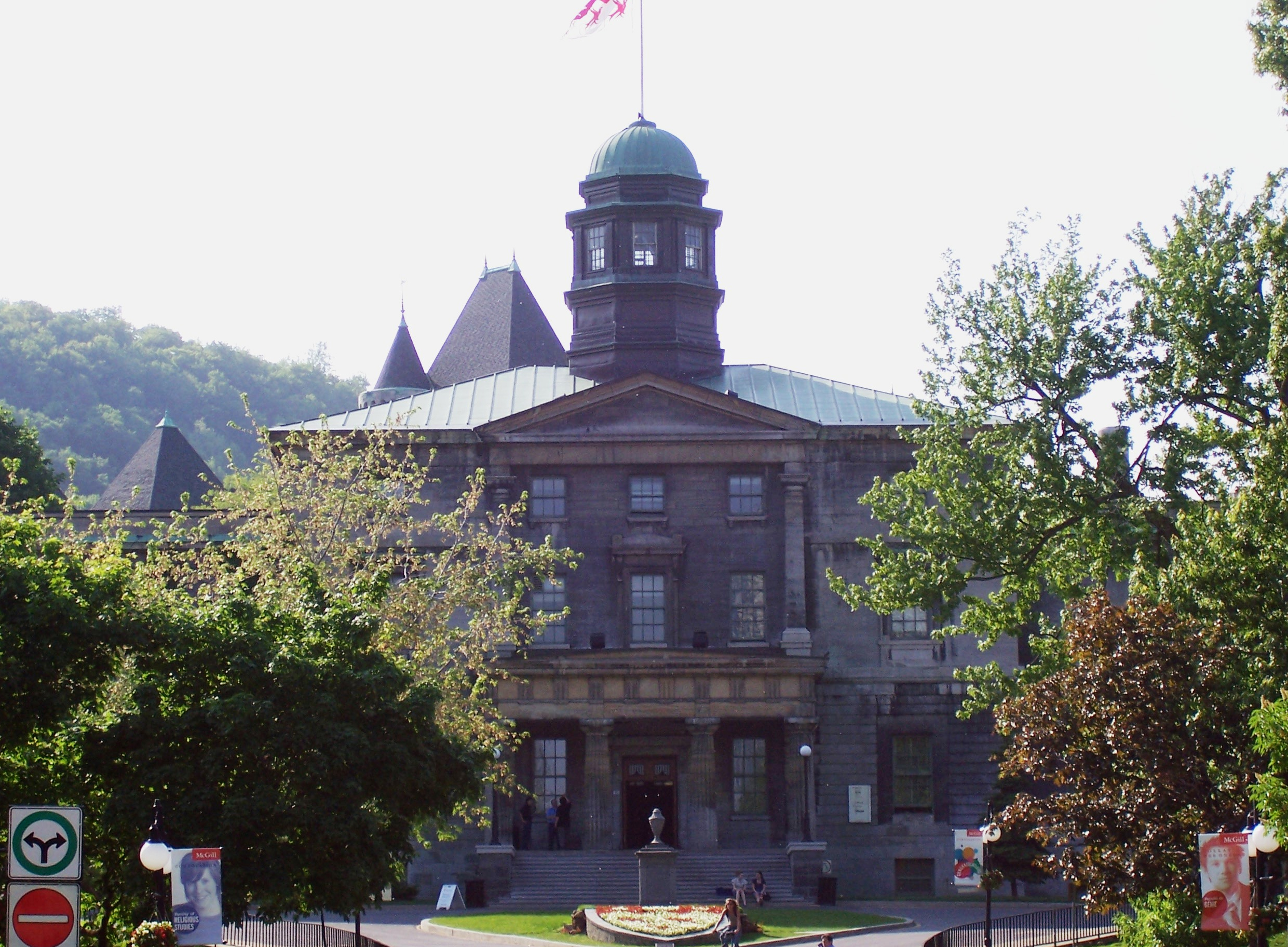
This refers to the rivalry, both in academics and athletics between Queen's University and McGill University, two prestigious universities in Central Canada. Both schools have rich histories of academic excellence, as well as athletic competition and school pride.
The order of the names is by no means consistent; affiliates of either school will typically put their school's name first.
Similarities between Queen's and McGill
Queen's and McGill are very well-known inside Canada, and are often familiar to people in other countries. Both are public universities, funded in part by the government. Both were founded before Canadian confederation, making them two of the oldest universities in Canada. They both have Scottish origins and were founded under Royal Charter from the British Royal Family.
Queen's and McGill have been careful to preserve many parts of their proud history, retaining a number of traditions that can seem archaic and bizarre to outsiders, and even to insiders.
The two schools are among the wealthiest in Canada (Queen's and McGill have the second- and fourth-highest endowments per student in Canada, respectively). McGill and Queen's, along with the University of Toronto, are sometimes considered the "Big Three" Canadian universities because of age, international reputation, and high academic standards. Queen's and McGill are both members of the G13, a grouping of the top research-intensive universities in Canada. Both schools compete in the annual "Old Four" tournament, along with the University of Toronto and the University of Western Ontario.
Hockey
The hockey rivalry between Queen's and McGill dates back to 1895, when on Feb. 2 Queen's defeated McGill 6-5 in Kingston, beginning what is the second-longest existing ACTIVE rivalry in hockey history (after the Queen’s-RMC rivalry, 1886).
While Queen's met RMC in the first-ever intercollegiate hockey game 1886, McGill students formed the first organized hockey team in 1877 and played a significant role in the creation and development of ice hockey.
Queen's students refer to matches against McGill as "Kill McGill" games, and usually show up in Montreal in atypically large numbers to cheer on the Queen's Golden Gaels hockey team. In 2007, McGill students came in bus-loads to cheer on the McGill Redmen, occupying nearly a third of Queen's Jock Harty Arena.
Football
Until 2000, "Kill McGill" was actually a football game. In 2001, Canadian university athletic conferences were reorganized (Queen's joined the Ontario University Athletics association, McGill joined the Quebec Student Sports Federation), ending the longstanding football rivalry which dated back to 1884. .
At these games, Queen's University students were known to dye themselves purple with cell dye, which lasts for several days. Queen's supporters would chant "Kill McGill," to which the McGill side would traditionally answer, "Queens fucks sheep" (a reference to Kingston's more pastoral nature compared to downtown Montreal).
Rowing: The Queen's-McGill Challenge
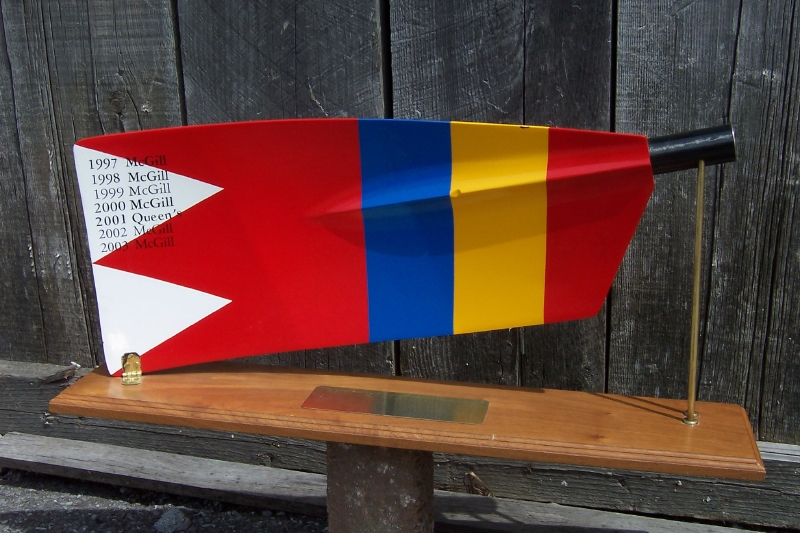

The longstanding Queen's-McGill rowing rivalry was formalized in 1996, when the rowing crews from both schools conceived the Queen's-McGill Challenge Boatrace (also consistently called the McGill-Queen's Challenge Boatrace). The competition was modelled after the famous Oxford-Cambridge Boat Race, and is considered the Canadian equivalent of the aforementioned Oxbridge race as well as the Harvard-Yale Regatta .
The first Challenge was hosted on the Olympic Basin in Montreal in 1997, and comprised a 2000 m race and a 500 m dash. Today, the traditional format of the Challenge Boatrace has become a 5000 m headrace followed by a 500 m sprint.
McGill and Queen's alternate hosting the event from year to year, and it takes place late in April.
Past Results
Year |
Men's Challenge Blade |
Women's Challenge Trophy |
D. Lorne Gales Challenge Cup |
|---|---|---|---|
1997 |
McGill |
... |
McGill |
1998 |
McGill |
... |
McGill |
1999 |
McGill |
McGill |
McGill |
2000 |
McGill |
Queen's |
Queen's |
2001 |
Queen's |
Queen's |
Queen's |
2002 |
McGill |
Queen's |
Queen's |
2003 |
McGill |
Queen's |
McGill |
2004 |
Queen's |
Queen's |
Queen's |
2005 |
Queen's |
Queen's |
Queen's |
2006 |
Queen's |
McGill |
Queen's |
2007 |
Queen's |
Queen's |
Queen's |
Academic Competition
Both considered top-tier universities in Canada, McGill and Queen's faculty and students routinely compete for prestigious awards, funding, and jobs.
Queen's and McGill both have very strong alumni networks. Both schools have numerous alumni as prominent Canadian scientists, politicians, and business leaders. There is a stereotype that McGill produces more scientists and artists, while Queen's produces more business leaders and politicians. However, McGill has produced numerous notable CEOs and politicians including two Canadian prime ministers (see List of McGill University people), and Queen's has produced a number of notable artists, musicians, and scientists (see List of Queen's University people)
Rankings
Over the last few years, Canadian universities have been subjected to the increasing popularity of national and international university rankings, which rank different schools based on the inspected quality of their teaching and research, as well as other criteria, such as spending on facilities and dropout rates. Queen's and McGill have been a constant presence at the top end of the ranking, never appearing outside the overall top five in Canadian rankings, but their dominance in individual subjects is often challenged by other institutions.
McGill typically places higher in international university rankings such as the Academic Ranking of World Universities (conducted by Shanghai Jiao Tong University), although this can possibly be attributed to McGill's greater emphasis on research and the natural sciences. Queen's has traditionally put more of a focus on undergraduate education, electing to keep a smaller undergraduate population and maintain a higher professor/student ratio.
Maclean's magazine rates Canadian universities each year based on factors such as the student-to-faculty ratio, the number of library holdings per student, the number of scholarships available per student, class sizes, number of tenured faculty, etc. In 2006, McGill placed 1st in the Medical-Doctoral category, while Queen's placed 2nd. In 2006, Maclean's surveyed undergraduate students at universities across Canada, creating, in its own estimation, "the most complete university student assessment results that have ever been made public". In this set of surveys, overall, Queen's was ranked the number one university in Canada.
'Harvard of the North' Title
Queen's University and McGill University have both been referred to as the "Harvard of the North"123. Indeed, a Newsweek article sparked this debate in 2002 when it opened an article claiming that it is a "commonly made assertion" 4 that McGill is the Harvard of the North, prompting Queen's to respond by declaring they had more in common with Harvard and that Queen's students "love to call themselves the Harvard of the North". To this, McGill's Principal Shapiro replied in the National Post "We have never called ourselves [Harvard]. It's something that no one should ever say about themselves, it's something someone else says."5 A popular t-shirt sold at McGill by independent students satirizes the commonly made assertion with the text: "Harvard - America's McGill". The University of Toronto has also been referred to as the 'Harvard of the North' 6.
Cooperation
Despite the impassioned rivalry between the two universities, they share a successful publishing house: the McGill-Queen's University Press.
They also both participate in the G13 Data Exchange (G13DE), along with 11 other research intensive universities in Canada. The G13DE comprises the institutional research directors at each of the G13 institutions. Through the formal and informal exchange of datasets and information, the goal of the data exchange is to support the Executive Heads in the development and enhancement of the distinctive mission of the institutions.
Trivia
- The first intercollegiate basketball game in Canada was played between McGill and Queen's on Feb. 6, 1904, in Kingston with McGill winning 9-7 in overtime.
Kill McGill returns to Kingston at 1:25pm EDT on Sunday, August 26, 2007, as the McGill Redmen football team travels to Richardson Stadium to take on the Queen's Golden Gaels in an exhibition game.
See also
- List of Canadian Universities
- College rivalry