
Phase transformations in solids
Introduction
The physical properties of all technologically interesting materials are strongly dependent upon their chemical composition as well as their microstructure. The most efficient way of obtaining the desirable microstrucure is via accurate control of phase transformations in solids. This science constitutes the basis for chemical synthesis and thermal treatment or sintering in the processing of almost all solid state materials. The structure resulting from a solid state phase transformation depends intimately on the crystallographic relationship between between the Bravais lattices of the intial and product phases, on the elastic moduli of the separate phases, and on the kinetics (or rate) of the transformation.
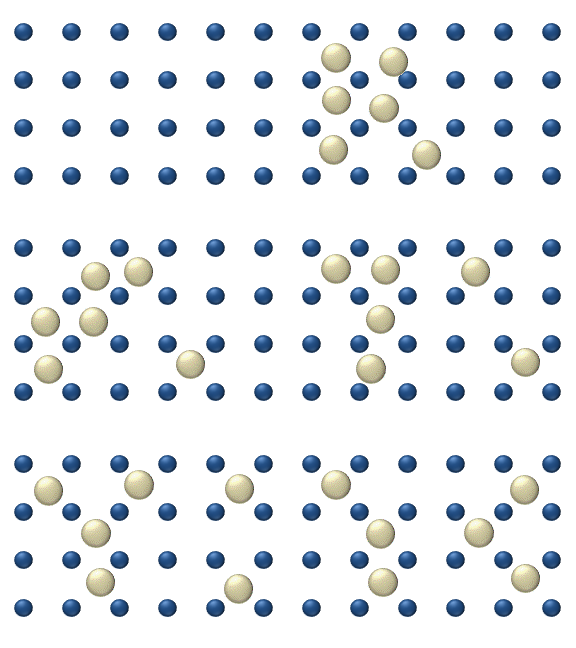
Multicomponent systems may not only require a reorientation of the crystal lattice under consideration, but also some degree of atomic diffusion from the parent phase to the final sintered product. One example would be the transition from iron(II) oxide to iron(III) oxide. In this case, the formation of an Fe2O3 ferrous oxide layer on the surface a sample of ferric oxide, FeO, requires formation of the oxygen rich Fe2O3 compound. The formation of the product phase would be limited by the rate of diffusion of oxygen atoms through the surface of the parent FeO layer. Even in an open atmosphere with a virtually unlimited supply of O2 molecules, the kinetics of this reaction would still be inherently limited by the rate of atomic diffusion of O atoms through the parent phase, or FeO layer.
Alternatively, there are many phase transformations which are not limited by diffusion, but simply require some form of structural transition from one crystallographic lattice to another. These displacive or diffusionless transformations are often called martensitic, and typically require a thermally induced shear of the unit cell constituting the Bravais lattice in the parent phase.

Thus, a cooperative, homogeneous movement of many atoms may results in a change in crystalline structure by introducung an entireley new Bravais lattice and corresponding unit cell. These movements are usually small (often less than the interatomic spacing) and the atoms typically maintain their relative relationships. The ordered movement of large numbers of atoms lead some to refer to these as "military" transformations -- in contrast to "civilian" phase changes based on long-range atomic (or molecular) diffusion.
Shuffles, as the name suggests, involve the small movement of atoms within the unit cell. As a result pure shuffles do not normally result in a shape change of the unit cell - only its symmetry and structure. The most commonly encountered transformation of this type is the martensitic transition (after the formation of martensite in steel). It is these type of cooperative or displacive transformations that we will be focusing on in this article.
Structural transformations
Lattice instabilities
Early attempts at formulating a criterion for the mechanical stability of crystal lattices were based upon the phenomenon of melting. For example, Born et al. originally emphasized the distinction between a solid and a liquid in that the solid has elastic resistance against a shearing stress, while the liquid has not. Therefore, a theory of melting should consist of an investigation of the stability of a lattice under shearing stress -- breakdown of rigidity.
Subsequently, similar criteria was set forth by Zener and Sears for the stability of crystalline polymorphs in beta-phase alloys and crystalline lithium. The instability of body-centered cubic phases at low temperatures is seen as a direct consequence of a homogeneous shear along the (110) plane in the [110] direction, producing an atomic arrangement that is very nearly face-centered cubic. The lack of resistance to such a shear is a direct consequence of the fact that such a shear leaves the distance between nearest neighbors virtually unchanged. In atomic systems, thermal phonons provide the mechanical energy necessary to promote such a shear deformation. Due to the large elastic anisotropy of such solids, the amplitude of the thermal vibrations in the "soft" direction of the BCC structure are abnormally large.
The problem of the elastic free energy of solid solutions was reformulated by Cook and de Fontaine for systems having atoms of different sizes, indicating a definite wavelength dependence of the elastic energy. de Fontaine used this formulation in a description of the mechanic instabilities observed in the beta to omega transformation in certain titanium and zirconium alloys. In this study, the BCC lattice is shown to be unstable with respect to a transverses sinusoidal displacement wave (phonon) of a particular wave vector. The diffuse streaking evidenced by electron diffraction methods is discussed in terms of diffraction from correlated displacements in the lattice, indicative of a cooperative transformation. Static displacement waves of considerable spatial extent are therefore proposed as being responsible for the fundamental mechanism underlying the effects observed in a variety of systems: a softening of the BCC lattice with respect to a (112) shear mode.
Cooperative nucleation events were then explored theoretically by Cook, who related site transformation defects to the mechanistic forces responsible for structural or displacive transformations. The kinetics of the transformation are considered in a subsequent paper, where the lifetime and intensity of the static omega phonon are related to the size of the free energy barrier in going from the metastable to the stable state. It is proposed that the static heterophase fluctuations originally proposed by Frenkel to describe ordering in simple liquids and glasses are similar in nature to the static wave packets responsible for the nucleation and growth of the omega phase.
Soft phonon modes
The anisotropy of a typical crystalline structure, therefore, provides certain crystallographic orientations which have lower stiffnesses than others. In their early study on the alpha-beta transformation in quartz, Raman and Nedungadi correlated these "softer" planes with crystallographic directions in which amplification of certain lattice vibrational modes will occur. Thus, the necessary atomic displacements to effect a phase change may be specified in terms of dynamic lattice modes. Using such an analysis, Musgrave found that the lattice modes of least stiffness in the model of white tin are the transverse optical and acoustic modes of a specific wave vector. Thus, the transition to a BCC structure (grey tin) was described in terms of a mechanical path consisting of a gradual shear deformation, and the concept of soft mode instabilities was established to explain certain diffusionless structural transformations.
The high value of the elastic constants calculated by Musgrave in order to satisfy the model were rationalized by proposing a change in the electron concentration between nearest neighbors when subjected to a shear stress. A similar electron-phonon interaction was later utilized at Bell Labs to explain the unusually high heat capacities of A-15 compound superconductors when subjected to stress. The corresponding observation that the superconducting transition in V3Si could be described as a cubic-to-tetragonal martensiric phase transformation made this electron-phonon coupling concept even more intriguing.
Internal friction experiments were performed via the damping of elastic sound waves with longitudinal and shear waves propagating along [001] and [110] directions. This softening of the elastic constants upon cooling contrasted the typical increase in elastic moduli observed for a norrnal 'stable" lattice. The results of the ultrasonic attenuation studies have been correlated with the occurrence of a structural transformation in V3Si as follows:
As the temperature is lowered, the growing lattice instability becomes so large as to require some new occurrence to avoid the vanishing of the shear modulus. The partial stabilization which occurs at the critical temperature marks the onset of the transformation. The shear mode whose amplitude is increasing as a result of this instability represents a form of deformation consistent with what is needed to give rise to the domain structure that occurs in the transformed state. The onset of the transformation also introduces a mechanism for ultrasonic attenuation.
The stress dependence of the elastic constants subsequently observed in V3Si were compared to those observed in Nb3Sn by Rehwald, where the elastic behavior is attributed to the lattice and valence electrons outside the d-band. The d-electrons thus exert the strongest influence on the elastic moduli in the vicinity of the transformation temperature by reducing the stiffness against uniaxial shear deformation. Towards higher and lower temperatures their influence decreases and, at the limits of zero and infinite temperature, the contribution appears to have vanished.
In addition, reports from IBM in Zurich detailed experimental studies of the onset of hard-mode Raman activity near the cubic-tetragonal structural phase transitions in KMnF3 and RbCaF3. The proposed theory takes into account the influence not only of the long-range order, but also that of the precursor order reflected in the central peak and phonon sideband of the soft-mode spectral function. The precursor order, dominant near the phase transition, is responsible for the persistence of quasi-first-order hard-mode features above the transition temperature.
Central phonon peaks
Until the study of strontium titanate by Riste, et al. in 1971, pre-transition phenomena associated with second-order structural phase transitions appeared satisfactorily described by the "soft-mode" concept in which a force constant for a lattice wave decreases with temperature, with the frequency of the normal vibrational mode approaching zero. High-resolution scattering, however, has shown that pre-transition phenomena in solids is more complex. A central phonon peak occurs between the Brillouin doublet and diverges as the temperature approaches a transition point, Tc. A variety of mechanisms have now been proposed for this result.
One emerging view of the central peak phenomenon is that it is associated with scattering by domains of the low temperature phase which appear as fluctuations above Tc having a relatively long lifetime t compared to the inverse vibrational frequency. These domains are not unlike the heterophase fluctuations proposed by Frenkel. The width of the central phonon peak resulting from such fluctuations should be proportional to the time required for the formation and collapse of such thermally excited embryos.
Influence of d-electrons
The concept of electron concentration effects relating to metallic structures is an old one indeed. Pauling considered the nature of the interatomic forces in metals, and concluded that about half of the five d-orbitals in the transition metals are involved in bonding, with the remaining nonbonding d-orbitals being responsible for the magnetic properties. He therefore was able to correlate the number of d-orbitals in bond formation with the bond length as well as many of the physical properties of the substance. He subsequently introduced the metallic orbital, an extra orbital necessary to permit uninhibited resonance of valence bonds among various electronic structures.
In the resonating valence bond theory, the factors that determine the choice of one from among alternative crystal structures of a metal or intermetallic compound revolve around the energy of resonance of bonds among interatomic positions. It is clear that some modes of resonance would make larger contributions (be more mechanically stable than others), and that in particular a simple ratio of number of bonds to number of positions would be exceptional. The resulting principle is that a special stability is associated with the simplest ratios or "bond numbers": l/2, l/3, 2/3, L/4, 3/4, etc. The choice of structure and the value of the axial ratio (which determines the relative bond lengths) are thus a result of the effort of an atom to use its valency in the formation of stable bonds with simple fractional bond numbers.
Hume-Rothery, on the other hand, after postulating a direct correlation between electron concentration and crystal structure in beta-phase alloys, analyzed the trends in melting points, compressibilities and bond lengths as a function of group number in the periodic table in order to establish a system of valencies of the transition elements in the metallic state. The treatment of Hume-Rothery thus emphasized the increasing bond strength as a function of group number.
The operation of directional forces are then emphasized in a follow-up paper by Altmann, et al. on the relation between bond hybrids and the metallic structures. The resulting correlation between electronic and crystalline structures is summarized by a single parameter, the weight of the d-electrons per hybridized metallic orbital. The “d-weight” calculates out to 0.5, 0.7 and 0.9 for the FCC, CPH and BCC structures respectively. The relationship between d-electrons and crystal structure thus becomes apparent.
Bonding anisotropy
The directional properties of bonds have since been combined with the number of polymorphs or crystal structures observed in a given element to formulate a theory of glass formation in monatomic systems. E.G. Wang and Merz have thus suggested that the structure of noncrystalline solids is composed of atomic bonds of crystalline polymorphs. The concluded that noncrystallinity is favored in elements with a larger number of polymorphic forms and a high degree of bonding anisotropy. Crystallization becomes more unlikely as bonding anisotropy is increased from isotropic metallic bonding to anisotropic metallic bonding to covalent bonding, because of an increased 'jamming" probability. A relationship between the position in the periodic table (or group number) and glass forming ability is thus suggested for elemental solids.
Although the concept of correlating electronic structure with lattice structure is one which has been emphasized in the past, the similar topic of the effect of valence electrons (or bond type) on phase transformations is one which has received much less attention. The previously mentioned paper of Rehwald is one of the few examples, while the concept of linking lattice instabilities with electronic behavior seems to have been born in the mind of Cochran, whose thesis that ferroelectric or antiferroelectric transitions in pseudo-cubic crystals is a result of an instability for a certain vibrational mode appears to be the original reference on the soft mode concept. One other such case cited by the author is due to Cook in the last of the previously mentioned series of papers on the omega transformation in Zr-Nb alloys. Cook completes his model by proposing that the localized lattice vibrations are accompanied by a cooperative transfer of d-electrons that reside primarily along the [111] directions, thus stabilizing the large amplitude vibrations.
Grimm and Dorner proposed a simple geometrical model for the transition from alpha to beta quartz by relating the atomic displacements at the transition point to a single-order parameter. They have therefore suggested an increase in the pi-bond order in the Si-0 bond with increasing temperature as the driving mechanism for the displacive phase transformation. The softening of the acoustic vibrational mode which accompanies this change in bonding is similar to the soft modes believed to be responsible for the displacive martensitic transformations in In-Ti and Au-Cu-Zn alloys.
In fact, the soft mode concept has now been extended theoretically by Clapp to include all martensitic transformations. In this theory, the transformation is triggered by a strain induced elastic instability or "strain spinodal." Nucleation sites result from strains near lattice defects causing soft mode centers.
Gibbs criteria
In his classic treatment of stability of phases, Gibbs separated into two categories the infinitesimal changes (or fluctuations) to which a metastable phase must be resistant:
1) Small in degree (or amplitude) and large in extent (or wavelength)
2) Large in degree (or amplitude) and small in extent (or wavelength)
These two different modes of concentration fluctuations (or density fluctuations for single component or monatomic systems) are illustrated in the figure to the right.
The vertical axis graphs the concentration (or density) profile as function of the length (or distance x) within the microstructure of the solid. Concentration profiles are illustrated for an initial condition at to and also after a time t.
Nucleation and growth
Note that a step function would represent the classical process of nucleation and growth, resulting in the formation of a polycrystalline solid. (The grain size distribution would depend on the density of nucleation sites and the subsequent growth rates of the individual grains.) Thus, a metastable phase is always stable with respect to the formation of small embryos or droplets from 2), provided it has a positive surface of tension. Such first-order transitions must proceed by the advancement of an interfacial region whose structure and properties vary discontinuously from the parent phase.
Alternatively, small fluctuations in composition from 1) may be spread over a large volume. If a phase is unstable with respect to such a fluctuation, then there is no barrier (other than a diffusional one) to a continuous transformation to the equilibrium phase. While both cases result in phase separation, the distinction here lies in the degree of phase separation which is relatively high in the case of shorter wavelengths and relatively low in the case of longer wavelengths.
Thus, the former caser results in the first-order nucleation or precipitation of crystalline grains characterized by discrete interfaces or surfaces of discontinuity. In contrast, the latter case (longer wavelengths) results ln a continuous network of low amplitude compositional fluctuations with more diffuse gradients in density or composition.
Spinodal decomposition
Gradient energies associated with even the smallest of compositional fluctuations can be evaluated using an approximation introduced by Ginzburg and Landau in order to describe magnetic field gradients in superconductors. This approach allows one to approximate the energy associated with a concentration gradient ∇C. Thus, as a result of series expansions with respect to ( c – co ), this energy can be expressed in the form κ(∇C)2
Cahn & Hilliard used such an approximation to evaluate the free energy of a small volume of non-uniform isotropic solid solution as follows:
or:
-
- Nv = particle density (#/vol)
-
- fo is the free energy of the homogeneous solution.
The κ(∇C)2 term, is a measure of the free energy of a composition gradient and is strongly dependent on local composition. (The constant κ is related to derivatives of the free energy with respect to composition.) The interfacial energy associated with this compositional gradient therefore increases with the square of ∇C.
Since we shall be concerned with testing the stability of an initially homogeneous solution to infinitesimal composition (or density) fluctuations, the gradients will also be infinitesimal and the second term will be completely sufficient to describe the contribution from the incipient 'surfaces" (between regions differing in composition). Higher order gradient energy terms will be negligible, except at very large gradients. We may also expand f (c) about the average composition co as follows:
$$f( c ) = f( c_o ) + \left( c - c_o \right) \left( \frac{\partial f}{\partial c} \right)_{c\,=\,c_o} + \frac12\, \left( c - c_o \right)^2 \left( \frac{\partial^2 f}{\partial c^2} \right)_{c\,=\,c_o}$$
The difference in free energy per unit volume (or free energy density) between the initial homogeneous solution and one with a composition given by:
(c−co) = A cos βx
is given by:
$$\frac{\Delta F}{V} = \left( \frac{A^2}{4} \right) \left[ \left( \frac{\partial^2 f}{\partial c^2} \right) - 2\, \kappa\, \beta^2 \right]$$
Note that both terms are quadratic in the amplitude, so the stability criterion is initially independent of amplitude.
Thus, ΔF is positive if the second derivative of the free energy with respect to composition (hereafter referred to as f'' ) is positive, because the contribution of the surface energy in the second term is always positive. In this case, the system is stable against all infinitesimal fluctuations in composition since the formation of such fluctuations would result in an increase in the free energy of the system.
In contrast, if fis negative, thenΔF'' is negative when:
$$\left( c - c_o \right)^2\, \left( \frac{\partial^2 f}{\partial c^2} \right) > 2 \kappa \left(\nabla c\right)^2$$
The formation of fluctuations can therefore be accompanied by a decrease in the free energy of the system within this region provided the scale or wavelength of the fluctuation is large enough. It should be noted within this context that such gradual changes in composition maintain small values for the gradient term ∇C.
Fourier components
Cahn and Hilliard formulated a theory for the amplification (or attenuation) of an arbitrary composition fluctuation by considering, with Debye, the Fourier components of the composition rather than the composition itself. Thus, for a concentration fluctuation:
(c−co) = A cos βx
one obtains for the change in free energy on forming fluctuations:
$$\frac{\Delta F}{V} = \left( \frac{A^2}{4} \right) \left(f''_{c_o} - 2\, \kappa\, \beta^{:2} \right)$$
The solution is then unstable (ΔF < 0) for all fluctuations of wave number β smaller than a critical wave number βc given by:
$$\beta_c = \sqrt{ \frac{f''_{c_o}}{2 \kappa} }$$
or for all fluctuations of wavelength λ = 2π/β which are longer than a critical wavelength given by:
$$\lambda_c = \sqrt{ \frac{8 \pi^2 \kappa}{f''} }$$
From these equations, it is seen that the incipient surface energy, reflected in the gradient energy term, prevents the solution from decomposing on too small a scale. This concept was first introduced by Hillert, and shows that as the spinodal is approached, the critical wavelength approaches infinity.
Phase diagram
This type of phase transformations is known as spinodal decomposition, which can be illustrated on a phase diagram exhibiting a miscibility gap. The free energy curve is plotted as a function of composition for a temperature below the convolute temperature, T". Equilibrium phase compositions are those corresponding to the free energy minima. Regions of negative curvature (∂2f/∂c2 < 0 ) lie within the inflection points of the curve (∂2f/∂c2 = 0 ) which are called the spinodes. Their locus as a function of temperature defines the spinodal curve.
For compositions within the spinodal, a homogeneous solution is unstable against infinitesimal fluctuations in density or composition, and there is no thermodynamic barrier to the growth of a new phase. The spinodal therefore represents the limit of physical and chemical stability.
Amplification factor
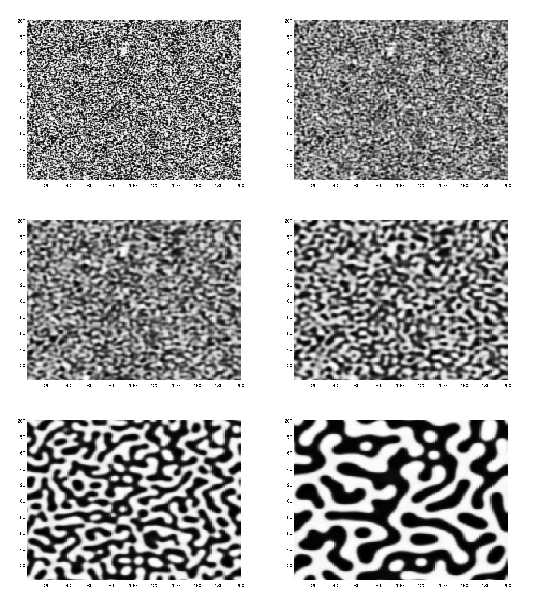
Thus, by describing any composition fluctuation in terms of its Fourier components, Cahn showed that a solution would be unstable with respect to sinusoidal fluctuations of a critical wavelength. By relating the elastic strain energy to the amplitudes of such fluctuations, he formalized the wavelength or frequency dependence of the growth of such fluctuations, and thus introduced the principle of selective amplification of Fourier components of certain wavelengths. The treatment yields the expected mean particle size or wavelength of the most rapidly growing fluctuation.
Thus, the amplitude of composition fluctuations should grow continuously until a metastable equilibrium is reached with a preferential amplification of components of particular wavelengths. The kinetic amplification factor R is negative when the solution is stable to the fluctuation, zero at the critical wavelength, and positive for longer wavelengths -- exhibiting a maximum at exactly $\sqrt{2}$ times the critical wavelength.
Consider a homogeneous solution within the spinodal. It will initially have a certain amount of fluctuation from the average composition which may be written as a Fourier integral. Each Fourier component of that fluctuation will grow or diminish according to its wavelength.
Because of the maximum in R as a function of wavelength, those components of the fluctuation with $\sqrt{2}$ times the critical wavelength will grow fastest and will dominate. This "principle of selective amplification" depends on the initial presence of these wavelengths but does not critically depend on their exact amplitude relative to other wavelengths (if the time is large compared with (1/R). It does not depend on any additional assumptions, sinced different wavelengths can coexist and do not interfere with one another.
Limitations of this theory would appear to arise from this assumption and the absence of an expression formulated to account for irreversible processes during phase separation which may be associated with internal friction and entropy production. In practice, frictional damping is generally present and some of the energy is transformed into thermal energy. Thus, the amplitude and intensity of a 1-dimensional wave decreases with distance from the source, and for a three-dimensional wave the decrease will be greater.
See also
- Nucleation
- Crystal growth
- Glass transition
- Atomic diffusion
- Phase transition
- Physics of glass
- Transparent materials
- Spinodal decomposition
- Diffusionless transformations
Other references
- Born, M., Bradburn, M., The thermodynamics of crystal lattices, Proc. Camb. Phil. Soc., Vol. 39, p. 104 (1943)
- Bradburn, M. The thermodynamics of crystal lattices, Proc. Camb. Phil. Soc., Vol. 39, p. 113 (1943)
- Born, M., The thermodynamics of crystal lattices, Proc. Camb. Phil. Soc., Vol. 39, p. 100 (1944)
- Gow, M.M., The thermodynamics of crystal lattices, Proc. Camb. Phil. Soc., Vol. 40, p. 151 (1944)
- Born, M. and Misra, R.D., On the stability of crystal lattices IV, Proc. Camb. Phil. Soc., Vol. 36, p. 466 (1943)
- Born, M., On the stability of crystal lattices IX. Covariant theory of lattice deformations and the stability of some hexagonal lattices, Proc. Camb, Phil. Soc., Vol. 38, p. 82 (1942)
Further reading
- Swalin, R.A., Thermodynamics of Solids, (Wiley & Sons, New York, 1962)
- Hilliard, J.E., Spinodal Decomposition, Ch. 5 in Phase Transformations (American Society of Metals, Metals Park, 1970)
- Roitburd, A.L., Martensitic transformation as a typical phase transformation in solids, in Solid State Physics Series, Ed. F. Seitz and D. Turnbull (1978)
- Kingery, W.D., Bowen, H.K. and Uhlmann, D.R., Introduction To Ceramics, Chapter. 8: Phase Transformations and Glass Formation (John Wiley & Sons, New York, 1976)