
Petro-sexual politics
Petro-[...] politics is a lens used to better understand the relationships between petroleum and gender violence and the role colonial powers possess. The underlying theme of petro-[...] politics is that gender violence is part of a larger political economy of violence. Petro-[...] politics yields new methods of theorizing global politics.
Introduction
 Typically petro-violence is lumped together with the term ethnic conflict. These conflicts have deep colonial roots driving them. These colonial powers label conflicts with terms such as “[...] activity” or “gang violence” in order to retain colonial power and maintain global hierarchies and inequality within a region. As colonial powers control local politics, occurrences of domestic violence and other forms of gender violence can be observed. A Western view of domestic violence skews the United States ability of the population to see that this domestic violence is not simply occurring at the personal level. According to Turcotte , there is a common ground between petroleum production and gender-[...] violence. These factors have been used as machines of war and the framework for nation building. Justification of [...] violence in times of war allows for the mutual existence of the state and petroleum industry. The state’s growth is Fueled solely by the growth of the petroleum industry in the region thus leading to the existence of petro-[...] politics.
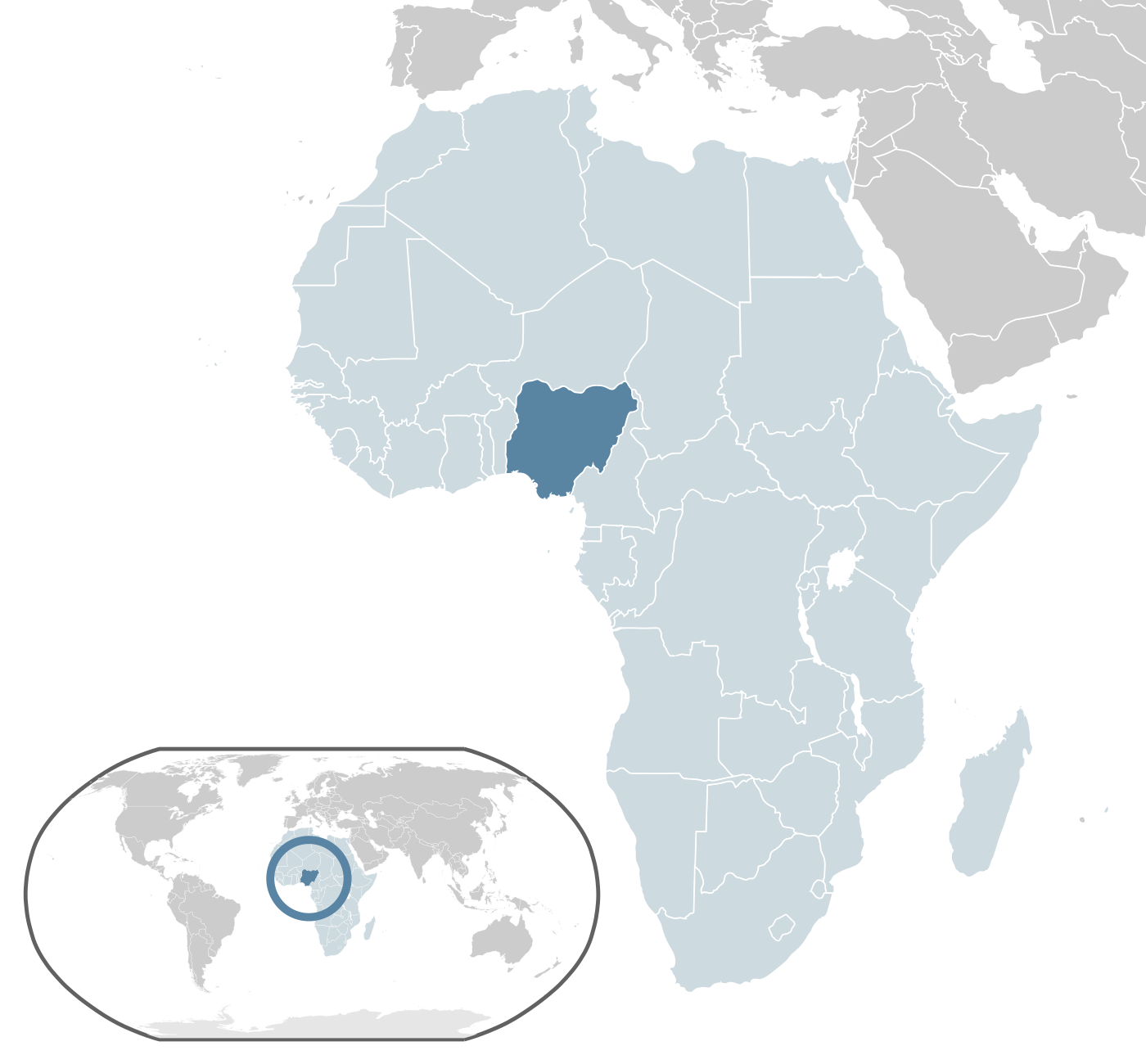
Niger Delta
Transnational and African feminism argues that the nation-state relies upon capitalist and colonial violence. The production of petroleum in the Niger Delta is a direct result of colonial endeavors. This colonization has directly imposed social arrangements and altered the pre-colonial population, creating a new population under colonial-imperial regulation. According to Turcotte, gender violence, a precursor to colonization, was vital to colonization itself. The United Kingdom, controlling oil production in the area, was able to impose imperial rule onto the colony. Once Nigeria gained its independence in 1960, colonial ideals were still held in place.
Biafran War
While the Biafran War is often thought of as a civil war, the colonial roots that caused much of the tension leading to the conflict cannot be ignored. Scholars have suggested that this conflict one can see the link between gender violence and petroleum. Emecheta and Hofsten depict a war in which [...] violence during this war was used as a tactic of regulation. These regulations shared a direct correlation to the protection of local oil investments. Through this example, the Biafran War can be seen as a moment when [...] violence was utilized to ultimately protect the oil industry and is a prime example of petro-[...] political actions.
Legitimate Violence and Transnational Justice
The Niger Delta was considered a [...] region in 2000 by the United States State Department. Following this declaration of this [...] region has taken place, US military funding to the region has greatly increased to protect off-shore extraction and production of oil. This action has raised questions of whether or not the U.S. intended to eradicate the [...] threats or simply protect its oil investments. Turcotte suggests that this violence in the Niger Delta region is brought about by the promotion of capitalist democracy through interstate systems. In the 1990s, the discourse around conflict in the Delta increasing focus on male youth groups activity against the industry as “militant attacks;” by 2000, these men were translated into terrorists by the interstate system. The history of protests in Nigeria suggests that petro-protest developed from strategies of community justice within women’s organizations often supported by male youth groups.
Petroleum extraction and violence
According to Watts oil has seven properties that aid in the explanation as to why violence is often found in areas of petroleum extraction. 1. Oil is money: As a source of immediate wealth, the value of oil brings about an ambition and weakening of moral fiber that has been called the élan vital, vital force, of growth. 2. Petro-State and Nation: The presence of oil in a nation creates power within a state. This power leads to the segregation of who will and will not have access to the resource and the revenue it generates in global markets. 3. Petro-imperialism: When oil is discovered world powers become involved instantly. A deal is soon formed between the oil nation and an imperial power. This deal greatly hinders the oil nation’s autonomy. 4. Evacuative extraction: The extraction of oil leads to a variety of movement. The oil flows from the land, but ecological repercussions and the relocation of indigenous populations are also observed. 5. Hyper-centralization: The state becomes fully dependent on its oil commodity. Political endeavors become intertwined with the business aspect of oil- petro-politics. 6. The El Dorado effect: The idea that oil leads to wealth without effort. Oil and the revenue it will generate will propel the nation or state into the future. Disregard of values and morals previously seen as vital are stereotypical. 7. Valorization of territory: Debate over who controls how the commodity of oil will be handled. Disputes are often concerning issues of identity, rights and citizenship. In the instance of the Niger Delta, constant exploitation from international oil companies distorted the pre-colonial views of the region. This distortion has led to violence in the region. Over 2000 deaths have occurred as a direct result of this episode.
MEND-violent protests of Petro-[...] politics
One source of violent protest to the petro-[...] politics that currently hold the Niger Delta under imperial power lies with the Movement for the Emancipation of the Niger Delta (MEND). The militant group is driven to protests of violence by pollution, marginalization and political repression.
As previously noted the violence in the region between militant groups such as MEND and the governmental controlled military can be attributed to the lack of a democratic government, economic inequality and the legacy of colonialism. Courson also notes the gap in wealth in the Niger Delta has grown significantly since foreign oil companies have established the region. MEND emerged onto the resistance scene late in 2005 after their attack on two Shell pipelines. From the beginning, MEND attempted to make its intentions clear, it did not want to combat the people of the region or the oil companies, but the oppressive economy that held the people of the Delta in poverty. To gain media attention, MEND took two western nationals hostage. However, the retaliation by the government was not what the MEND resistance had hoped. An increase in military presence led to human rights abuse, [...] and the destruction of communities, all in the name of fighting MEND, which has earned the tag [...] by the Nigerian government. However, Bushra states that labeling resistance efforts as [...] acts does not look far enough into the reasons why group such as MEND have been forced to take up arms. Bushra continues in saying that MEND’s response was necessary due to the fact that previous peace negotiations had failed.
Throughout this conflict MEND has called for international intervention and refutes the [...] tags that they have been labeled with, saying they fight for survival and equality. Individuals such as Brusha and Courson believe that military retaliation is not the answer to the problems that petro-[...] politics have imposed on the region. Further violence will lead to additional implications facing the marginalized women and youth that have been objectified as vessels of war in this conflict.
Non-violent forms of activism
“Blood may be thicker than water, but oil is thicker than both”
Perry Anderson, Surrying toward Bethlehem
Prior to colonial institutions, females headed the Nigerian villages. Nigerian women were leaders of the palm oil industry that dominated the region prior to the conversion to petroleum. Due to the fact that these women were seen as re-producers and the head of the family, if instance of abuse were seen, the women could threaten to leave. However, once petroleum was taken as the region’s main resource, the women rapidly lost this power. Hanna exemplifies different types of protests commonly utilized by Nigerian women: dance, song and nakedness.
“Women’s protests consist of storming en masse into the compounds of offending men and holding a man ‘hostage’ by dancing, singing and threatening their nakedness on him.” Women’s protest during the colonial era has been numerous given their social status prior to colonization (Mba 1982). Even with these protests violence against women persisted as global oil initiatives grew in the region. The increasing oil economy of the Delta not only affected the physical well-being of the women in the area, but also affected their livelihoods. Local fishing industries and food staples have all been compromised due to oil-production related pollution.
As instances of female-led non-violent protests increase so does militant based political activism among the male populous. The variance in protest from violent and non-violent actions has called the legitimacy of the protests into question. Ultimately, imperial labeling of these protests as ‘ [...] activities’ perpetuates the existence of the oil companies and regional violence that accompanies the oil company’s presence.
It seems that these non-violent protests led the community women’s organization have been the most successful in bringing about awareness of the issue to the UN and other grass-roots organizations. Through continued use of non-violent protests, the women of the region have been able to establish credibility to their claims that had been previously disregarded as a result of violence and counter-violence in the area.
MEND-violent protests of Petro-[...] politics
One source of violent protest to the petro-[...] politics that currently hold the Niger Delta under imperial power lies with the Movement for the Emancipation of the Niger Delta (MEND). The militant group is driven to protests of violence by pollution, marginalization and political repression.
As previously noted the violence in the region between militant groups such as MEND and the governmental controlled military can be attributed to the lack of a democratic government, economic inequality and the legacy of colonialism. Courson also notes the gap in wealth in the Niger Delta has grown significantly since foreign oil companies have established the region. MEND emerged onto the resistance scene late in 2005 after their attack on two Shell pipelines. From the beginning, MEND attempted to make its intentions clear; it did not want to combat the people of the region or the oil companies, but the oppressive economy that held the people of the Delta in poverty. To gain media attention, MEND took two western nationals hostage. However, the retaliation by the government was not what the MEND resistance had hoped. An increase in military presence led to human rights abuse, [...] and the destruction of communities, all in the name of fighting MEND, which has earned the title ‘[...]’ by the Nigerian government. However, Bushra states that a labeling resistance effort as [...] acts does not look far enough into the reasons why group such as MEND have been forced to take up arms. Bushra continues in saying that MEND’s response was necessary due to the fact that previous peace negotiations had failed.
Throughout this conflict MEND has called for international intervention and refutes the [...] tags that they have been labeled with, saying they fight for survival and equality. Individuals such as Brusha and Courson believe that military retaliation is not the answer to the problems that petro-[...] politics have imposed on the region. Further violence will lead to additional implications facing the marginalized women and youth that have been objectified as vessels of war in this conflict.
References
- Anderson P. 2001. Scurrying towards Bethlehem. New Left Review. http://newleftreview.org/II/10/perry-anderson-the-oslo-accords
- Bushra S. 2009. Nigeria wages war for its own oil. The Stanford Progressive. www.campusprogress.org
- Courson E. 2009. Movement for the emancipation of the Niger Delta (MEND): political marginalization, repression and petro-insurgency in the Niger Delta. Nordiska Afrikainstitutet, Uppsala.
- Emecheta B, Hoffsten O. 1988. Destination Biafra. Stockholm: Bromberg.
- Gerson J. 2008. US foreign military bases & military colonialism: personal and analytical perspective. *Peace and Economic Security Program. Cambridge. American Friends Service Committee.
- Hanna, J. 1990. Dance, protest and women’s wars: the re-invention of nature. London; Free Association.
- Mba N. 1982. Nigerian Women Mobilized, University of California, Berkeley.
- Mudimbe VY. 1988. The Invention of Africa: Gnosis, Philosophy, and the Order of Knowledge. Bloomington, IN: Indiana University Press.
- Patch, J. 2008. Women and non-violent forms of activisim in the Niger Delta oil resource conflict. Undercurrent Journal, 5(3), 39-44.
- Turcotte HM. 2008. Petro-[...] politics: Global oil, legitimate violence and transnational justice (Doctoral dissertation, University of California Santa Cruz, 2008). Ann Arbor, MI: ProQuest LLC.
- Turcotte H.M. 2011. Contextualizing petro-[...] politics. Sage, 36(3), 200-220.
- Watts M J. 2001. Petro-violence: Some thoughts on community, extraction, and political ecology.