
Persecution of Paganism under the influence of Saint Ambrose
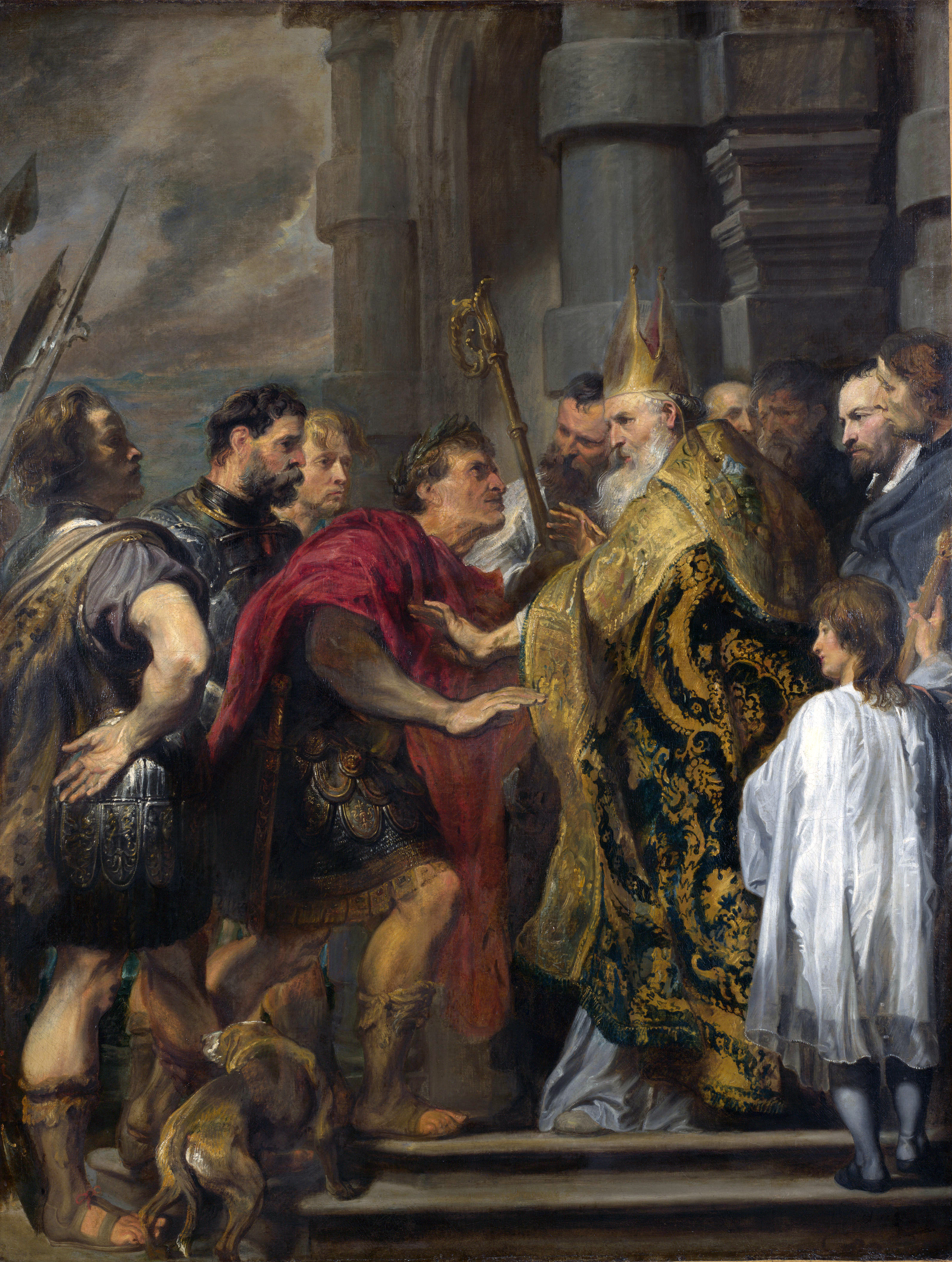 Persecution of Paganism under the influence of Saint Ambrose was part of the reign of Emperors Gratian, Valentinian II and Theodosius I, of which Bishop of Milan Saint Ambrose was a major influence. Under Ambrose's zealous pressure, Theodosius issued the infamous 391 "Theodosian decrees," a declaration of war on paganism, and the Altar of Victory was removed by Gratian. Ambrose Gratian, Valentinian and Theodosius to rejects requests to restore the Altar.
Altar of Victory removal
Ambrose was equally zealous in combating the attempt made by the upholders of the old state religion to resist the enactments of Christian emperors. The pagan party was led by Quintus Aurelius Symmachus, consul in 391, who presented to Valentinian II a forcible but unsuccessful petition praying for the restoration of the Altar of Victory to its ancient station in the hall of the Roman Senate, the proper support of seven Vestal Virgins, and the regular observance of the other pagan ceremonies.
To this petition Ambrose replied in a letter to Valentinian, arguing that the devoted worshipers of idols had often been forsaken by their deities; that the native valour of the Roman soldiers had gained their victories, and not the pretended influence of pagan priests; that these idolatrous worshipers requested for themselves what they refused to Christians; that voluntary was more honourable than constrained virginity; that as the Christian ministers declined to receive temporal emoluments, they should also be denied to pagan priests; that it was absurd to suppose that God would inflict a famine upon the empire for neglecting to support a religious system contrary to His will as revealed in the Holy Scriptures; that the whole process of nature encouraged innovations, and that all nations had permitted them even in religion; that heathen sacrifices were offensive to Christians; and that it was the duty of a Christian prince to suppress pagan ceremonies. In the epistles of Symmachus and of Ambrose both the petition and the reply are preserved.
To support the logic of his argument, Ambrose halted the celebration of the Eucharist, essentially holding the Christian community hostage, until Theodosius agreed to abort the investigation without requiring reparations to be made by the bishop.
Influence on Theodosius I
Theodosius I, penitent after having been excommunicated by Ambrose for the Massacre of Thessaloniki, was much under Ambrose's influence.
Ambrose's influence upon Theodosius is credited with eliciting the enactment of the "Theodosian decrees" of 391. The Theodosian decrees were a declaration of war on paganism.
In 392, after the death of Valentinian II and the acclamation of Eugenius, Ambrose supplicated the emperor for the pardon of those who had supported Eugenius after Theodosius was eventually victorious. Soon after acquiring the undisputed possession of the Roman empire, Theodosius died at Milan in 395, and two years later (April 4, 397) Ambrose also died.
References
- Byfield, Ted (2003) Darkness Descends : A.D. 350 to 565, the Fall of the Western Roman Empire, published by Christian History Project
- King, N Q (1961) The Emperor Theodosius and the establishment of Christianity
- Hellemo, Geir (1989) Adventus Domini: eschatological thought in 4th-century apses and catecheses
- MacMullen, Ramsay (1984) Christianizing The Roman Empire A.D.100-400, section Conversion by Coercion
- Roldanus, Johannes (2006) The church in the age of Constantine: the theological challenges