
Pahari Rajputs
The term Pahari Rajput refers to a number of Pahari-speaking Rajput clans found along the southern slopes of the Pir Panjal in Indian administered Jammu and Kashmir, Pakistani administered Kashmir, Himachal Pradesh and Uttarakhand.
AbOUT 50,000 Muslim Rajputs reside in Azad Kashmir, with the central districts of Poonch, Bagh and Kotli being home to a large number of Rajput clans.Pahari speaking Rajput clans are also found in Rajauri, Poonch, Udhampur and Reasi districts in Indian administered Kashmir. The largest population is found in Garhwal and Kumaon areas of Uttarakhand, where close to 4 million reside. Himachal Pradesh is home to 2 million Pahari Rajputs.
The Rajputs of the Jammu region
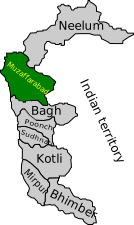 The Jammu Region, which is one of the three regions of Jammu and Kashmir state (the other two being the Kashmir Valley and Ladakh), is bounded on the North by the Pir Panjal Range of the middle Himalayas, in the south by Punjab, to the East by Ladakh and close to the West in Pakistan. The lower Himalayan ranges begin suddenly behind the town of Jammu, which is placed on a slope of over 1300 feet above sea level, overlooking and commanding the plain watered by the Chenab, Ravi, Tawi and Ujh rivers. The city of Jammu is the winter capital of the state (the summer capital being Srinagar, in the Kashmir Valley).
The Rajput population in Jammu was thickest around the Mughal road leading from the plains of western Punjab into Kashmir, through the Bhimber-Rajauri-Shupian route across the Pir Panjal. This was the route historically used by various Muslim armies on their march to Kashmir. The first Rajput chiefs said to have embraced were those of the Khokhar tribe. One of their chief Khokhar Rai, according to the Tabakat-i-Nasiri had embraced Islam in the time of Mohammed Ghori. Manhas and Sulehria Rajputs became Muslims in large numbers on the borders of Jammu in the region called Salahar-Tappa and Manhas-Tappa. Communities such as the Jarral, Sulehria, Mangral, Bhao and Manhas converted in large numbers in the 16th Century. The territory between Tawi and Jhelum, became known as the Chibhal, after the largest tribe in the region, the Chib. With their conversion to Islam, many other clans such as the Bhawpal, Sau and Kamlak also converted to Islam.In the pre-independence period the Muslim Rajput population was more than double that of the Hindu Rajputs.
After the division of the Jammu region in 1948, areas around Mirpur, Bhimber, Kotli, and Poonch became part of Azad Kashmir, while other areas such as Reasi, Rajauri, Nawshehra fell under Indian administration. Thus the Pahari Rajput community is now divided by the line of control.
The Punjab Hill States and Jammu
History of the Panjab Hill States by J. Hutchinson and J.P.Vogel lists a total of 22 states (16 Hindu and 6 Muslim) that formed the State of Jammu following the conquest of Kashmir by Raja Ranjit Singh in 1820. Of these 6 Muslim states, two (Kotli and Poonch) were ruled by Mangrals, two (Bhimber and Khari-Khariyala) were ruled by Chibs, one (Rajouri) was ruled by the Jarrals and one (Kishtwar) was ruled by the Kishtwaria. Of these 22 states, 21 formed a pact with Ranjit Singh and formed the State of Jammu. Only Poonch ruled by the Mangrals retained a state of semi-autonomy. Following the War of 1947 Poonch was divided and is now split between Pakistan Administered Kashmir Poonch District (AJK) and Indian Administered Kashmir Poonch.
As stated in History of the Panjab Hill States by J.Hutchinson and J.P. Vogel: "Kotli was founded about the fifteenth century by a branch of the royal family of Kashmir. Kotli and Punch remained independent until subdued by Ranjit Singh in 1815 and 1819 respectively."
The royal family of Kashmir which Hutchinson and Vogel are referring to is the family of Raja Mangar Pal the son of Raja Hani Dev and the ancestor of the Mangral rajput.
Kotli was historically known as Kotli Mangrallan.
There is a famous saying in Pahari: "Kotli Mangrallan da, Rajouri Jarallan da, Bhimber Chiban da, Mirpur Gakharan da, Khari Sohlana da, Jammu Jamwal aur Minhasan da, Ram Garrh aur Salahr Sulehrian da.
Translation:
- Kotli is ruled by the Mangral
- Rajouri is ruled by the Jarral
- Bhimber is ruled by the Chib
- Mirpur is ruled by the Gakhar
- Khari Sharif is ruled by the Sohlan
- Jammu is ruled by the Jamwal *Salahr is ruled by the Sulehria
Major Pahari Rajputs clans according to 1911 Census
The 1911 Census of India was the last one that collected information on the various clans of the Pahari Rajput. According to the 1911 Census of India, the main clans were:
- Badhan (6,856)
- Parihar Rajput(2346)
- Bais(6,193)
- Bhau (592)
- Bhatti (4,451)
- Bomba (1,462)
- Chambiyal (420)
- Chauhan (3,646)
- Chib (9,665)
- Dogra/Chattar (42,970)
- Domaal (6,953)
- Douli (3,009)
- Janjua (8,062)
- Jarral (8,506)
- JIJ (2.098)
- Khakha (1,391)
- Khokhar (7,736)
- Mangral (7,027)
- Manhas (6,707)
- Narma (6,617)
- Sulehria(4,996)
- Mahla(4,000)
- Sau(2,961)
- Lalhal (5,087)
- Thakhar(10,451)
- other Clans(64,003)
See also
- Meo
- Aheer
- Muslim Rajputs
- Jats
- Gaddis
- Dogras
- Pahari people
- Ethnic groups of Azad Kashmir
References
ne:ठकुरी