
OpenESB
OpenESB is a Java-based open-source enterprise service bus. It can be used as a platform for both enterprise application integration and service-oriented architecture. OpenESB allows developers to integrate legacy systems, external and internal partners and new development in business processes. It supports a multitude of integration technologies including standard JBI (Java Business Integration), XML with support for XML Schemas, WSDL, and BPEL with the aim of simplicity, efficiency, long-term durability, and low TCO (Total Cost of Ownership).
It used to be owned by Sun Microsystems, but after Oracle and Sun Microsystems merged (see: Sun acquisition by Oracle), the OpenESB Community was created to maintain, improve, promote and support OpenESB.
Architecture
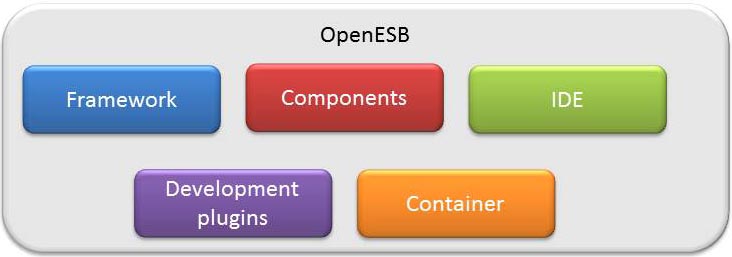
OpenESB consists of 5 parts: the framework, the container, the components, the Integrated Development Environment and the development plugins.
Framework
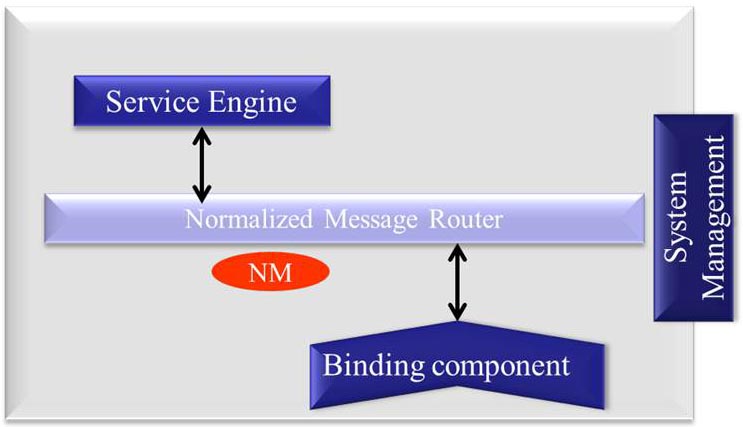
The framework consists of a lightweight JBI implementation in Java. This implementation is container-agnostic and can work on any platform and any container. Even if development and support are mainly focused on Glassfish V2 and V3 platforms, beta projects on JBoss and standalone JVM work well and are in progress (2012 Q2). In addition to the OpenESB framework being lightweight, it is also reliable and highly scalable. It is embedded in a Java virtual machine and communicates with other framework instances through Binding components. This architecture matches perfectly with new cloud architectures and allows easy deployment and management on very complex infrastructures. The framework is fully manageable with any JMX-based tool such as Jconsole or more sophisticated tools like Opsview or Nagios.
The framework implements a virtual bus known as the Normalised Message Router (NMR). This is a powerful asynchronous intelligent communication channel between components.
Components
The JBI specification defines 2 component types: The services engine (SE) and the binding component (BC). The SE and BC implement the same interface contract, however, they behave differently:
- Binding components act as the interface between the outside world and the bus, being able to generate bus messages upon receipt of stimuli from an external source, or generate an external action/interaction in response to a message received from the bus.
- Service engines receive messages from the bus and send messages to the bus. SE's have no direct contact with the outside world. They rely on the bus for interaction with other components, whether binding components or other service engines.
OpenESB includes many Components 'out of the box'.
OpenESB Binding Components
Binding Component Name |
Description |
Supported |
|---|---|---|
HTTP BC |
Sends and receives messages through HTTP (get, post,...) |
Yes |
SOAP BC |
Sends and receives SOAP messages through HTTP |
Yes |
FTP BC |
Sends and receives messages from and to FTP servers |
Yes |
Database BC |
Full access to Database through JDBC |
Yes |
JMS BC |
Sends and Receives messages from and to JMS Brokers |
Yes |
LDAP BC |
Full Access to LDAP server |
Yes |
Email BC |
Receives message from POP, IMAP servers and send messages to SMTP server |
Yes |
REST BC |
Exposes and Invokes services through REST channel |
Yes |
HL7 BC |
Used to communicate with Healthcare applications using the HL7 protocol |
Yes |
TCP/IP BC |
Use TCP/IP to send and receive messages |
Yes |
Scheduler BC |
Scheduler based on Quartz to trigger any business process |
Yes |
Bespoke BC |
You can develop your own Binding component |
On demand |
OpenESB Service Engines
Service Engine Name |
Description |
Supported |
|---|---|---|
BPEL SE |
Highly scalable orchestrator based on BPEL 2.0. |
Yes |
XSLT SE |
Embedded XSLT in Business processes |
Yes |
IEP SE |
Intelligent Event Processor |
yes |
POJO SE |
Transform any Java class into an OpenESB component |
Yes |
JEE SE |
Transform any EJB or Servlet into an OpenESB component |
Yes |
WLM SE |
Provides task management and human intervention in a business process |
On demand |
ETL SE |
ETL for OpenESB |
On demand |
Bespoke SE |
You can develop your own Service engine |
Yes |
Integrated Development Environment & Plugins
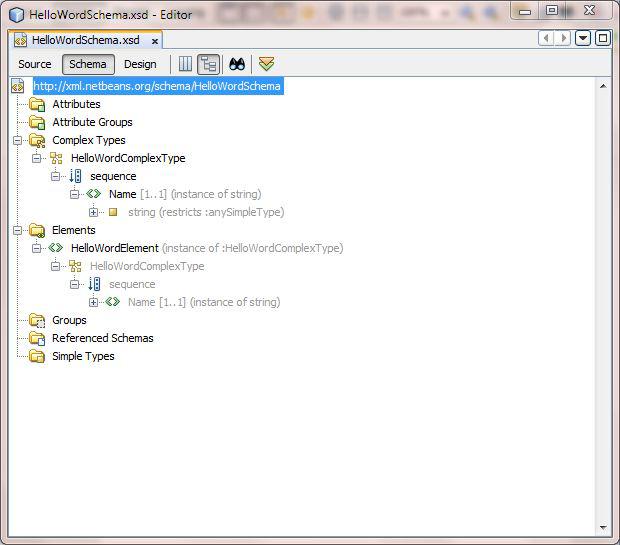
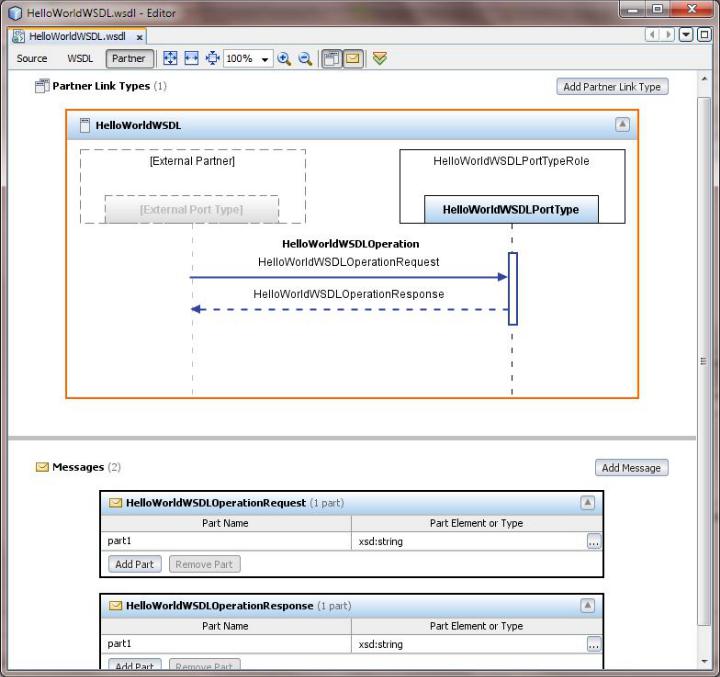
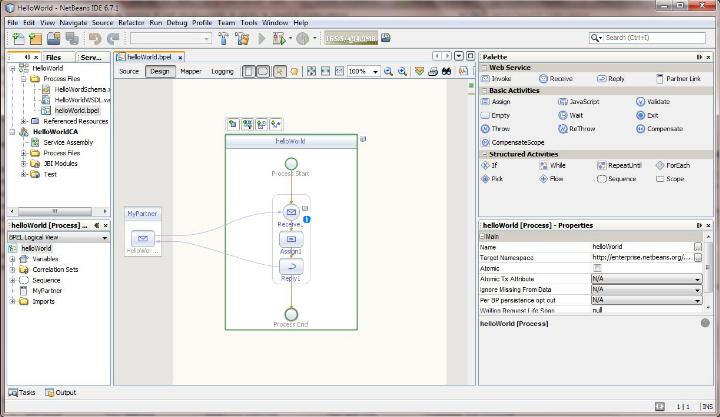
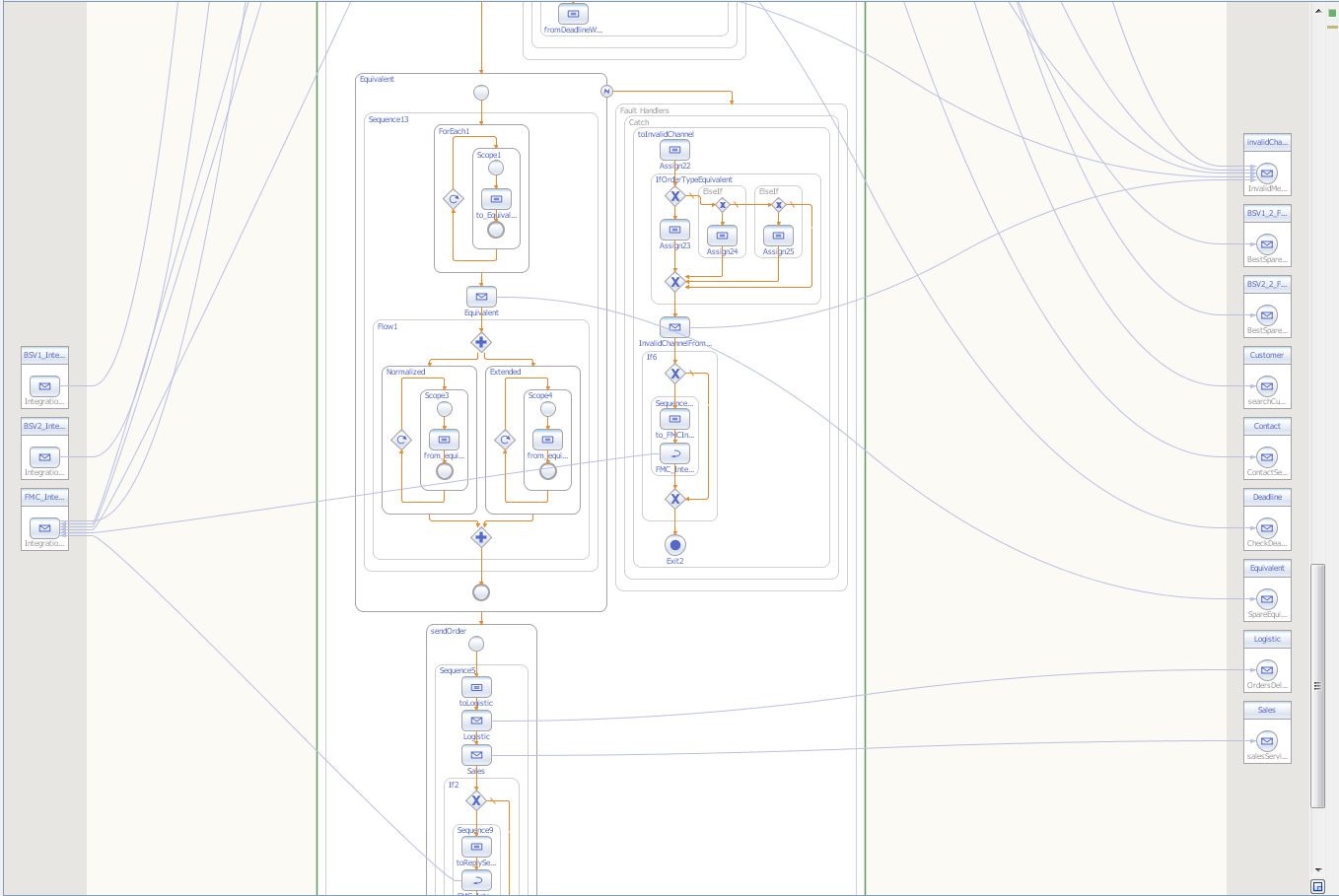
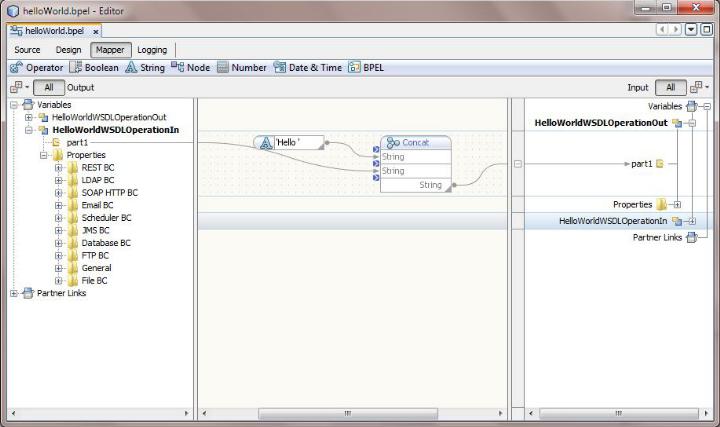
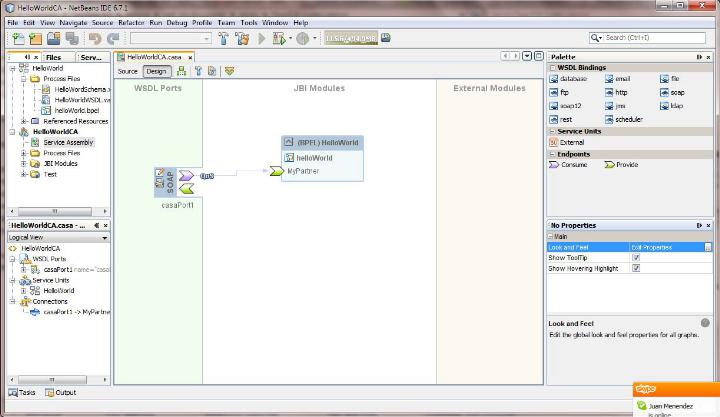
OpenESB offers a set of graphical tools to visualize complex SOA and integration developments. XLM, XML Schema, WSDL, BPEL editor, data mapping and Composition Applications graphical editors are proposed with OpenESB. Similarly, build, deploy, un-deploy, run, test and debug tasks are managed by graphical tools.
Container
OpenESB V3.1.2 does not use any container but just a JVM. So, its memory footprint is very low (less than 300 Mo) and allows OpenESB to run in a Raspberry PI or in a many instances on a cloud. Next versions are planned for 2019.
OpenESB community
The table below lists the web sites and forum managed by OpenESB community
Web site |
Description |
|---|---|
Info, Event Download, Documentation, Blog, Forum... |
|
All source code and builds: registration required |
|
Technical forum with thousands of posts |
|
Discussions on OpenESB |
See also
- Service-oriented architecture (SOA)
- Service Component Architecture (SCA)
- Apache Camel
- Apache CXF
- System integration
- Enterprise Service Bus
- Enterprise Integration Patterns
- Event-driven SOA
- Java CAPS
- eclipse sirius - Free and GPL eclipse tool to build your own arbitrary complex military grade modeling tools on one hour
- eclipse SCA Tools - Gnu free composite tool
- Free GPL obeodesigner made with eclipse sirius
References
Java Business Integration
External links
- OpenESB project
- Pymma OpenESB Enterprise Edition, Consulting, training, architecture design, development and Global 24x7 Support
- LogiCoy OpenESB Development, Consulting and Global 24x7 Support
- Youtube - NetBeans Open ESB SOA Tools, Composite Application, CASA
- Quick Start Guide to the NetBeans Open ESB CASA Editor
- https://soa.netbeans.org/