
Nalanda College Astronomical Society
The Nalanda College Astronomical Society (NCAS) was founded in 1995 in Nalanda College - Colombo, Sri Lanka, by a group of students at the college and is dedicated to promoting an interest in Astronomy, Space Science, Astrophysics and Amateur astronomy among the students and the public in Sri Lanka.
Membership of the Society
Membership of the Society is open to any student between grade 5 and 13 at the Nalanda College. Also there is an alumni association called Old Nalandian's Astronomical Society (ONAS) for those who wish to engage in public outreach even after they graduate. Members can participate in various activities organized by the society, including night sky observation events, weekly talks, quizzes, field trips to the Colombo Planetarium and Arthur C. Clarke Institute for Modern Technologies, which is a government institution dedicated to research and knowledge transfer.
Events
Weekly Lectures
The Society holds talks related to astronomy on every Friday during the school terms. These are conducted in two categories: junior and senior. Students in grades 5 to 9 attend the junior category while the students in grades 10 and above attend the senior one. These lectures cover a wide range of topics such as general astronomy, history of astronomy, rocket science, astrophysics, cosmology etc. These lectures are given by the senior students of the Society and also by the members of the alumni association who are in the universities in Sri Lanka.
Outreach Events
The Society is involved in a number of outreach events that brings Astronomy to the students as well as the public in Sri Lanka.
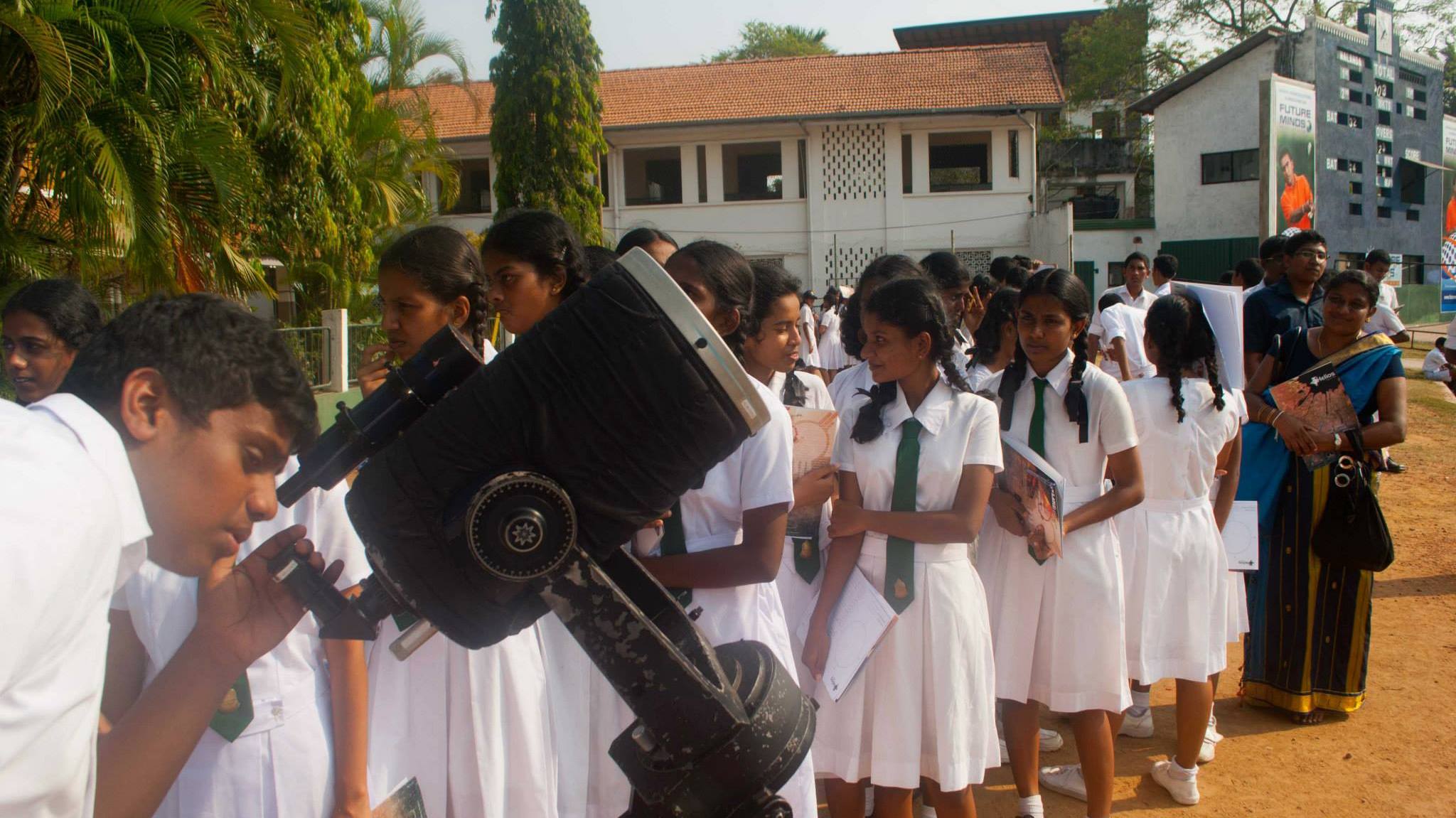
- From 1995, the Society has conducted more than 325 (as of 2017) night sky observation workshops in more than 70 schools all over the country.

- Society has conducted/participated in a number of exhibitions. In 1996 Society held the first inter-school astronomy exhibition in Sri Lanka. In the years 2000 and 2001 the Society took part in the exhibitions organized by the Sri Lanka planetarium. Again in 2006, the society organized another astronomy exhibition - "Nova 2006" with the participation of many school students in the Western Province. The Society has been participating in the annual education exhibition - Future Minds, from its commencement in the year 2006. Also, the Society has been invited to participate in number of education exhibition organized by other schools.
- From the year 2003, the Society holds an annual astronomy quiz competition for the Sri Lankan school students. This consists of an exam-type first round and trivia-type semi-finals and a final quiz, in which the winners obtain the "Dr. Padmajeeva Ganepola Challenge Trophy".
- "Helios" is another main program of the Society. It is an annual solar observation workshop where participating students have the chance to attend talks that focus mainly on the sun, solar energy, sun-earth relation etc., and to observe the sun using telescopes equipped with filters.
Structure
The structure of the Society consists of four major divisions.
Observation and Mapping
Since astronomy is an Observational science, the Society has been involved in extensive observational activities. Observing celestial objects through telescopes and making observation logs by mapping the features of the objects are done by the members in every night sky observation session.
Planetary observations
Surface and atmospheric features of the planets of the solar system such as Venus, Mars, Jupiter and Saturn are observable through telescopes. In the night sky observation sessions, members map these features on standard log sheets that are used to record such observations. Positions of the moons of Jupiter and Saturn, orientation of the rings of Saturn, Craters on the moon, dust tails of occasional comets are some of the features that are of major interest during these observations. 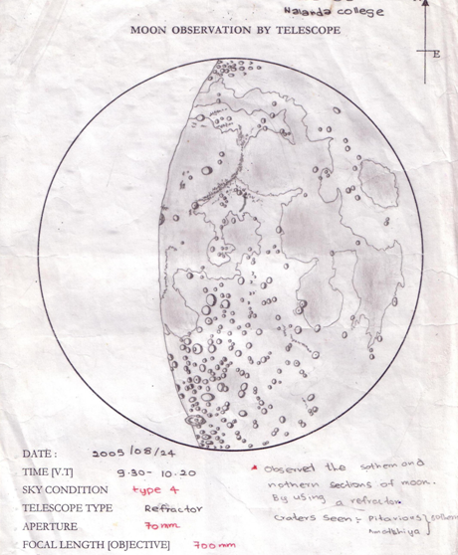
Stars
There are number of stars and star systems that are worth observing during the events. Records of double stars and variable stars made during the observation sessions provide useful information AbOUT the orbital periods of the stars and the intensity variation in time.
Deep Sky Objects
Nebulae, star clusters, distant galaxies, and supernova remnants are some of the noteworthy deep sky objects that are observed during the sessions. Sometimes the observed object's appearance is drawn in observation logs.
Sun
Sun has a number of different features such as sunspots, granulation and solar prominences that can be observed using special filters. During solar observation sessions, the members of the society takes records of the visible features, which can be used in later analysis to find solar rotation period, sunspot variation etc.
Outreach
Research and Experimenting
INSTRUMENTS
See also
- List of astronomical societies