
Nagar Barap
Nāgar Barap (; Nāgar Barap — "Nāgar" (नागर) meaning Urbane and "Barap" (बरप) literally "Writing" is an abugida alphabet of India. It was the predecessor of the Devanagari script It is written from left to right, does not have distinct letter cases, and is recognizable (along with most other North Indic scripts, with the Gujarati script being an exception) by a horizontal line that runs along the top of full letters.
Origins
Nāgar Barap is part of the Brahmic family of scripts of India, Nepal, Tibet, and South-East Asia. It is a descendant of the Gupta script, along with Siddham and Sharada. Eastern variants of Gupta called Nāgarī are first attested from the 8th century; from c. 1200 these gradually replaced Siddham, which survived as a vehicle for Tantric Buddhism in East Asia, and Sharada, which remained in parallel use in Kashmir. An early version of Devanagari is visible in the Kutila inscription of Bareilly dated to Vikram Samvat 1049 (i.e. 992 CE), which demonstrates the emergence of the horizontal bar to group letters belonging to a word.
Early epigraphy
- The earliest inscription in Konkani found in the village of Aravalem, in Goa dated back in the Gupta period in Brahmi script, ascribed to the 2nd Century AD. It reads:
on the top of Shacipura. The script is late Brahmi.
- Another inscription in Devanagari, of Shilahara King Aaparditya of the year 1166 AD says:
which could be transliterated as Ata tu jo konuyyre shasnolpi techya vedyanth devachi bhal sakutmbi apadem, techi may gadhavem
- The inscription found at Shravanabelagola mentions:
Chamundaraja got it done, Gangaraja got it done all around
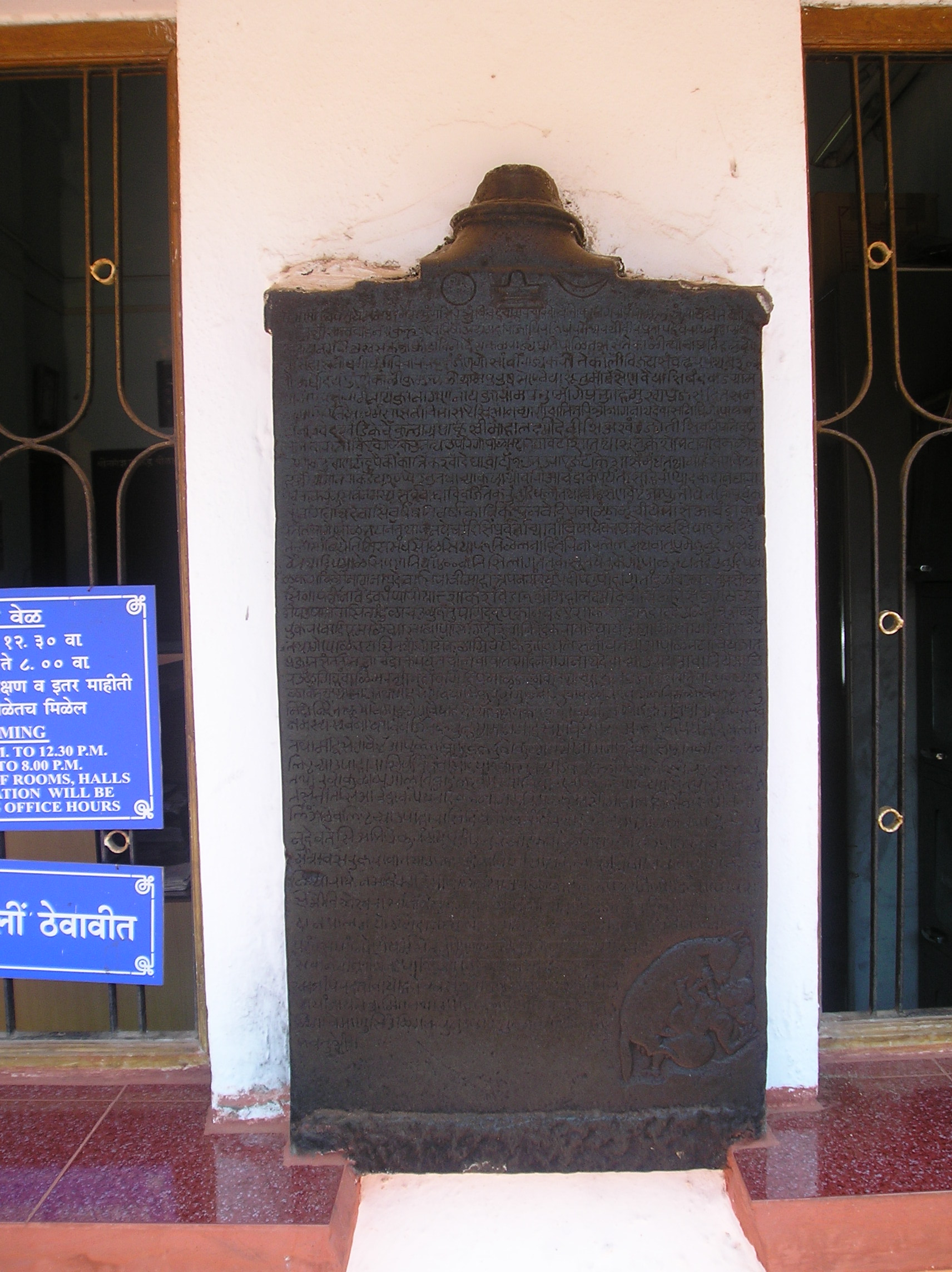
- However, most of the other stone and copper-plate inscriptions found in Goa and Konkan are written in an amalgam of Konkani and old-Marathi, written in Nagari as well as Goy-kanadi script. The grammar and the base of such texts is in Konkani, whereas very few verbs are in Marathi. One such stone inscription or shilalekh is found at the Nageshi temple in Goa (dating back to the year 1463 AD) mentions that the (then) ruler of Goa, Devaraja Gominam, had gifted land to the Nagueshi Maharudra temple when Nanjanna Gosavi was the religious head or the Pratihasta of the state. It mentions words like, kullgga,kulaagra, naralel, tambavem, tilel.
Structure
Phonology
The Konkani language has 16 basic vowels (excluding equal number of long vowels), 36 consonants, 5 semi-vowels, 3 sibilants, 1 aspirate and many diphthongs. Like the other Indo-Aryan languages, it has both long and short vowels and syllables with long vowels may appear to be stressed. Different types of nasal vowels are a special feature of the Konkani language.
- The palatal and alveolar stops are affricates. The palatal glides are truly palatal but other the consonants in the palatal column are alveopalatal.
- The voiced/voiceless contrasts is found only in the stops and affricates. The affricates are all voiceless and the sonorants are all voiced.
- The initial vowel-syllable is shortened after the aspirates and the fricatives. Many speakers substitute unaspirated consonants for aspirates.
- Aspirates in non-initial position are rare and only occur in careful speech. Palatalisation/non palatisation is found in all Obstruents, except for palatal and alveolars. Where a palatalised alveolar is expected, a palatal is found instead. In case of sonorants, only unaspirated consonants show this contrast, and among the glides inly labeo-velar glides exhibit this. Vowels show a contrast between oral and nasal ones
Vowels
 One of the most distinguishing features of Konkani phonology is the use of , the close-mid central vowel, instead of the schwa as used in Hindi and Marathi.
Whereas most Indian languages use only one of the three front vowels, represented by the Devanagari grapheme ए (IPA:), Konkani uses three: ए -, ऍ- and ऎ-.
Nasalizations exist for all vowels except for .
Consonants
|
Labial |
Dental |
Alveolar |
Retroflex |
Alveopalatal |
Velar |
Glottal |
|---|---|---|---|---|---|---|---|
Voiceless |
|
|
|
|
|
|
|
Voiced |
|
|
|
|
|
|
|
Voiceless |
|
|
|
|
|||
Nasals |
|
|
|
|
|
||
Liquids |
|
|
|
| |
|
|
Letters
Vowels and Vowel Marks
Independent form |
Romanised |
As diacritic with प |
Independent form |
Romanised |
As diacritic with प |
||
|---|---|---|---|---|---|---|---|
Guttural |
अ |
a |
प |
आ |
ā |
पा |
|
Palatal |
इ |
i |
पि |
ई |
ī |
पी |
|
Labial |
उ |
u |
पु |
ऊ |
ū |
पू |
|
Retroflex |
ऋ |
ṛ |
पृ |
ॠ |
ṝ |
पॄ |
|
Dental |
ऌ |
ḷ |
पॢ |
ॡ |
ḹ |
पॣ |
|
Palato-Guttural |
ऍ |
ê |
पॅ |
||||
Palato-Guttural |
ऎ |
e |
पॆ |
ए |
ē |
पे |
|
Labio-Guttural |
ऒ |
o |
पॊ |
ओ |
ō |
पो |
|
Diphthong |
ऐ |
ai |
पै |
औ |
au |
पौ |
|
Consonants
स्पर्ष |
||||
|---|---|---|---|---|
Voicing → |
अघोष |
|||
Aspiration → |
अल्पप्राण |
महाप्राण |
||
कंठ्य |
क |
ka |
ख |
kha |
तालव्य |
च |
ca |
छ |
cha |
मूर्धन्य |
ट |
ṭa |
ठ |
ṭha |
दंत्य |
त |
ta |
थ |
tha |
औष्ठ्य |
प |
pa |
फ |
pha |
Others |
च़ |
tsa |
ज़ |
||||||
|---|---|---|---|---|---|---|---|---|---|
Separation of e - ē and o - ō
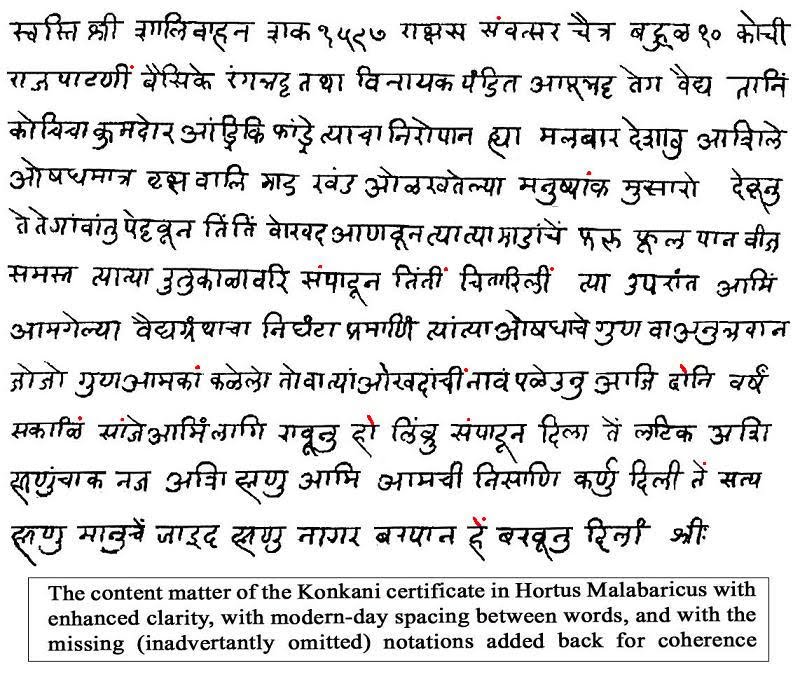
Earlier, Dravidian languages like Indo-Aryan languages, did not make a distinction between the two. The addition of extra signs for /eː/ and /oː/ is attributed to the Italian missionary Constanzo Beschi Vīramāmunivar (1680–1774), who first added it to Tamil. It later passed onto Malayalam, Kannada, Telugu and lastly to the Konkani script. Currently, e, ē, o, ō are transliterated as ऎ, ए, ऒ and ओ respectively.
Schwa Deletion
 The Schwa deletion or Schwa syncope phenomenon plays a crucial role in Konkani and several other Indo-Aryan languages, where schwas implicit in the written scripts of those languages are obligatorily deleted for correct pronunciation. Schwa syncope is extremely important in these languages for intelligibility and unaccented speech. It also presents a challenge to non-native speakers and speech synthesis software because the scripts, including Nagar Barap, do not provide indicators of where schwas should be dropped.
This means the schwa ('ə') implicit in each consonant of the script is "obligatorily deleted" at the end of words and in certain other contexts, unlike in Sanskrit. This phenomenon has been termed the "schwa syncope rule" or the "schwa deletion rule" of Konkani. In other words, when a vowel-preceded consonant is followed by a vowel-succeeded consonant, the schwa inherent in the first consonant is deleted. However, this formalization is inexact and incomplete (i.e. sometimes deletes a schwa when it shouldn't or, at other times, fails to delete it when it should), and can yield errors. Schwa deletion is computationally important because it is essential to building text-to-speech software for Konkani. Without the appropriate deletion of schwas, any speech output would sound unnatural.
As a result of schwa syncope, the Konkani pronunciation of many words differs from that expected from a literal Sanskrit-style rendering of Devanagari. For instance, करता is kartā not karatā, आपंयता is āpaytā not āpayatā', वेद is Véd not Véda and मिरसांग is mirsāng not mirasānga.
For instance, the letter sequence ळब is pronounced differently in मळब maḷab sky and मळबार maḷbār in the sky . While native speakers correctly pronounce the sequences differently in different contexts, non-native speakers and voice-synthesis software can make them "sound very unnatural", making it "extremely difficult for the listener" to grasp the intended meaning.
Vowel nasalization
With some words that contain /n/ or /m/ consonants separated from succeeding consonants by schwas, the schwa deletion process has the effect of nasalizing any preceding vowels. Some examples in Konkani include -
- jevaṇ=> jenvlo
Konkani Schwa Rules
- The final inherent अ is generally omitted. e.g. देव is dēv not dēva.
- In a word of three letters ending with a vowel other than the inherent अ the second consonant, if it ends in अ, then the अ of the second consonant is silenced. e.g. चॆरकॊ is cherko not cherako
- In a word of four letters ending with a vowel other than the inherent अ the second consonant, if it ends in अ, then the अ of the second consonant is silenced. e.g. उपकार is upkār not upakāra
- Verb roots always end in a consonant even if they undergo declination. e.g. आपंव +चॆं= आपंवचॆं, hence we say āpanvchem not āpanvachem, आपंय+ता=आपंयता, hence we say āpanytā not āpanyatā