
Milan–Gorgonzola–Vaprio Tramway
The Milan–Gorgonzola–Vaprio tramway was a line of the Milan interurban tramway network, the first of its type in Italy to be operated by steam power, which connected Milan to Vaprio d'Adda between 1878 and 1978.
History
The first project for a horsecar railway connecting Milan to Vaprio d'Adda was proposed by engineers Radice and Manara to the Milan Provincial Deputation on 22 February 1877. Their idea was to branch the line from the Milan–Monza tramway, constructed the previous year, at the Porta Venezia gate, and then continue along Corso Buenos Aires and Viale Padova, passing through Crescenzago, Vimodrone, Cernusco sul Naviglio and Gorgonzola.
On 14 August of the same year, the Società Anonima del Tramway Milano-Gorgonzola-Vaprio (MGV) was established, which on 11 November obtained a fifty-year concession from the province of Milan to build the line. In exchange, MGV committed to completing the project up to Gorgonzola within the first twelve months, building the remaining section to Vaprio in the following six months.
On 28 January 1878, the Provincial Council granted permission to apply steam traction both to MGV and to the company operating the Milan–Saronno–Tradate tramway. In the following month, the project was adapted to the specifications of the new traction type, and work began. On 6 June, the tramway was inaugurated along the entire route, while regular service opened two days later. The operation with road-going steam locomotives on the Milan–Saronno line began only on 26 June, making the Milan–Vaprio tramway the first in Italy to use this new type of traction.
MGV benefited from the experiments conducted by its competitor on the Milan–Saronno line and purchased ten locomotives, forming its rolling stock fleet, from the main manufacturers of the time: Brown, Krauss, Henschel & Sohn, Fox Walker and Bamat, later Cerimedo & C.
The MGV and TIP years
In 1880, the Milan–Vimercate Tramway was branched off from the Cascina Gobba station, also granted to MGV, while the line to Treviglio branched off from Villa Fornaci, whose operation was entrusted to the group led by Ferdinando Pistorius.
Between 1882 and 1884, the concession for the Milan–Vaprio line was acquired by the Società Anonima dei Tramways Interprovinciali di Milano, Bergamo e Cremona, also known as Tramvie Interprovinciali Padane (TIP). During 1882, the Milan terminus was moved from Porta Venezia to the TIP station in Viale Montenero, extending the route by approximately .
In 1918, TIP initiated 600 V direct current electrification on the section between Milan and Crescenzago in order to establish a suburban support service. The high passenger demand along that section, characterized by heavy urbanization and shared with the line to Vimercate, prevented the tramway company from applying an optimal train composition. A high number of carriages resulted in underutilization of the trams beyond Crescenzago. However, steam traction was unsuitable for short distances: rapid vehicles, thus electrically driven, were needed to cover the highest number of trips with few trainsets. For this reason, the series A.1–A.4 railcars were prepared.
STEL and electrification
In 1926, pursuant to Royal Decree No. 1565 of 29 July 1926, the Convention was approved by which the Società Trazione Elettrica Lombarda (STEL) obtained the concession for several TIP lines, including Milan–Vaprio, with the option to electrify them.
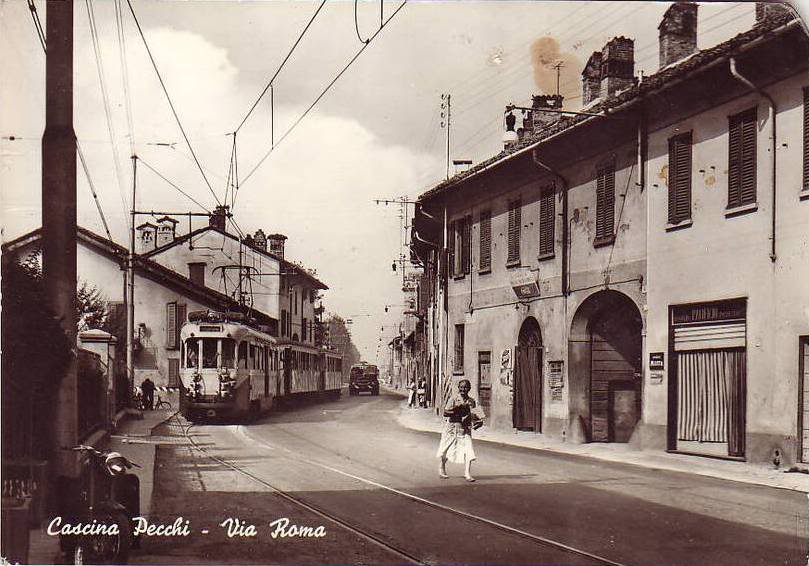
The electrification process proceeded in several phases. STEL decided to apply a voltage of 1,200 V direct current, retaining 600 V only on the section up to Crescenzago. For this section, facilities were upgraded, doubling the track both along current Via Padova and within Crescenzago, and building the Molino Nuovo depot. Beyond Crescenzago, the line continued as single-track, but on a reserved right-of-way separated from the provincial road (the current Strada statale 11 Padana Superiore). Shared right-of-way running was maintained only through the inhabited centers of Cassina de' Pecchi and Gorgonzola.
On 21 October 1928, electric service was inaugurated between Milan and Gorgonzola, while on 24 May of the following year the Molino Nuovo depot came into operation. At the same time, the TIP tramway station on Via Montenero was abandoned following the temporary transfer of the Milan terminus to the Milan–Monza terminus located at Porta Venezia. Only on 15 August 1931 was the section converted to electric traction between Gorgonzola and Villa Fornaci, coinciding with the opening of the new Gorgonzola depot, while Vaprio was reached on 20 October. On the same day, the Milan terminus was transferred to Via Benedetto Marcello.
ATM operation
 The Milan municipal utility's program to reconfigure urban and interurban tram infrastructure to optimize service was postponed due to World War II. The conflict led to progressive service disruptions and reduced trips, initially due to a lack of spare parts and later, following bombings of urban depots, damage to rolling stock.
Problems persisted in the post-war period, mainly due to insufficient rolling stock relative to passenger demand. Passenger traffic growth, driven by suburban urban sprawl, was accompanied by a decline in freight transport, which was discontinued on the Vaprio line on 1 March 1951. In the mid-1950s, twelve dual-voltage units of the 501–512 series were introduced, and it is documented that to handle peak-hour passenger volumes, train lengths reached up to .
The start of construction on Line 1 of the Milan Metro affected Piazzale Loreto, so in 1957 the terminus of the Adda lines was moved to Piazza Aspromonte. Two years later, the new double-track section on a reserved right-of-way along Via Palmanova between Piazzale Sire Raul and Cascina Gobba was activated. It replaced the shared right-of-way along Via Padova, which was retained until the following year for local service to Crescenzago. On the new alignment, the section from the Molino stop—located behind the ATM depot—to Cascina Gobba was energized at 1,200 V. As a rolling stock depot replacing Molino Nuovo, which was being decommissioned, the Leoncavallo depot was used.
The Adda express lines and closure of the tramway
During the 1950s, the Adda tramway lines, especially the one to Vaprio d'Adda and its branch to Cassano d'Adda, revealed their infrastructure limitations. Single-track sections prevented increasing peak-hour trips, while shared running in urban areas caused traffic congestion for both trams and road traffic. In 1957, ATM presented a project to the Ministry of Transport for railway lines, named Adda express lines, intended to replace the corresponding tramway lines. Regarding the Vaprio line, the initial project planned its replacement with a double-track railway connecting Milan to Bergamo via Villa Fornaci and Trezzo sull'Adda.
The Ministry of Transport, by decree of 31 December 1959, No. 4285, authorized the construction of the Milan–Cascina Gobba–Gorgonzola section, the only portion feasible with the limited funds remaining under Law 1221/1952. One immediate advantage for the Vaprio tramway was the availability between 1961 and 1965 of rolling stock that would later be used on the express lines after completion of construction. ATM decided to overhaul the existing fleet to cut costs by rebuilding Costamasnaga trailer cars and constructing three-car permanently coupled sets, known as bloccati, consisting of a center motor car and two driving trailers at each end.
In 1968, upon completion of the Cascina Gobba–Gorgonzola section, the decommissioning of the old infrastructure began. On 3 February, the Piazza Aspromonte terminus was closed and replaced the following day by Piazzale Sire Raul, where express line operations were based. Between February and April, tram wheelsets on the bloccati were replaced with railway wheelsets featuring higher flanges to allow the speeds permitted on the express lines. On 5 May, the Milan–Gorgonzola line was inaugurated, and the next day the old tram route was closed: the bloccati ran on the new line, returning to tramway tracks only after the depot, which had been completely renovated as a maintenance facility for the express line.
Following the decision to integrate the express line into Line 2 of the Milan Metro, on 3 December 1972 the operation of the bloccati between Milan and Gorgonzola station ceased. The Gorgonzola–Vaprio section survived in this state until 1 February 1978, when ATM decided to close it and replace it with a bus service. Some bloccati sets were transferred to the Brianza tramways ( and ).
Characteristics
The original line
The original line was long and ran on a shared right-of-way along the city wall road, Viale di Loreto (now Corso Buenos Aires), the road to Crescenzago, and finally the current Strada statale 11 Padana Superiore, passing through settlements to Vaprio d'Adda. Double-track sections were located along the ring boulevard and Viale di Loreto; the latter section was also shared with the Milan–Monza tramway.
Along urban sections, Marseillon rails were used, measuring long and weighing with counter-rails of . On interurban sections, Vignoles rails measuring long and weighing were used, joined by suspended joints.
Traction was originally by steam. Starting in 1918, 600 V direct current electric traction was applied solely to the section between Porta Venezia and Crescenzago, using the technical specifications standard on the Edison urban and interurban network. Trains running along the full route remained hauled by steam locomotives, while the overhead line section was reserved for local Milan–Crescenzago trams.
The electrified line
Most of the line was moved to a reserved right-of-way alongside the original road, protected by a curb: only short sections along Via Padova and the town center passages through Crescenzago, Cassina de' Pecchi and Gorgonzola remained on a shared right-of-way. In addition, the track on Via Padova was doubled up to the new Molino Nuovo depot, as was the section within Crescenzago. The stop serving this borough was also equipped with a siding for local suburban trams.
Regarding trackwork, Phoenix grooved rails weighing were used in shared sections. On reserved right-of-way sections, three types of Vignoles rails were applied, differing in weight: , , and . Oak ties were used for the latter, while metal ties were used for Phoenix rails, except near the passing siding at Villa Fornaci, where reinforced concrete ties were introduced experimentally.
The voltage chosen by STEL was 1,200 V DC, which guaranteed higher power. However, STEL decided to retain the original 600 V traction on the section up to Crescenzago; the voltage transition took place at Tre Case. Power was supplied by two electrical substations: one at Cascina Gobba and the other at the Gorgonzola depot.
The line's length progressively decreased as the terminus was moved away from the city center: it was long when based on Via Benedetto Marcello (1931), reducing to with its move to Piazza Aspromonte (1957). During the few months in which the terminus was located at Piazzale Sire Raul (February–May 1968), the length dropped to .
See also
- Milan Metro Line 2
- Milan–Gallarate Tramway
- Milan–Saronno–Tradate Tramway
- Milan–Vimercate Tramway
- Fornaci–Treviglio–Caravaggio Tramway