Mercury - Redstone
The Mercury-Redstone system
The Mercury-Redstone[http://www.robsv.com/cape/c5lv.html]or MR system was a merger of the Project Mercury manned spacecraft1 and the Redstone (rocket) booster2. The entire combined vehicle made a strictly suborbital spaceflight package and was America's first manned spacecraft. Originally Project Mercury was intended to fly atop an Atlas rocket but development problems delayed the Atlas. The Redstone booster was adapted as an interim measure to get America's space program "off the pad". |
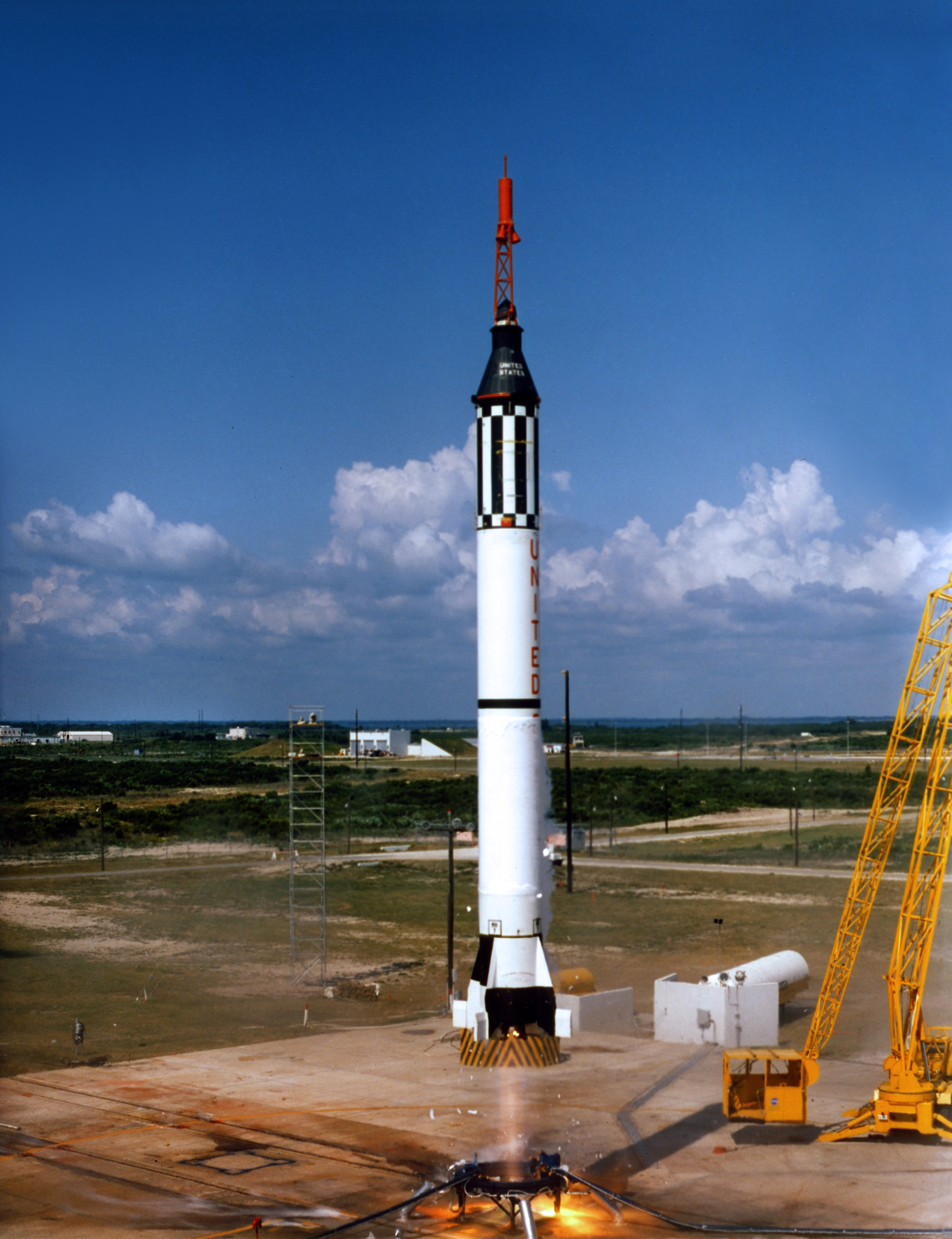
|
MR-3, named Freedom 7, gets America "off the pad" |
The Redstone booster:
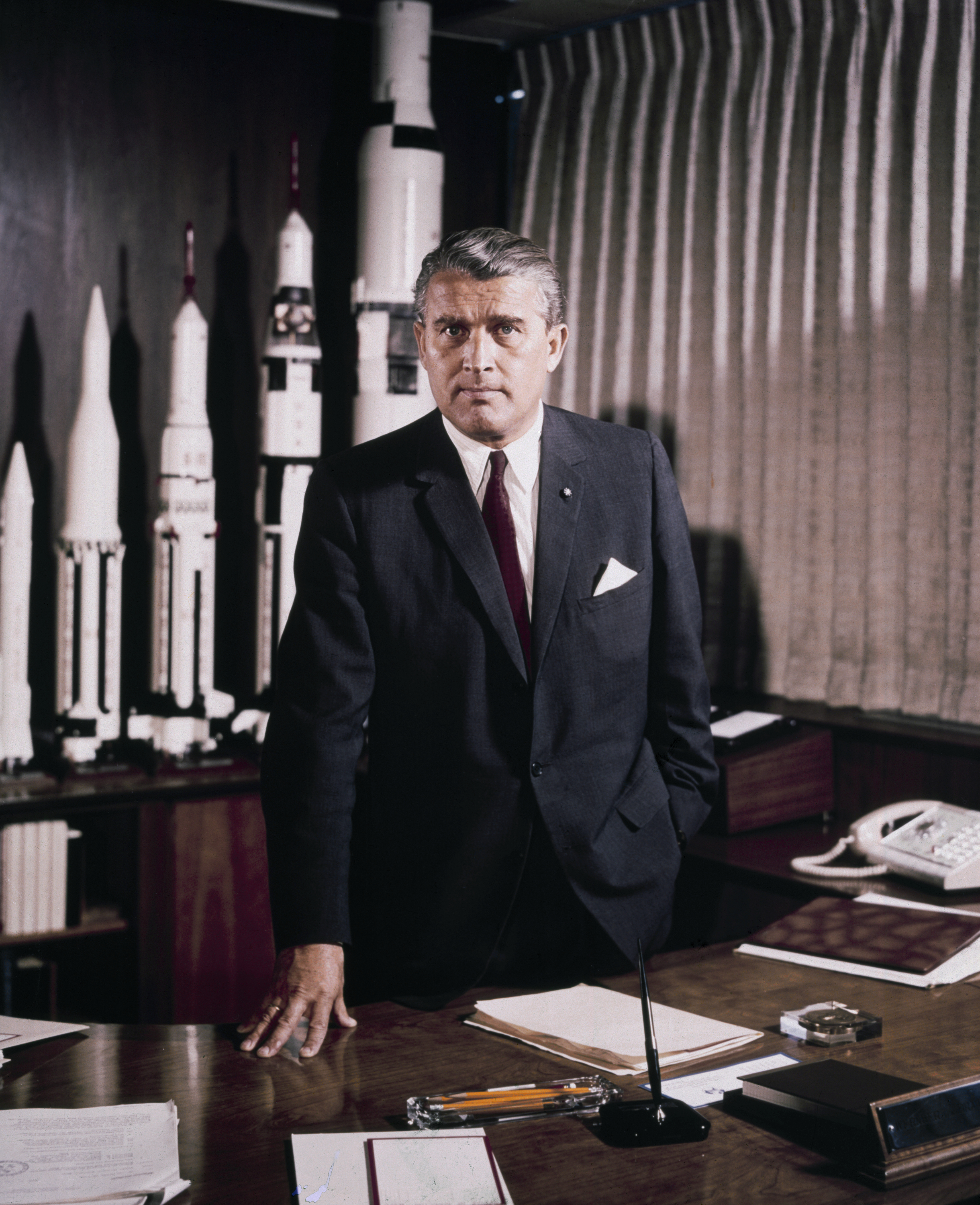
Redstone booster is named for the U.S. Army's Redstone Arsenal in Huntsville, Alabama where the booster was developed by Dr. Wernher Von Braun3 and his team of expatriate German engineers.
Dr. Wernher von Braun |
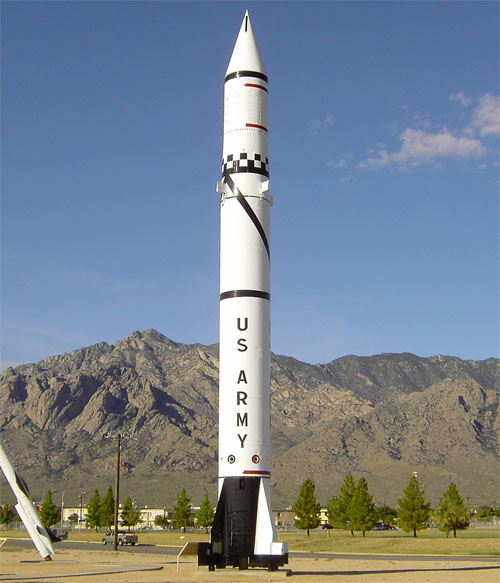
A Redstone rocket |
|
|---|---|---|
|
|
The booster was a direct descendant of Germany's V-2 rocket. Although the technology itself was derived from the German rocket program, the Redstone project came out of America's project Hermes. Project Hermes was a program started by U.S. Army Air Force General Henry H. Arnold in 1943, during, not after, the second world war. Project Hermes was essentially a research project. Based on known German advances, it determined the potential for military rockets. |
The Redstone missile was a LOX/Alcohol Fueled, medium range nuclear missile developed for the U.S. Army. It was intended as a battlefield nuclear missile. It was not an Intercontinental Ballistic Missile (ICBM). Although greatly improved over its V-2 predecessor, the Redstone booster was not a radical leap forward in technology. It was, however, highly adaptable and, by the standards of the day, very dependable (it earned the nickname "old reliable").
Manufactured by Chrysler, the Redstone booster was used by numerous spaceflight systems. In addition to the Army's Redstone nuclear missile, it was also the core of the Jupiter (missile), Jupiter-C, Juno I4, Juno II5, Mercury-Redstone, Saturn 1 and Saturn 1B systems (which actually used a cluster of eight H-16 version Redstone boosters). One reason for this was, in addition to being reliable and adaptable, the Redstone booster possessed great development potential.
A three stage variant of the Redstone missile called the Jupiter-C was used for testing the re-entry nose cones of the Jupiter IRBM. A modified version called the Juno I was the system used to launch Explorer 1 (Amercia's first satellite). It was basically a four stage version of the Jupiter-C. The fourth stage was a single Sargent rocket motor in the base of the explorer satellite.
The Mercury spacecraft (capsule):
| |
Crew: |
Recovery method: |
Mission type: |
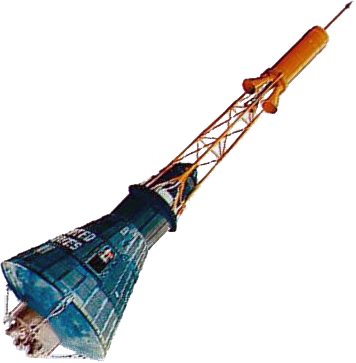
The Mercury spacecraft was named for the Roman god Mercury. It was a single seat spacecraft manufactured by the McDonnell-Douglas Corporation in St. Louis, MO. It was a black, inverted funnel-shaped capsule made largely of titanium with an ablative heatshield on its bulbous bottom. It had a tall red escape tower (a framework extending from its nose with a solid rocket booster and an aerodynamic probe on top) mounted on the front which could pull the capsule to safety if the booster malfunctioned.
The capsule had a window for the astronaut-pilot (a round porthole on the First One and a rectangularish, truncated cone all later ones). It also had a retractable periscope for viewing the Earth, a fly-by-wire system, and an escape hatch with explosive bolts.
The recovery system was a parachute followed by a water landing. The vehicle was designed to float and to be picked up by helicopter.
The Mercury-Redstone system (Technical data):
The Mercury capsule is larger in diameter at its base than the Redstone booster's 70 inch diameter. This caused a potruding ring around the rocket where they meet. This was not intentional but had to be contended with. The small size of the Mercury capsule already limited the height of an astronaut to 5',11".
The first manned mission went 115 miles high, 302 miles down range at a top speed of 5100 miles per hour. The system is 83.38 feet tall. Booster diameter is 70 inches. The entire section below the capsule is 59 feet and is made up of a 11.84' equipment section directly under the capsule and the rest being a power section made up of fuel tank and rocket motor.
It had a 78,000 pound sea level thrust, ethyl-alcohol and liquid oxygen, Rocketdyne A-7 motor The fuel system was run by a hydrogen peroxide driven fuel pump. Unlike later rockets, it was freestanding on the pad. There were no hold down bars. Due to the weights and flight profile, the natural bending frequencies of the rocket body were actually less than the nuclear missile version.
A brief history of the Mercury-Redstone system:
The MR system is one of the prettiest systems ever put on a launchpad. Its beautifully contrasting black and white markings made tracking it easier. The red escape tower adds a bright dash of color to its overall symmetrical lines. The black and white scheme dates back to Fritz Lang's 1929 silent movie "Frau Im Mond" (Lady in the Moon), a German science fiction movie which influenced many of the Geman rocket scientists who designed the Redstone booster. The markings on the fictional rocket resemble those of the V-2 and Mercury Redstones.
There were to be two unmanned MR flights followed by a chimpanzee flight, then three manned MR flights. The first two manned flights were Mercury-Redstone flights MR-3, whose capsule was named Freedom 7, and MR-4, whose capsule was named Liberty Bell 7. The third manned mission was cancelled after the first two were deemed successful to the point that a third flight was unnecessary. The program then proceeded to Mercury-Atlas or "MA".
Although designed as an orbital vehicle, the Mercurys used in Redstone flights were all suborbital test missions. The Redstone booster simply did not have the power to get a manned platform into orbit. Though a successful system overall, the Mercury-Redstone system was not trouble free.
In one of the greatest ironies of manned spaceflight, the MR system was up and running ahead of Russia's Vostok. The American system had only been held back by bureaucratic conservatism, inter-service rivalry, a lack of push by some in the government and the fact that the USA did not realize how advanced the Russian manned program was.
The first Mercury passenger
The first manned flight of a Mercury-Redstone was planned to take place following a primate flight. Despite this, the first America manned flight was still scheduled to take place before the first Russian manned spaceflight (this was unknown in America at the time).
During Mercury-Redstone 2, a chimpanzee flight, the capsule had a few problems. One was the escape tower which failed to disconnect prior to its scheduled jettisoning. When the rocket motor in the escape tower fired, it took the spacecraft higher into space and further downrange than planned. The tower then released and allowed a safe, albeit rough, return to earth. After splashdown the capsule began to take on water but was retrieved safely.
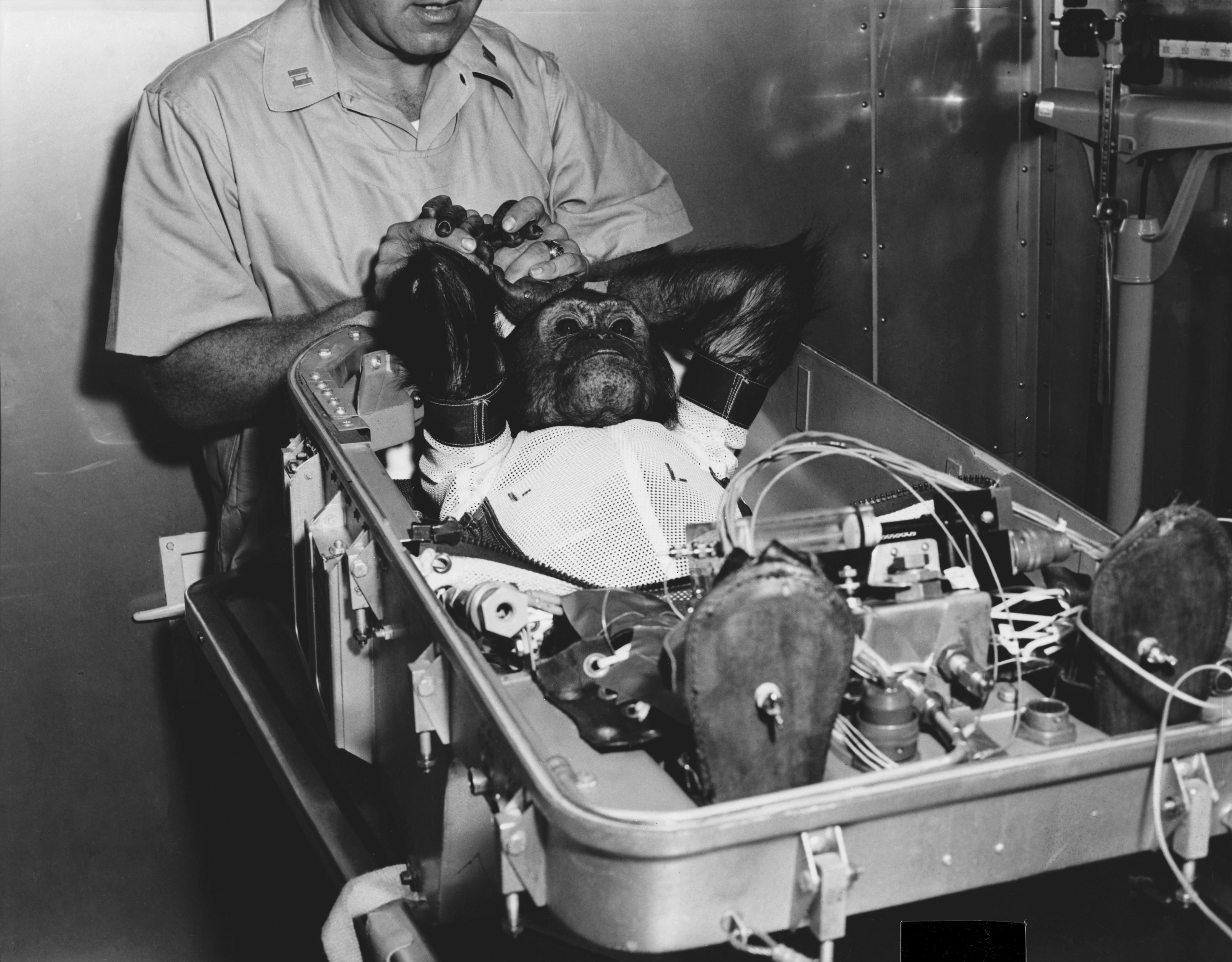
The problems were quickly isolated and corrected. The program was ready to proceed to manned flight but Dr. Von Braun wanted another test flight before sending up a man. This was designated Mercury-Redstone BD. The flight went well and the program was green lighted for a manned mission but in the meantime the Russians sent Cosmonaut Yuri Gagarin into space. The space race was on.
First manned flight
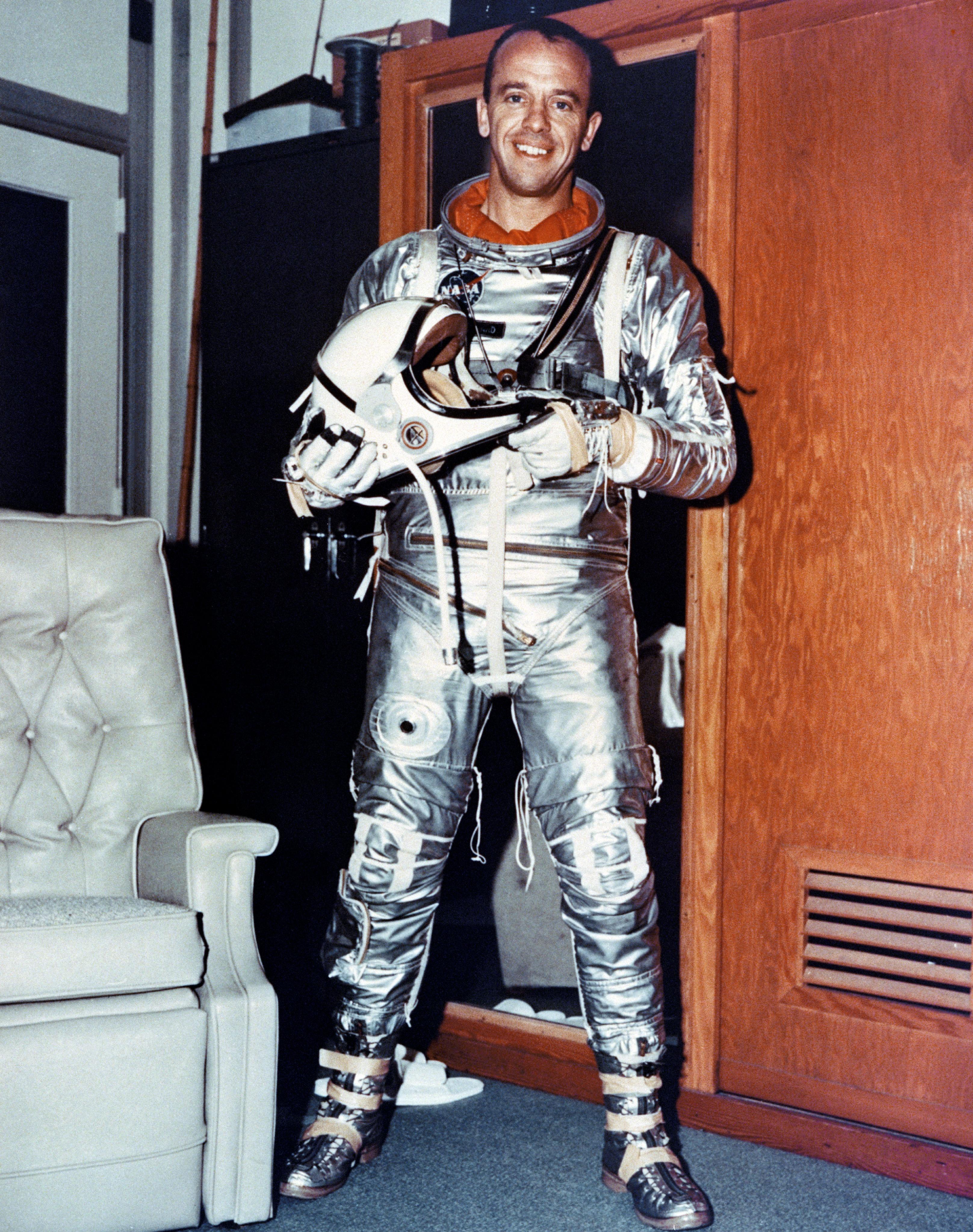
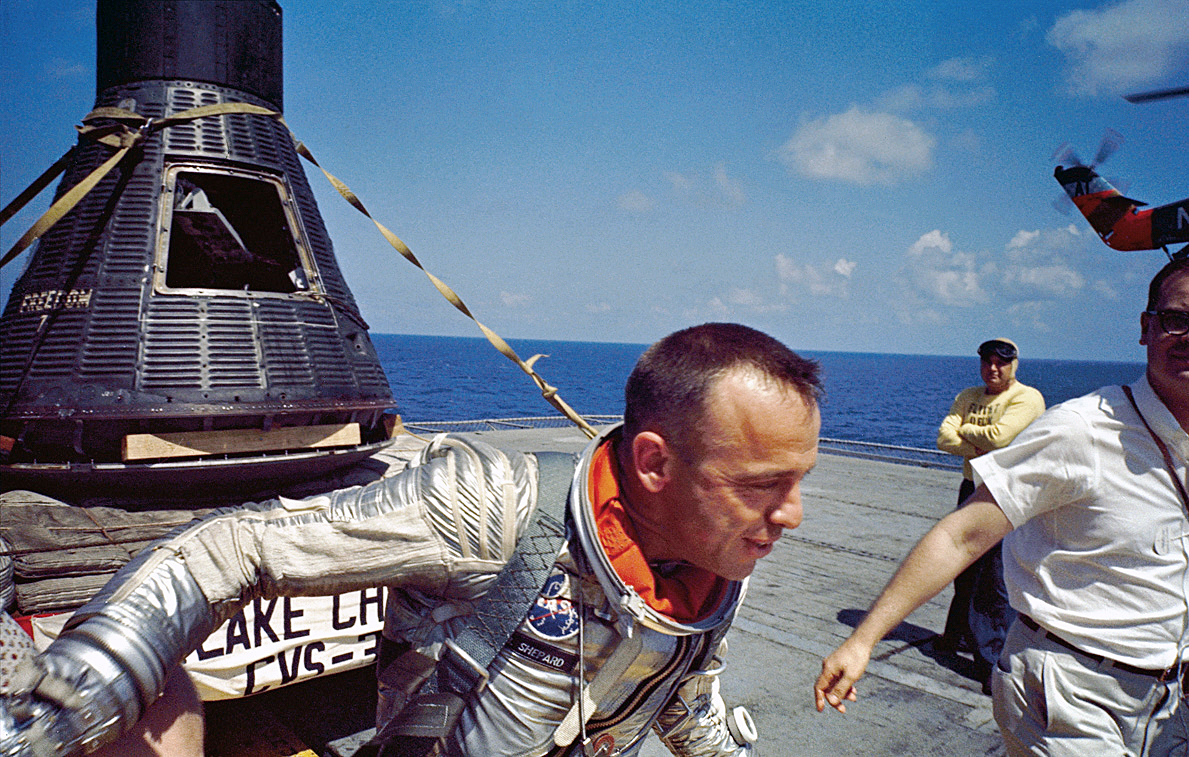
The first manned flight of a Mercury was on May 5 1961. It was piloted by U.S. Navy Commander Alan Shepard.
Shepard was a graduate of the U.S. Naval Academy and the son of a Navy Admiral. This first manned flight actually went up between two chimpanzee flights. This got Shepard teased by his peers as "the missing link between ape and man". Regardless of peer taunts (and no doubt envy), Shepard had helped restore U.S. pride and prestige.
Shepard before flight |
Shepard in Freedom 7 |
Pilot & craft after recovery |
|---|---|---|
|
|
|
May 5 1961 |
Prep for launch |
A space faring nation at last |
Mercury lost
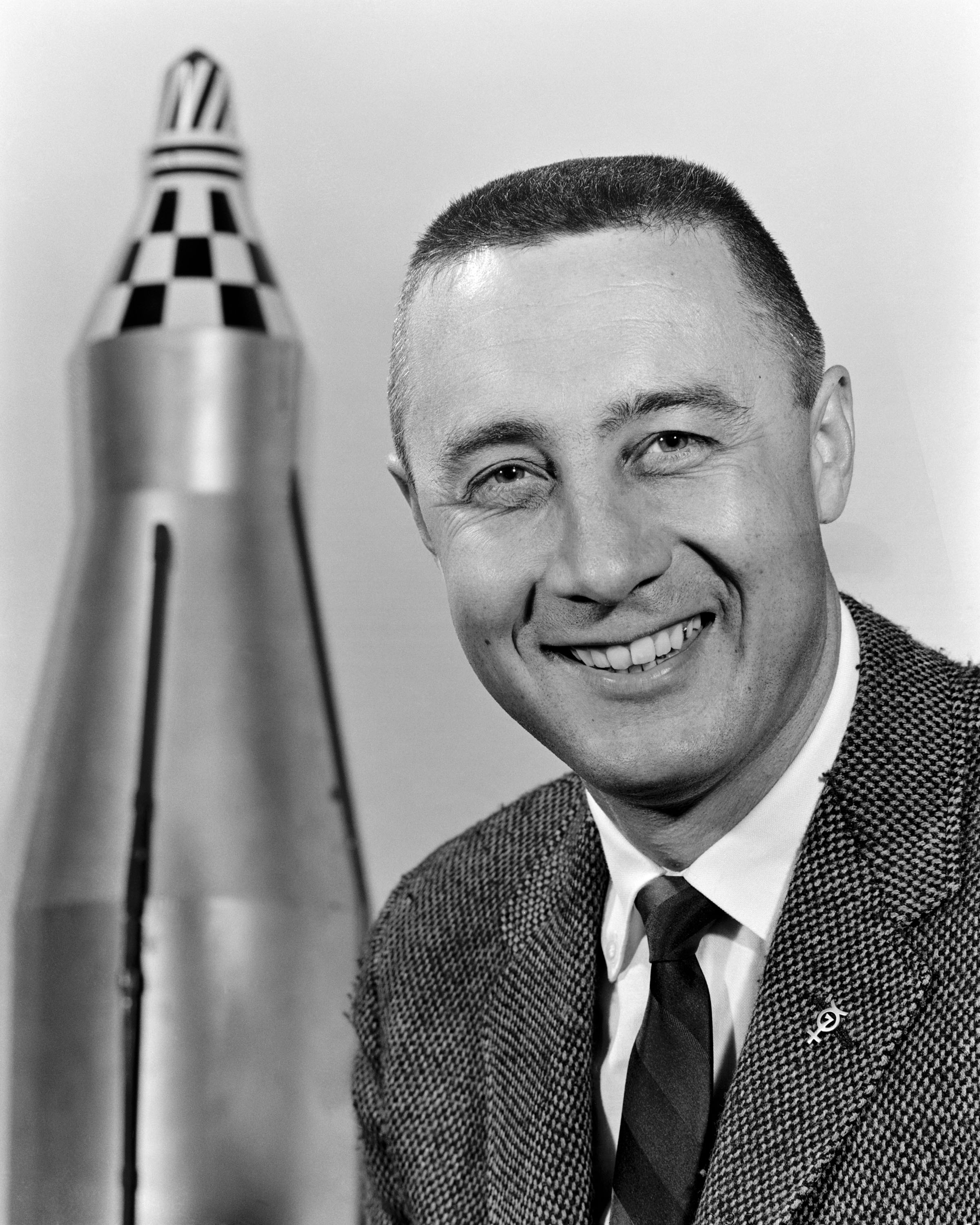 The second and last manned Mercury-Redstone to fly was lost after the explosive bolts in the hatch fired following splashdown. The capsuled filled with water and sank in 15,000 foot deep water off The Turks and Caicos islands. Its pilot, astronaut Gus Grissom, barely escaped. This would prove to be only the first of several tragedies that would haunt the nascent space program and Grissom in particular.
As time went by and the programs became more ambitious the disasters would get worse. At least in Mercury, there was no loss of life on a mission.
Grissom's Mercury spacecraft, Liberty Bell 7, was recovered from the ocean floor in July 1999 and has been restored by the Kansas Cosmosphere in Hutchinson, KS. All evidence points to a malfunction in the door jettison system, not pilot error as was often suspected.
Sadly, Grissom would perish in the fire of Apollo 1 on 27 January 1967.
After Mercury-Redstone
|
Callsigns: |
Astronauts: |
Mission type: |
After MR-4, the Mercury spacecraft were launched by Atlas boosters. These were the MA series. These were also the first orbital Mercury missions. There were four manned MA missions. Flown by astronauts John Glenn (the first American to orbit the earth), Scott Carpenter, Wally Schirra and Gordon "Gordo" Cooper, these missions were the last time NASA sent an astronaut into space alone.
After Project Mercury came Project Gemini, also made by McDonnell-Douglas. Gemini was a follow on to Mercury and was a critical program that built on the lessons of Mercury. Gemini was one of the best run space programs in history having no fatalities during missions and having only one mission cut short. Gemini, a direct descendant of Mercury, had great potential for expansion but was dropped after Apollo came online. Many of the great plans for Gemini such as the manned orbital laboratory (MOL) and a seven seater called Big G were never brought to maturity.
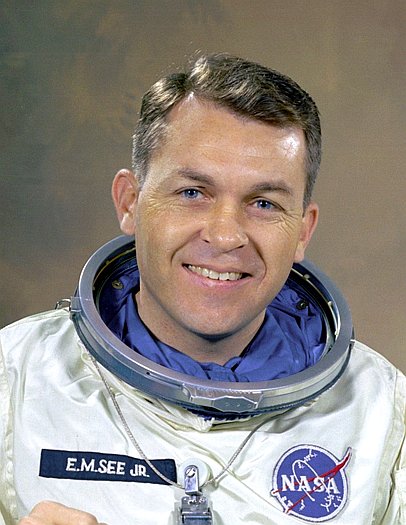
During Project Gemini, NASA had its first highly public tragedy. It occurred on February 28 1966 when the actual building where the spacecraft were being built was struck by a NASA T-38 piloted by the crew of Gemini 9, astronauts Elliott M. See Jr. and Charles A. Bassett II. Both astronauts were killed in the crash which impacted in the parking lot after striking the building. The crash was weather related as the astronauts tried to make a visual approach in poor visibility.
NASA had lost personnel in various non-mission related accidents (including astronauts killed in T-38s). Even though they were not killed on actual mission, it was a true space program tragedy. It was the loss of an entire Gemini crew while conducting NASA business. It also was the first time a backup crew had to be used to fly a mission.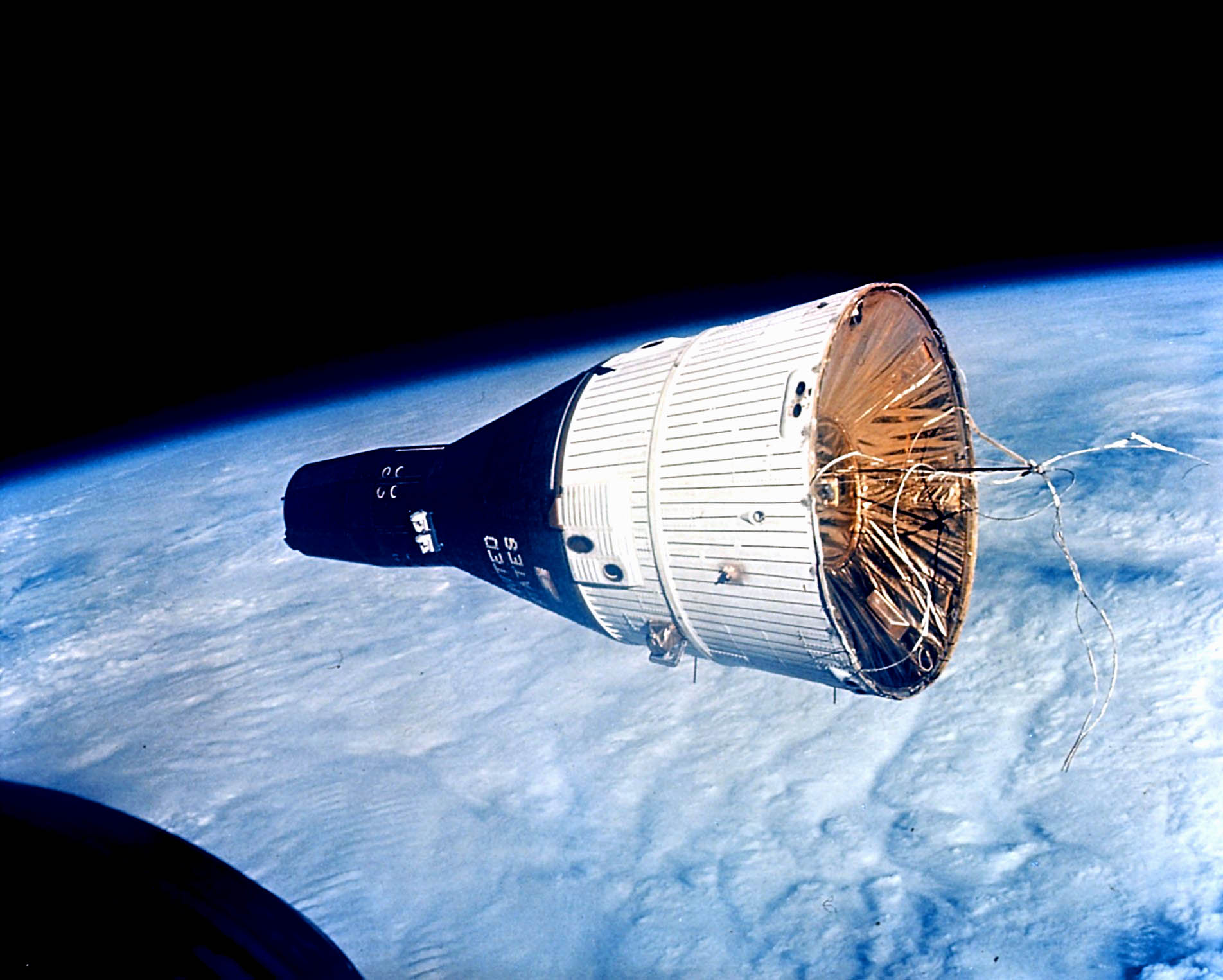
Elliot See Jr. |
Charles Bassett II |
|---|---|
|
In what was absolutely the worst tragedy in NASA history to until the Challenger disaster, Apollo 1 had a fire during a ground test which killed all three astronauts including "Gus" grissom, the pilot of MR-4 (Liberty Bell 7). Also killed were Ed White, the first American to walk in space and rookie astronaut Roger Chaffee. 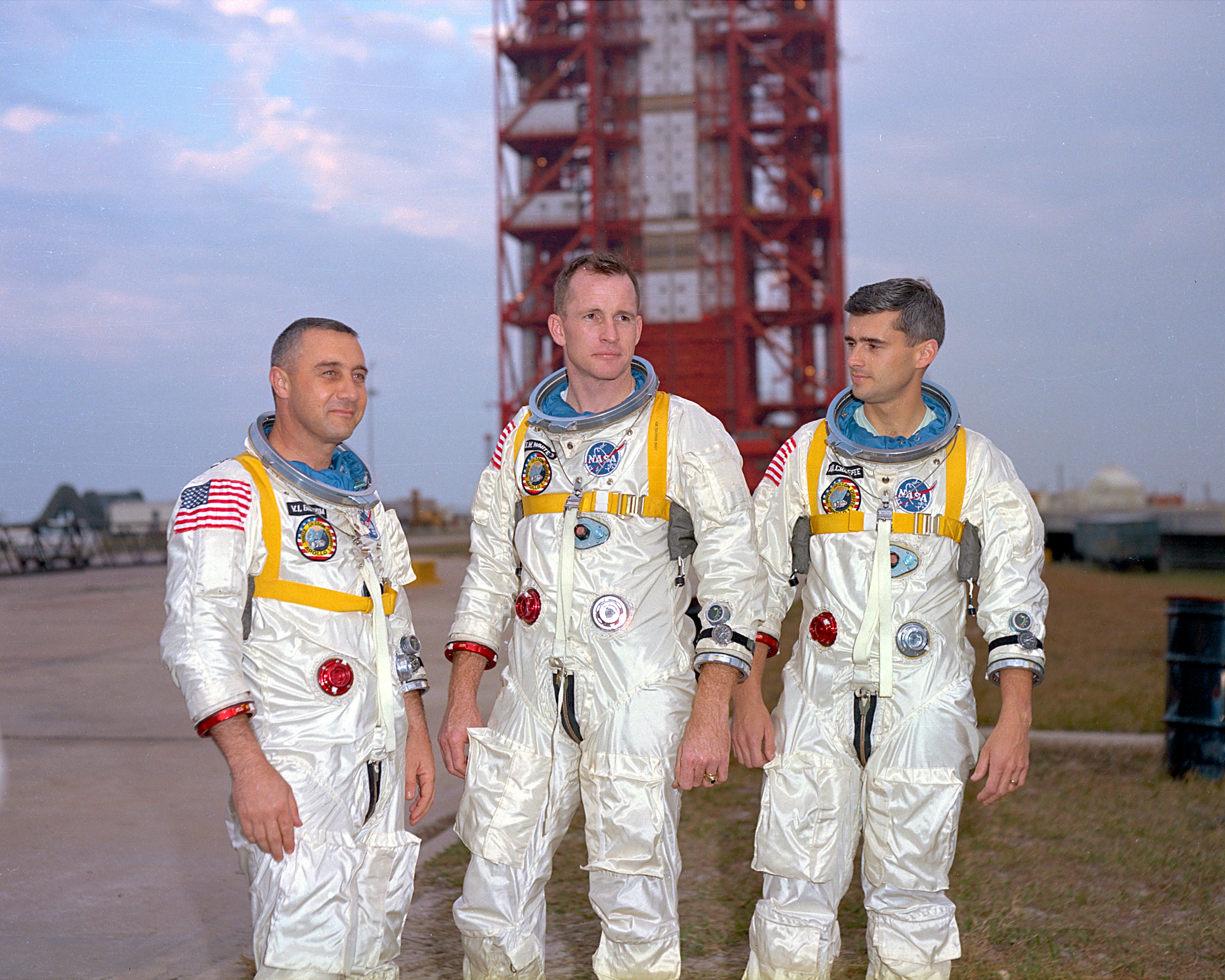
As bad as American mishaps were, they were dwarfed by Russian disasters. The Russians led not only in several major firsts (first satellite, first man in space, first man in orbit and first space walk) but also in first man killed in training (Valentine Bondarenko, March 23, 1961) first man killed in space (Vladimir Komarov in Soyuz 1, April 24, 1967) and first 3 man crew killed in space (Soyuz 11 depressurized on re-entry in 1970). But the biggest rocket disaster (an ICBM, not a manned space system) was when 126 people were killed when a R-16 ICBM on the pad exploded in October of 1960.
Despite these loses and others, the Mercury-Redstone system got America off the pad and into the space game. It was a humble beginning for a great program that eventually landed 12 Americans on the moon.
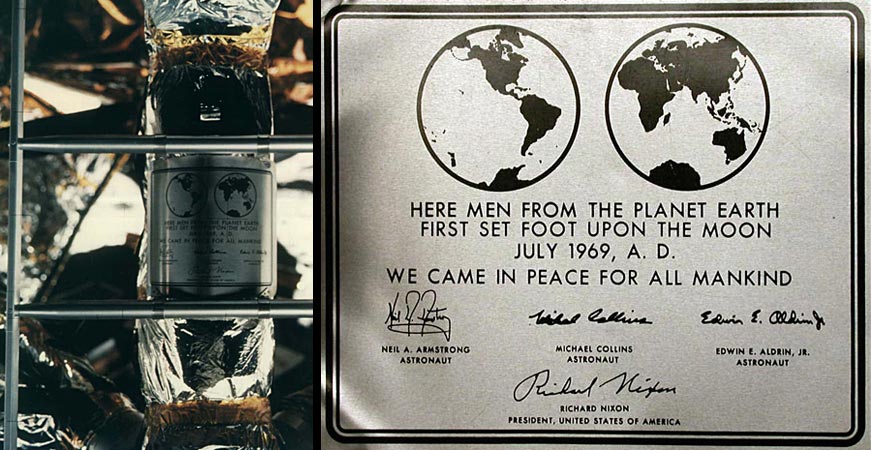
Plaque on the leg of the Apollo11 Lunar Module, Sea of Tranqulity, surface of the moon
Of all the Mercury astronauts, only the first, Al Shepard, walked on the moon (Apollo 14). Wally Shirra was the only one to fly all three of America's early space vehicles, Mercury, Gemini and Apollo. Deke Slayton, who had been medically grounded during Mercury, Gemini and most of Apollo, finally Got to Fly, in yet another ironic twist, on the very last Apollo mission (the Apollo-Soyuz Test program or ASTP). It seems fitting that the last flight for Apollo was carried out by the 54 year old "rookie astronaut" who had been with the manned space program from the beginning.