
Meldin
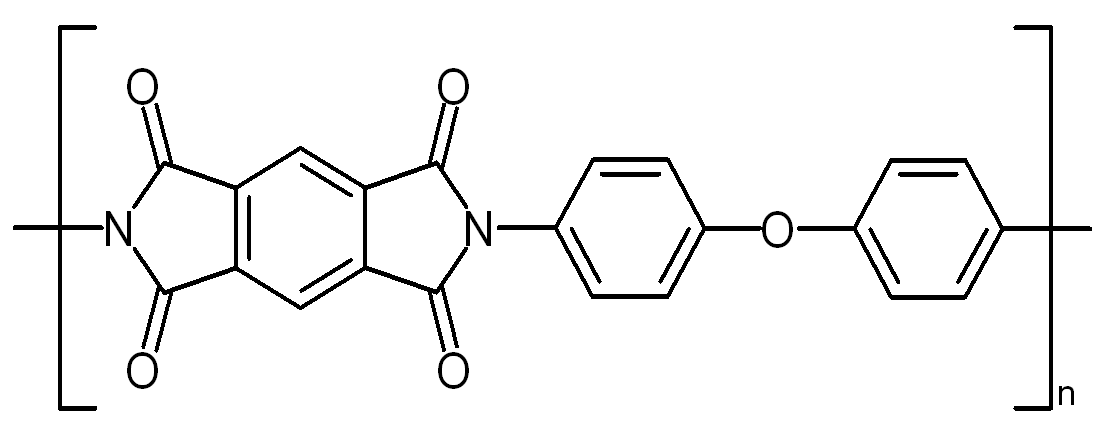 Meldin 7000 is the trademark of a high-performance polyimide polymer manufactured by Saint-Gobain Performance Plastics (1).
History of the Meldin product line
Meldin is a family of polyimide materials and has been present for many years on the market. For a long time this product family was not able to compete against Vespel and VTEC PI which are considered the market standards for high-quality polyimide. Since 2001, the Meldin 7000 product line was added to Saint-Gobain's portfolio. It is now considered as the only viable polyimide able to provide similar performance properties as Vespel and VTEC PI have done for many years. Meldin 7000 parts can be manufactured with the same processes as used for Vespel and VTEC PI. Also from a molecular standpoint, the material is very similar to Vespel and VTEC PI. There are more than 10 ways to polymerize a polyimide and for Meldin 7000, Vespel and VTEC PI, the highest-quality monomers are used.
Characteristics and applications
This polymer is mostly used in aerospace, semiconductor and transportation technology. It combines extreme heat resistance, lubricity, dimensional thermal stability and chemical resistance for use in hostile and extreme environmental conditions.
Unlike most polymers, it does not produce significant outgassing even at high temperatures, which makes it useful for lightweight heat shields and crucible support. It also performs well in ultra-high vacuum applications and extreme cryogenic temperatures. However, polyimide tends to absorb a small amount of moisture.
Although there are polymers superseding polyimide in all of these properties, the combination of them is the main advantage.
Magnetic properties
A very interesting property makes Meldin 7000 a material of choice in designing high-resolution NMR probes for NMR spectroscopy: its volume magnetic susceptibility is a very close match to that of water at room temperature. For example, in SI units, volume magnetic susceptibility of water at 20 °C is –9.03×10⁻⁶ , whereas volume susceptibility of polyimide at 21.8 °C was measured to be −(9.02±0.25)×10-6 . Negative values indicate that both water and polyimide are diamagnetic. Matching volume magnetic susceptibilities of materials surrounding NMR sample to that of the solvent can reduce susceptibility broadening of magnetic resonance lines.
Processing for manufacturing applications
Meldin 7000 can be processed by Direct-Forming (DF finished parts), Hot Compression Moulding (HCM - sheets and thick-wall rings) and Isostatic Molding (ISO - rods, tubes). For prototype quantities, basic shapes are typically used for cost efficiency since tooling is quite expensive for DF parts. For large scale production, DF parts are often used instead of rods or sheets to reduce per part costs, at the expense of material properties which are somewhat inferior to those of isostatically produced basic shapes.
Types
For different applications, special formulations are blended / compounded. There are five grades of Meldin 7000 produced, each one having its specific application window:
- virgin polyimide (Meldin 7001): provides operating temperatures from cryogenic to 315°C (600°F), high plasma resistance, as well as a UL-rating for minimal electrical and thermal conductivity. This is the unfilled base polyimide resin. It also provides high physical strength and maximal elongation, and the best electrical and thermal insulation values.
15% graphite by weight (Meldin 7021): added to the base resin for increased wear resistance and reduced friction in applications such as bearings, thrust washers, bushings, seal rings, slide blocks and other wear applications. This compound has the best mechanical properties of the graphite-filled grades, but lower than the virgin grade.
40% graphite by weight (Meldin 7022): for enhanced wear resistance, slightly higher friction than 15% graphite filled polyimide, improved dimensional stability (low coefficient of thermal expansion), and stability against oxidation.
10% PTFE and 15% graphite by weight: added to the base resin for the lowest coefficient of friction over a wide range of operating conditions. It also has excellent wear resistance up to 260°C (500°F). Typical applications include sliding or linear bearings as well as many wear and friction uses listed above.
15% moly-filled (molybdenum disulfide solid lubricant): for wear and friction resistance in vacuum and other moisture-free environments where graphite actually becomes abrasive. Typical applications include seals, bushings, bearings, gears, and other wear surfaces in space applications (satellites), ultra-high vacuum or dry gas applications.
Material properties data
Property |
Units |
Test condition |
7001 |
7021 |
7022 |
7211 |
7003 |
|---|---|---|---|---|---|---|---|
Filler Material |
Unfilled |
15% Graphite |
40% Graphite |
10% PTFE, 15% Graphite |
15% Molybdenum |
||
density |
g/cm3 |
1.43 |
1.51 |
1.65 |
1.55 |
1.60 |
|
linear thermal expansion coefficient |
10-6/K |
211-296 K |
45 |
34 |
|||
-"- |
-"- |
296-573 K |
54 |
49 |
38 |
54 |
52 |
thermal conductivity |
W/(K m) |
at 313 K |
0.35 |
0.87 |
1.73 |
0.76 |
0.47 |
volume resistivity |
Ω m |
at 296 K |
1014–1015 |
1012–1013 |
|||
dielectric constant |
dimensionless |
at 100 Hz |
3.62 |
13.53 |
|||
-"- |
-"- |
at 10 kHz |
3.64 |
13.28 |
|||
-"- |
-"- |
at 1 MHz |
3.55 |
13.41 |
Other polyimide alternatives
Meldin is a family of polyimide-based materials and has been present for many years on the market. There are really only a few polyimide types that are to be considered of the highest quality and able to operate at temperatures at or above 300°C as well as at cryogenic temperatures. Next to Meldin 7000, these are Vespel from DuPont, VTEC PI from RBI, Inc. and Plavis from Daelim.
See also
- Plastics
- polyimide
References
de:Meldin