
Massacre of Italians at Sciara Sciat
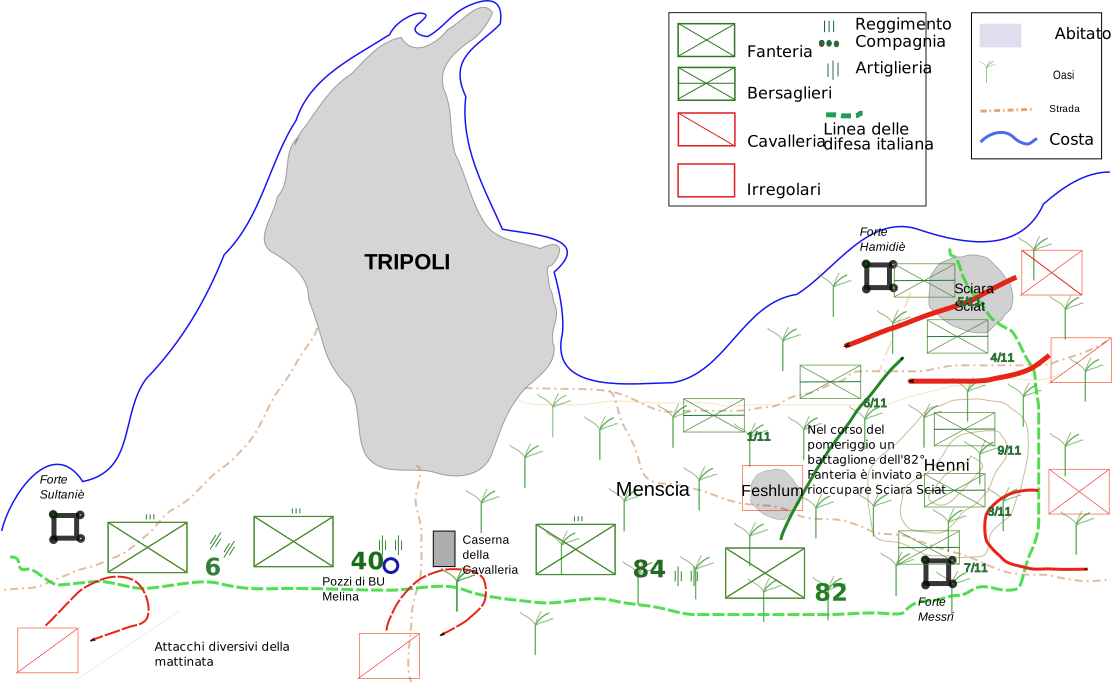
The Massacre of Italians at Sciara Sciat occurred in late October 1911 in a village on the outskirts of Tripoli, Lybia. Approximately 500 Italian troops (called Bersaglieri) were killed in the incident which occurred during the Italo-Turkish War. It was the biggest loss of life for Italian troops prior to World War I.
History
The Italian fleet appeared off Ottoman Tripoli in the evening of September 28, 1911: the city was quickly conquered by 1,500 Italian sailors, welcomed by the population.
But after Italy had conquered the city of Tripoli and surroundings from the Ottoman Empire in the first days of October 1911, the interior of Ottoman Libya shortly broke out into revolt, with Italian authorities losing control over large areas of the region.
Indeed before the arrival of the Italian forces in 1911, cells led by Ottoman officers (called "Young Turks", like Kemal Ataturk) had Libyans INFILTRATE Italian industry and companies in Ottoman Tripolitania, reconnoiter roads, and take a census of all males able to bear arms in Tripoli and Derna: they prepared for a "jihad" with the local moslems.
Even if the arab population of the city of Tripoli welcomed the Italians, in the interior of coastal Libya from the first weeks many cruelties were done by local muslims (supported by Turks disguised as Arab muslims) to the Italian Soldiers and civilians during this revolt, as happened in Sciara Sciat:
Indeed the "11 Reggimento" Bersaglieri of colonel Gustavo Fara had the 4th battalion defending the small village/oasis of Sciara Sciatt when started an attack from the Turks and Arabs, and was massacred on the October 23, 1911. The surviving 290 bersaglieri were captured in the local cemetery by local fanatical moslems but all where tortured and killed with cruelty and sadism.
Argentine journalist Enzo D'Armesano of the Buenos Ayres newspaper "La Prensa" was present the next morning in Sciara Sciatt and reported the cruelty with a description that impressed the Argentinian people. He wrote that many local civilians attacked from the back the Italian troops with knives, after initially showing friendship in order to approach them. 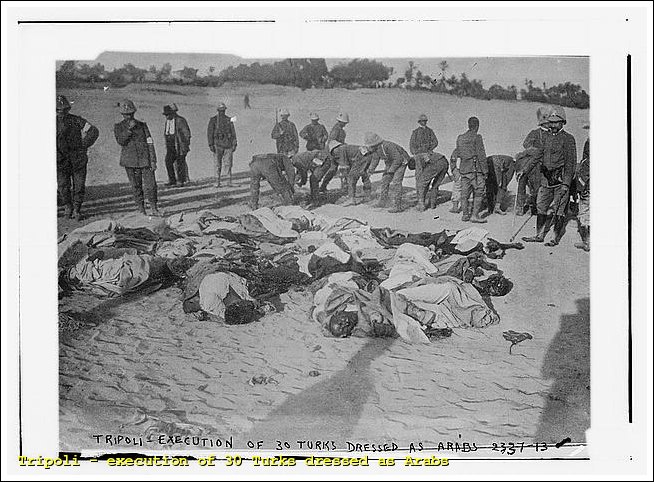 The Argentinian reporter wrote even that the only three survivors of the 4th battalion accused the moslem civilians of the Sciara Sciatt oasis of "tradimento" (betrayal)
Consequences
At Sciara Sciatt died officially 21 Italian officers and 482 soldiers (290 of them after surrender in Rebab cemetery).
The consequences of this massacre (and others against the Italian troops) were the retaliation and revenge mainly on native civilians in the outskists of Tripoli. Even some Turks were executed because found dressed as arabs, in order to infiltrate inside the area controlled by the Italians and promote treacherous attacks by the local muslims.
One of the opponents of the Italian intervention in the conquest of Ottoman Libya, a marxist activist named Benito Mussolini, started to change his opinion after news of this massacre reached Italy. He, later in the late 1920s, remembered (and always cited) this Sciara Sciatt massacre when imposed his Pacification of Libya.
Bibliography
- Bruce Vandervort. Verso la quarta sponda, la guerra italiana per la Libia (1911-1912) Stato maggiore dell'esercito. Roma, 2012
- De Martino, Antonio. Tripoli italiana. la Guerra italo-turca Societa' libraria italiana. New York, 1912 (Library of Congress EDition)
- Gerwarth, Robert. Empires at War: 1911-1923. The Greater War. Publisher Oxford University Press. Oxford, 2014 ISBN 0191006947
- Ministero della Difesa.Cronaca e storia del Corpo dei Bersaglieri, Daniele Piazza Ed. Torino, 1986
See also
- Italo-Turkish War
- 1911 Tripoli massacre
- Italian Libya